Chinese drywall is a real, if uncommon, problem for houses built or renovated between 2001 and 2009, concentrated heavily in Florida. It corrodes copper wiring, AC coils and plumbing, and it makes a house genuinely hard to insure and finance — which affects your sale far more than any disclosure requirement does. This page covers how to tell if you actually have it, what you have to disclose, what remediation costs, and the honest math on fixing it versus selling as-is, including the one case on this site where a straight cash sale can beat repairing and relisting.

Step 1 of 5
Send the address and tell us what you know — lab results, insurance history, any of it. We buy houses with confirmed or suspected problem drywall.
You’ll talk to Trevor McAmis, Owner & Acquisitions Lead
(313) 710-6129
Takes about two minutes. Or call (313) 710-6129 — we answer.
Educational only. This explains how these situations generally work. It is not legal, tax or financial advice, and the rules differ by state — talk to an attorney or CPA about your own situation before you act on any of it.
Selling a house with Chinese drywall is legal in every state, but you must disclose what you know. Confirmed problem drywall corrodes copper wiring, AC coils and plumbing and can make a home hard to insure or finance until remediated. Remediation of the drywall, alarms, electrical devices and gas piping runs roughly $30,000–$100,000+ depending on size. A cash sale skips the financing and insurance problem entirely, at a discount; a fully remediated and re-listed house nets more if you can fund and wait for the repair.
General information, not legal or engineering advice. Disclosure duties vary by state and by what you actually know. Talk to a real estate attorney about your specific obligations and a qualified environmental/remediation contractor about your house.
Between roughly 2001 and 2009 — concentrated in 2005–2007, during the building surge that followed the 2004–2005 Gulf hurricanes — builders in the hardest-hit markets ran short of domestic drywall and imported gypsum board from China to keep up. Some of that imported drywall off-gasses sulfur compounds (hydrogen sulfide, carbon disulfide, carbonyl sulfide) that intensify with heat and humidity. The result is a rotten-egg odor, blackened and corroded copper wiring, AC evaporator coils and plumbing, and reported respiratory complaints from occupants.
The Consumer Product Safety Commission, working with HUD, CDC and EPA as a federal task force, confirmed the connection: a “strong association between problem drywall, hydrogen sulfide and corrosion.” By the CPSC's April 2012 count, 4,051 reports had come in from 44 states, but the problem is heavily concentrated where the import volume was highest — Florida accounted for roughly 56% of those reports, with Louisiana, Mississippi and Alabama making up most of the rest.
If your house was built or had drywall replaced in that 2001–2009 window, and especially if you're in one of our Florida markets, this is worth ruling out before you list — not because it's likely, but because a buyer's inspector will ask the same question you should ask first.
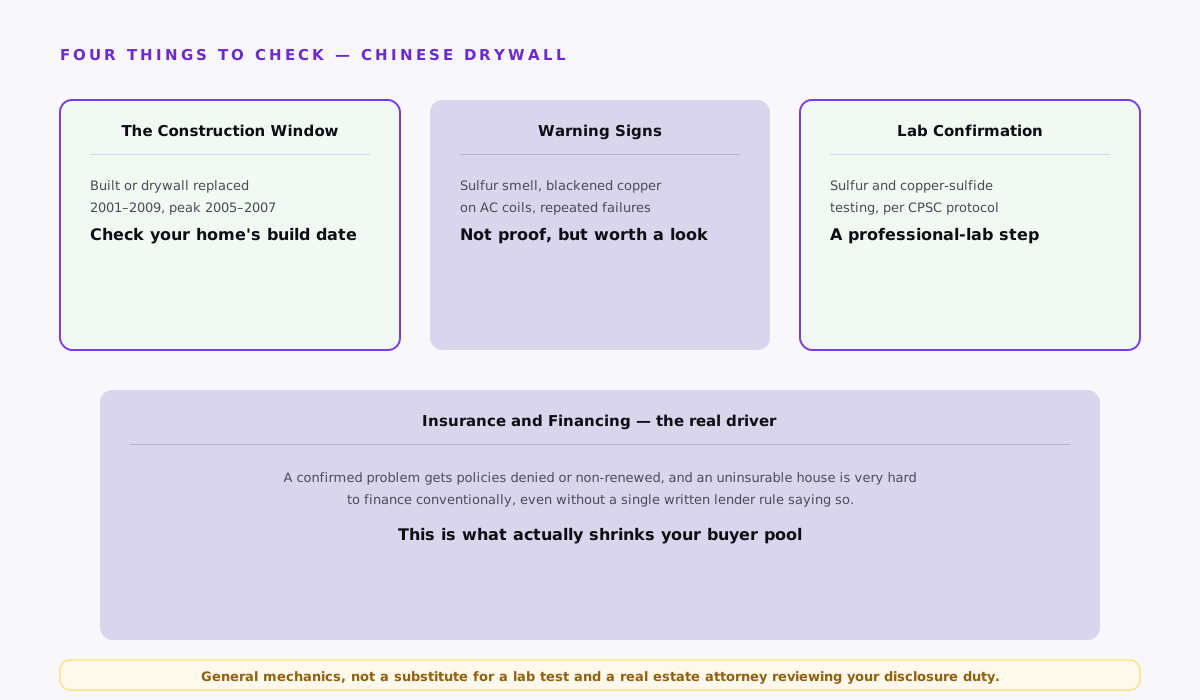
You cannot diagnose Chinese drywall by eye or by smell alone, and a DIY test kit will not confirm it either. What you can do cheaply, before paying a lab, is check for the warning signs below and note whether your home's construction or last drywall replacement falls in the 2001–2009 window that matters.
If any of that is present, the CPSC's identification guidance calls for lab confirmation: elemental sulfur testing of the drywall core plus copper-sulfide testing on wiring and coil samples, cross-checked against the home's construction or renovation date. This is a professional-lab step, not a DIY test kit.
One correction worth making plainly, because it's commonly overstated: CPSC and HUD's 2011 remediation protocol does not require rewiring the entire house. A Sandia National Labs study found the corrosion, even simulated over 40 years of exposure, didn't create a safety hazard in the wiring itself. What the protocol does call for is removing the problem drywall and replacing smoke and CO alarms, electrical receptacles and switches, circuit breakers, gas service piping and any fire-sprinkler components — a real project, but narrower than “rewire the whole house.”
There's no federal statute naming Chinese drywall specifically, so what actually governs whether and how you must disclose it is each state's general duty to disclose known material defects — and that duty is broader than most sellers assume.
Florida has the clearest law here because it has the most cases: under Johnson v. Davis, 480 So.2d 625 (Fla. 1985), a seller who knows facts materially affecting the property's value, that aren't readily observable and aren't known to the buyer, has an affirmative duty to disclose them. A confirmed or reasonably suspected Chinese-drywall problem falls squarely inside that duty. Ohio, Texas, Michigan, Indiana and Maryland each have general residential-defect disclosure statutes that work the same way for a known, material issue, even without naming this problem specifically. For Georgia, Missouri, Alabama, Arizona and New York, we could not confirm a codified disclosure statute reaching this specific case — the operating rule in those states is the common-law duty not to affirmatively conceal a known material defect, which is narrower than an affirmative duty to volunteer it.
The rule that holds regardless of which state you're in: disclose what you actually know, in writing, and never paint over or conceal a known problem. An “as-is” sale means the buyer accepts the condition they were told about. It has never been a license to hide something you know. Courts are unusually consistent on that point nationwide, and fraudulent concealment claims are exactly the kind of litigation this created at scale in 2009–2013.
This is the part that actually drives a seller's decision, more than the disclosure question itself. Multiple insurers denied claims and cancelled or refused to renew policies on homes with confirmed problem drywall, citing exclusions for faulty materials and corrosion — and an uninsurable house is very hard to finance conventionally, even without a single named lender policy saying so directly.
Because a mortgage lender requires the borrower to carry insurance, that insurance problem becomes a financing problem in practice, even though we could not find a formal written lender rule stating it as policy. The honest way to put it: expect financing and insurance to become genuinely hard, not impossible by written policy, but hard enough in practice that most retail buyers using a mortgage will not get through it.
That's also exactly why litigation on this reached the scale it did. The consolidated federal litigation, In re: Chinese-Manufactured Drywall Products Liability Litigation, MDL No. 2047 (E.D. La., Judge Eldon E. Fallon), produced a series of major settlements between 2013 and 2020 against the Knauf entities, Taishan Gypsum and several distributors — not because remediation itself is exotic, but because the insurance and financing fallout was severe enough to make it worth fighting over.
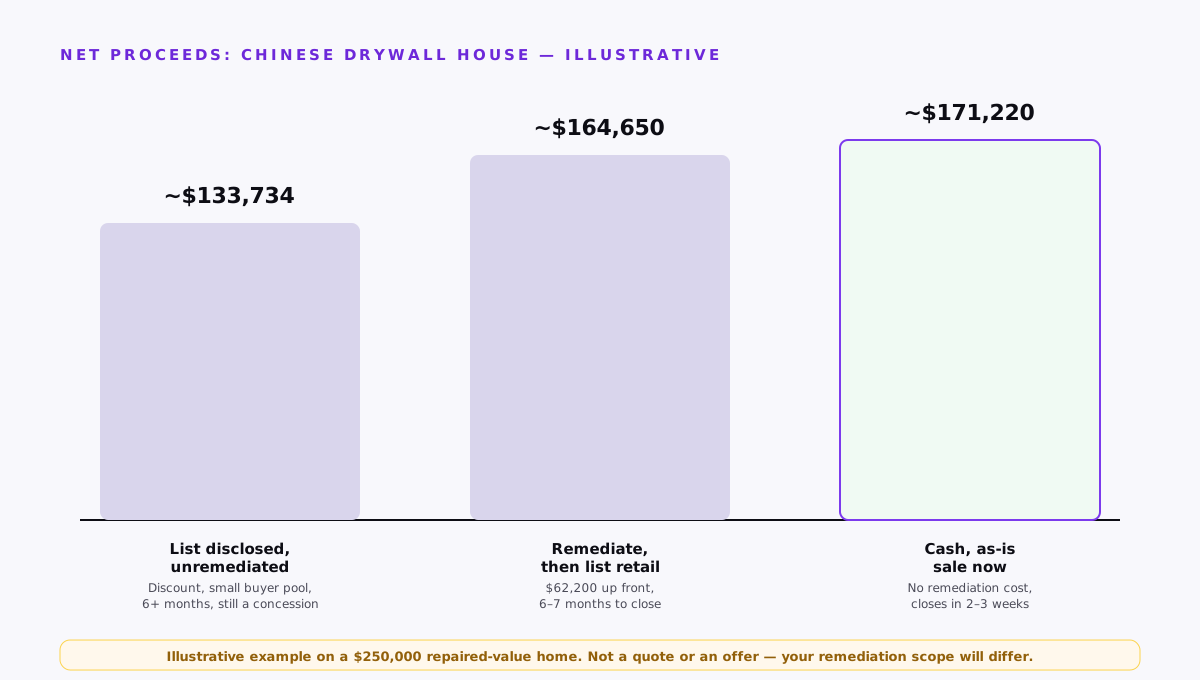
Take a hypothetical 1,800-square-foot Florida house, repaired value $250,000, no mortgage, carrying costs $780 a month. Testing confirms problem drywall in about 60% of the interior. A licensed remediation contractor quotes $58,000 for the CPSC-protocol scope — drywall removal and replacement, AC coil replacement, smoke/CO alarms, electrical devices, and inspection of gas piping — plus $4,200 for lab confirmation and post-remediation testing, and the house needs roughly five months of work and re-inspection before it's back on the market.
| Route | Remediate, then list | List disclosed, unremediated | Sell as-is for cash |
|---|---|---|---|
| Sale price | $250,000 | $158,000 | $172,000 |
| Remediation, testing | −$62,200 | — | — |
| Agent commission | −$13,750 | −$8,690 | — |
| Seller closing costs | −$3,000 | −$1,896 | covered |
| Holding costs | −$3,900 | −$4,680 | −$780 |
| Buyer concessions | −$2,500 | −$9,000 | — |
| Net proceeds | $164,650 | $133,734 | $171,220 |
| Time and cash needed | 6–7 months, $62,200 up front | 6+ months, nothing up front, small buyer pool | 2–3 weeks, nothing up front |
An illustration on one hypothetical house, not a quote and not a prediction. Your remediation scope, insurance situation and local buyer pool will differ.
Two things stand out, and the second one is the one sellers usually get backwards.
Remediating does not automatically win here, unlike most defect articles on this site — see cash offer vs listing net proceeds for how that comparison usually runs on a smaller repair. Because the repair cost is large relative to the house's value, a straight cash sale nets more than fixing and relisting in this example — $171,220 versus $164,650 — once you count six months of carrying costs and the cash a homeowner would have to find and float before any of it comes back. That gap narrows or reverses on a larger or lower-repair-cost house; run your own contractor quote before assuming either answer, using the same approach as our should I repair before selling guide.
Disclosing and listing without remediating is the losing move in every version of this, because it stacks a steep price discount, a shrunken buyer pool of mostly non-financed buyers, a longer hold, and a bigger concession all at once. If you're not going to remediate before selling, a direct cash sale to a buyer who can close without a mortgage or a standard homeowners policy is very likely to outperform listing it disclosed and unfixed.
Run the numbers before you assume either “fix it” or “sell as-is” is the right call — this is one of the few defects on this site where remediating isn't automatically the highest-net route, because the repair cost can be large relative to the house. Get the lab confirmation, get a real remediation quote from a contractor who knows the CPSC protocol, and compare that against what a cash buyer will pay today with none of the insurance or financing risk. Send us the property and we'll give you a number in writing you can hold up against that contractor's quote.
The useful comparison is a real remediation quote against what a cash buyer will pay today with none of the insurance or financing risk. We will put ours in writing.
Send us the property here. Get the remediation quote too — on a smaller repair the math can favor fixing it, and you should know that before you decide.
All guides · Should I repair before selling? · Cash offer vs listing net proceeds · Selling a house with mold
Step 1 of 5
No obligation, no fees, no repairs. We respond the same day.
You’ll talk to Trevor McAmis, Owner & Acquisitions Lead
(313) 710-6129
Takes about two minutes. Or call (313) 710-6129 — we answer.
