In most states there's no bed-bug-specific disclosure law for a home sale — New York's bed bug statute, for example, only applies to rental units, not sales. But general "known material defect" disclosure rules still apply in nearly every state, and a known, active infestation is the kind of fact courts and disclosure forms are built to catch. Treatment runs roughly $400 to $5,500 depending on method and home size, and a cash, as-is sale lets you skip fronting that cost before you have a buyer.

Step 1 of 5
Tell us about the house. We'll give you a straight read on what it's worth and whether treating first or selling as-is makes more sense.
You’ll talk to Trevor McAmis, Owner & Acquisitions Lead
(313) 710-6129
Takes about two minutes. Or call (313) 710-6129 — we answer.
Educational only. This explains how these situations generally work. It is not legal, tax or financial advice, and the rules differ by state — talk to an attorney or CPA about your own situation before you act on any of it.
No state has a bed-bug-specific sales disclosure statute, but general material-defect disclosure rules in most states still cover a known, active infestation. Treatment runs roughly $400 to $5,500 depending on method and home size. A cash, as-is sale doesn't make the infestation disappear from the conversation — it changes who pays for treatment and when.
The rest of this page covers what the law actually requires, what treatment costs by method, how an infestation can affect financing, and the honest math on treating first versus selling as-is.
This article is general educational information, not legal advice. Disclosure obligations are state-specific — confirm what your state's disclosure form actually requires before deciding what to say and when.
No state we found has a bed-bug-specific sales disclosure statute. New York's well-known bed bug law (the 2010 "Peralta Bill," later joined by NYC's 2017 Local Law 69) requires landlords to disclose a building's bed bug infestation history going back 12 months to new tenants — it's a rental law, not a home-sale law, though a co-op sale can trigger it indirectly because a co-op sale involves signing a new proprietary lease. A straight condo or single-family sale does not.
That doesn't mean silence is safe. General property-disclosure statutes ask broader pest questions that a reasonable seller should read as covering a known, active infestation. New York's own Property Condition Disclosure Statement asks directly whether there's "any termite, insect, rodent or pest infestation." Ohio's disclosure statute requires disclosure of known material defects generally, without naming pests specifically — but a live infestation you know about and don't mention is exactly the kind of omission that statute exists to prevent.
| Method | Typical cost | Notes |
|---|---|---|
| Heat treatment | $400–$5,500 whole-home | Roughly $1–$3 per sq ft; scales with square footage, no residual effect against reinfestation |
| Chemical treatment | $150–$400 per room | Whole-house $1,500–$5,000+; often needs more than one visit |
| Fumigation | $2,000+ | Severe or structural infestations; requires vacating the home 24–72 hours |
| Follow-up inspection | $100–$150 per visit | Moderate-to-severe cases typically need several |
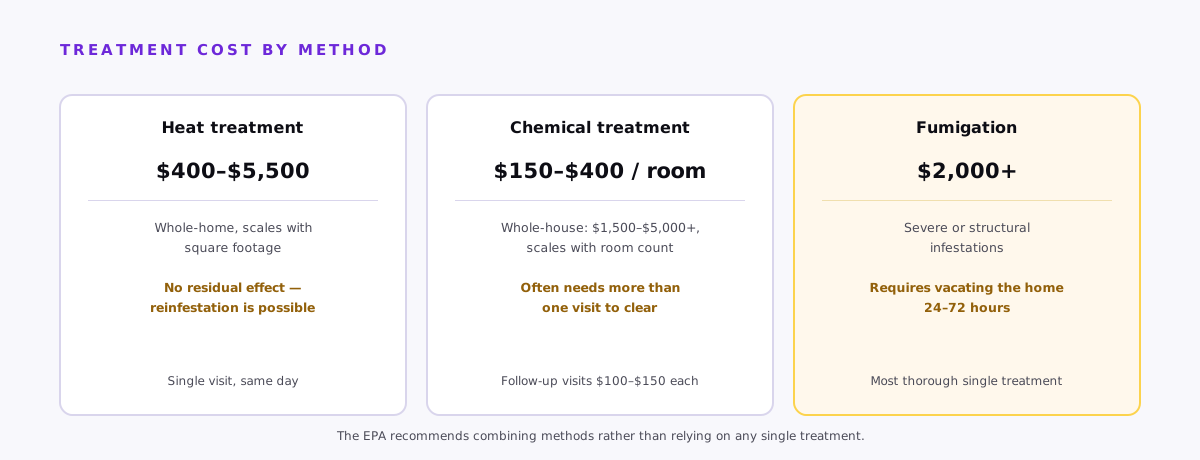
The EPA specifically warns against relying on a single method: heat alone leaves no lingering protection against reintroduction, and cold treatments can fail outright because bed bugs go dormant and appear dead for days before reactivating. Its guidance recommends combining chemical and non-chemical methods and always scheduling a follow-up evaluation, since a first treatment often doesn't fully clear a heavy infestation.
Not automatically, and this is a real gap sellers should understand. The standard termite/wood-destroying-insect inspection required on many FHA and VA loans (the NPMA-33 form) only covers termites, carpenter ants, carpenter bees, and wood-boring beetles — bed bugs fall outside its scope entirely. FHA pest inspections are only required when there's visible evidence of infestation or damage, state or local law requires it, it's customary for the area, or the lender specifically asks for one.
In practice, a live infestation usually surfaces through the buyer's general home inspector or the appraiser noticing something — at which point what happens next is entirely up to that lender's discretion, not a standard rule.
Not the conversation — we still need to know about it. What changes is the sequence: a financed buyer's lender may require treatment and a clean reinspection before closing, which can add weeks and forces you to pay for treatment before you're certain the sale will close. A cash, as-is purchase prices the infestation into the offer instead, so you're not fronting a $3,500 heat treatment on a house that might not sell to that buyer anyway.
Say a house is worth $220,000 retail with no infestation, and a moderate bed bug problem needs a $3,500 whole-home heat treatment plus a $300 reinspection before a financed buyer's lender will clear closing.
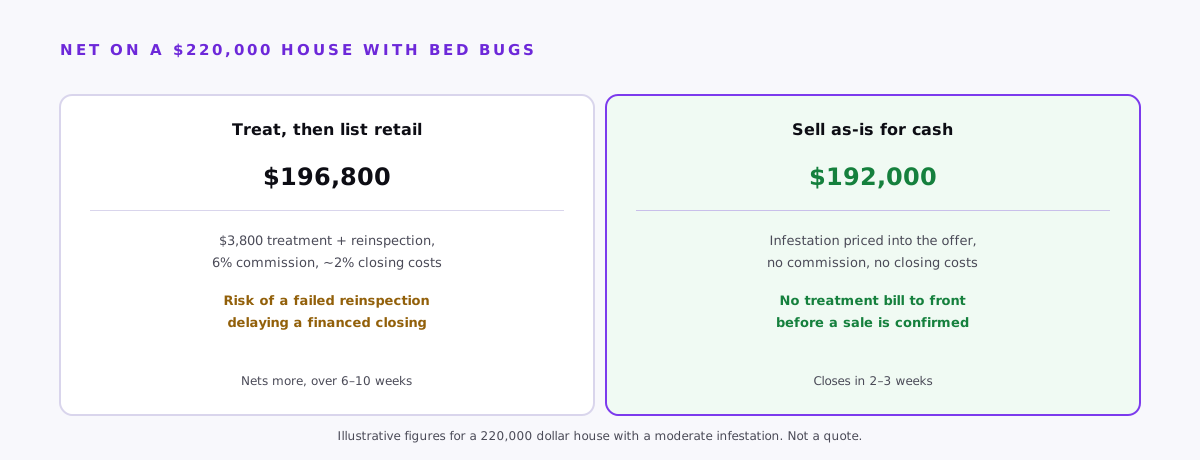
| Treat, then list retail | Sell as-is for cash | |
|---|---|---|
| Starting value | $220,000 | $220,000 |
| Heat treatment + reinspection | −$3,800 (paid upfront) | $0 |
| Agent commission (6%) | −$13,200 | $0 |
| Seller closing costs (~2%) | −$4,400 | $0 |
| Holding costs, ~6 weeks | −$1,800 | $0 |
| As-is cash offer | — | $192,000 |
| Net to seller | $196,800 | $192,000 |
| Timeline | 6–10 weeks | 2–3 weeks |
Listing after treatment nets about $4,800 more in this example. A cash sale isn't the bigger number — it's the option that doesn't require you to pay $3,800 out of pocket before you know the house will sell, and it removes the risk of a financed buyer's lender delaying or killing the deal over a failed reinspection.
Treat first, then list retail. Nets the most if you can front the treatment cost and have 6–10 weeks to manage it and a clean reinspection.
Disclose and price it into a retail listing without treating first. Some buyers will still make an offer, typically at a discount reflecting the treatment cost they'll take on.
Sell as-is for cash. Skips fronting treatment cost in exchange for a lower price and a faster close.
If a bed bug infestation means paying for heat treatment or fumigation before you even have a confirmed buyer, we can make a cash offer that prices the problem in directly — no treatment invoice to front, no reinspection to pass, no risk of a financed buyer's lender delaying closing over it.
Send us the property here and we'll walk you through the numbers.
All guides · Selling a hoarder house · Selling a house with mold · Cost of not disclosing a known defect
Step 1 of 5
No obligation, no fees, no repairs. We respond the same day.
You’ll talk to Trevor McAmis, Owner & Acquisitions Lead
(313) 710-6129
Takes about two minutes. Or call (313) 710-6129 — we answer.
