Yes, in most cases you can sell a house with a child support lien attached to it. The lien has to be paid off, negotiated down, or otherwise resolved, usually at closing out of your proceeds, before the buyer gets clear title and you get paid the rest.
Step 1 of 5
Send the address. We'll run our own title check, confirm the lien payoff, and put a written cash offer in front of you within 24 hours.
You’ll talk to Trevor McAmis, Owner & Acquisitions Lead
(313) 710-6129
Takes about two minutes. Your address is never shared.
Educational only. This explains how these situations generally work. It is not legal, tax or financial advice, and the rules differ by state. Talk to an attorney or CPA about your own situation before you act on any of it.
Federal law requires every state to have a procedure under which a lien "arises by operation of law" against a parent's real and personal property once child support goes significantly overdue. What that looks like on the ground varies a lot by state.
In some states the lien is close to automatic: once arrears cross a set threshold, the law treats the unpaid support like a judgment, and that judgment becomes a general lien on anything the parent owns, no separate lawsuit needed to create the underlying debt. But for the lien to attach to one specific piece of real property, so it shows up when a title company searches that address, most states still require something to be recorded: an abstract of judgment, a notice of lien, or a certified copy of the support order, filed with the county recorder or clerk of court. California treats child support arrears as creating a statutory lien, but that lien still has to be recorded against the property, typically by sending an abstract of judgment to the county recorder, before it is enforceable against that specific house.
Other states build in more process before a lien can be docketed against a parcel. North Carolina requires a verified statement of the arrears to be filed with the clerk of superior court, the parent to be notified, and, outside of state-run cases, a window to contest the amount before the lien gets indexed on the judgment docket.
Either way, once a child support lien is properly attached and recorded, it stays attached to that property, not just to the person, until it is paid, released, or expires under state law. That's a real difference from a mortgage, and it behaves a lot like any other judgment lien once it's on the title.
A child support lien almost never surfaces because someone tells the seller about it at the right moment. It surfaces because a title company runs a search.
Before closing, the title company or closing attorney searches the county's recorded documents and the civil or judgment docket for the seller's name and the property's legal description. A recorded notice of lien or abstract of judgment for child support arrears shows up there the same way a mortgage, a mechanic's lien, or any other lien would. The title company doesn't care why the debt exists. It cares that something is recorded against the property or the person, and that it has to be cleared before the company will issue a clean title policy to the buyer.
This is also why the lien turns up even when the seller hasn't been tracking their own child support case closely. A title search typically goes back years, to the prior transfer of the property, and catches liens recorded well before a sale was ever on the table.
Once the lien is confirmed, the closing agent treats it like any other payoff: a line item that comes out of the seller's proceeds before the seller sees a check.
For a child support lien, that usually means direct coordination with the state's child support enforcement agency, not just a payoff letter from a bank. The closing agent, or the seller's attorney, requests a current payoff figure from the agency, which can differ from what the seller remembers owing once interest, fees, or partial payments are factored in. The agency's number, not the seller's memory, is what gets paid at closing. The federal Office of Child Support Enforcement describes a property lien as a tool that stops a sale, transfer, or refinance from going through until the debt behind it is addressed. It isn't designed to collect money on its own; it's designed to force the issue the moment a parent tries to sell, borrow against, or transfer the house.
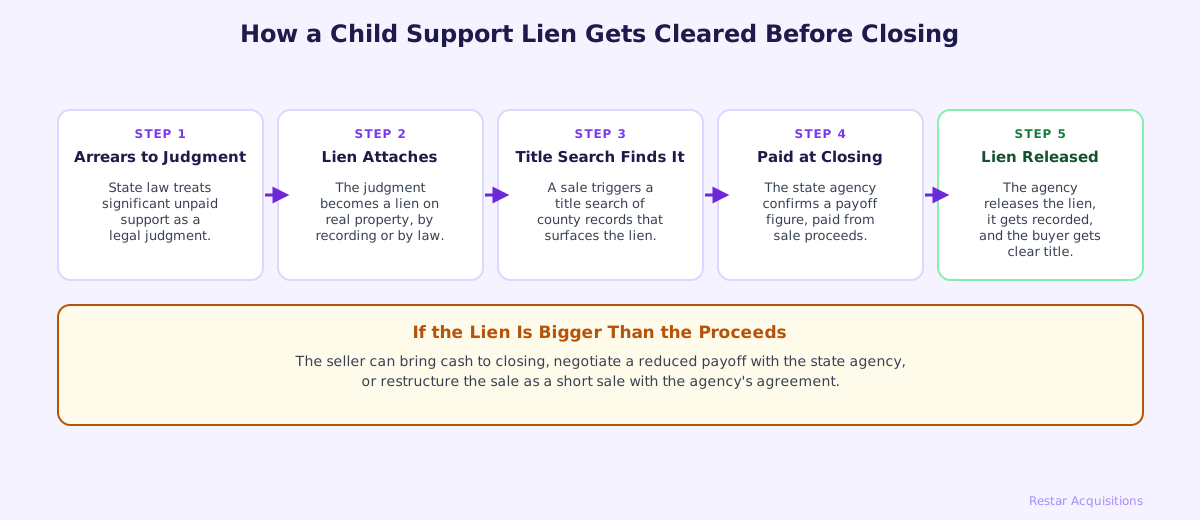
If the sale proceeds cover the payoff, the agency releases the lien, the release gets recorded, and the sale closes like any other. If the arrears balance is bigger than what's left after the mortgage, repairs, commission, and closing costs are covered, the deal doesn't automatically fall apart, but it does need more work: the seller can bring cash to the closing table to cover the gap, negotiate a reduced payoff with the agency, or the sale gets restructured as a short sale with the agency's agreement, the same way it would with a shorted mortgage.
A mortgage, a HELOC, a contractor's lien signed as part of a financing agreement: these are voluntary liens. The homeowner agreed to the terms, signed documents, and got something in exchange, a loan, a renovation, financing.
A child support lien is involuntary. Nobody signs up for it at the time it's created. It exists because a court ordered support, the parent fell behind, and state law or a judgment attaches the debt to real property, automatically or through a recording requirement, regardless of what the homeowner wants. A tax lien or a lien from an unrelated civil judgment works the same way.
The practical result at closing is the same either way: an involuntary lien gets paid or released just like a voluntary one before the buyer takes clear title. The difference shows up earlier, in whether the seller had any say in the lien existing in the first place, and in who the closing agent has to coordinate with to get a payoff number. A mortgage lender answers a routine payoff-request process. A state child support agency has its own process, often slower, and the seller may need to call or file paperwork directly rather than leaving it entirely to the closing agent.
Example: a house is worth $265,000 fixed up, needs about $15,000 in repairs and updates to list at that price, and has a $26,000 child support lien recorded against it. Listing it: repairs first, then roughly 60 to 90 days to find a buyer, then 30 to 45 days to close, call it 4 to 6 months from decision to payoff. A cash sale as-is, no repairs, typically closes in 1 to 3 weeks once an offer is accepted, at a lower sale price of around $195,000.
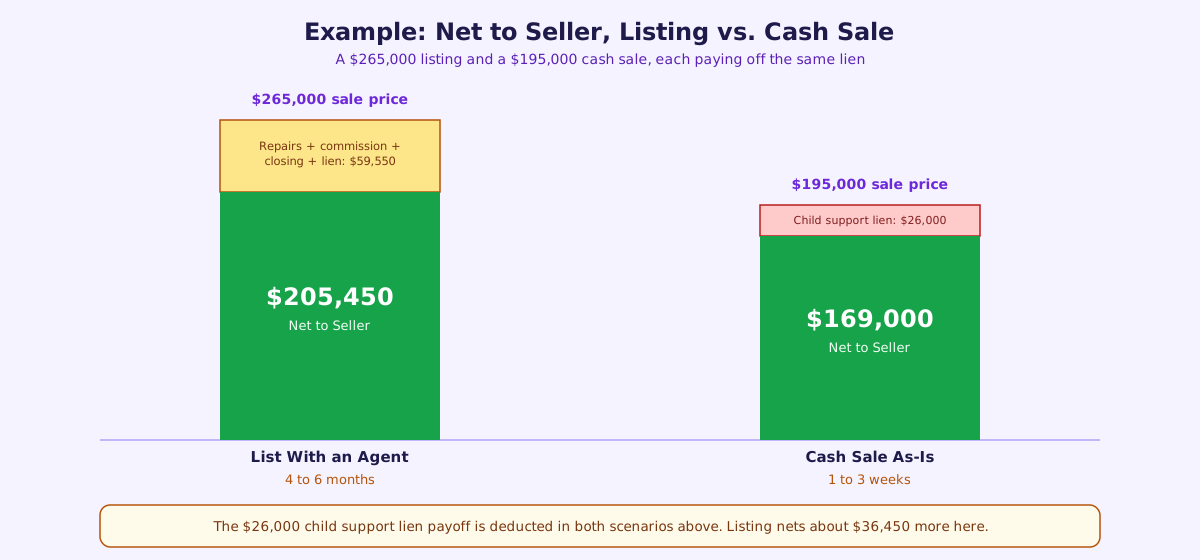
| List with an agent | Cash sale as-is | |
| Sale price | $265,000 (post-repair) | $195,000 (as-is) |
| Repairs/updates | −$15,000 | $0 |
| Agent commission (about 5.5%) | −$14,575 | $0 |
| Closing costs (about 1.5%) | −$3,975 | $0 |
| Child support lien payoff | −$26,000 | −$26,000 |
| Net to seller | $205,450, in 4–6 months | $169,000, in 1–3 weeks |
In this example, listing nets roughly $36,450 more. If the house doesn't need extensive repairs and the lien isn't urgent (no pending contempt action, no license suspension risk, no mounting interest that outruns the gain from waiting), listing is very likely the better move financially, and that's the honest answer. The math changes fast on a house that needs real repair money, where the gap narrows or disappears, or in a situation where the lien needs to be resolved quickly because enforcement action is already underway. Compare your own numbers before picking a path; see our cash offer vs listing net proceeds breakdown for how to run it on your property.
If a child support lien is sitting on your title, we buy houses as-is for cash, work the lien payoff into closing like any other line item, cover standard closing costs, and let you pick the closing date. A written offer in 24 hours means you get a real number while the lien gets sorted out, not after.
All guides · Selling a house with a judgment lien · Selling a house with a lien on it · Cash offer vs listing net proceeds
Step 1 of 5
No obligation, no fees, no repairs. We respond the same day.
You’ll talk to Trevor McAmis, Owner & Acquisitions Lead
(313) 710-6129
Takes about two minutes. Your address is never shared.
