Yes, you can sell a house with an SBA disaster loan. The loan is secured by a deed of trust or mortgage recorded against your property, so it gets paid off out of your sale proceeds at closing, the same as any other mortgage. There is no prepayment penalty. The real risk is timeline: SBA payoff statements can take longer than a bank's to arrive, so order one as soon as you have a sale in mind, not the week of closing.

Step 1 of 5
Send the address and your current SBA loan balance, and we'll give you a written cash offer within 24 hours that accounts for the payoff.
You’ll talk to Trevor McAmis, Owner & Acquisitions Lead
(313) 710-6129
Takes about two minutes. Your address is never shared.
Educational only. This explains how these situations generally work. It is not legal, tax or financial advice, and the rules differ by state. Talk to an attorney or CPA about your own situation before you act on any of it.
After a presidentially declared disaster, FEMA's process starts when a state or tribal government determines the damage is beyond local resources, and the governor requests a federal declaration. Once that declaration is approved, it opens several assistance programs, including SBA's low-interest disaster loans to homeowners and renters, not just businesses.
These aren't small programs. After the January 2025 Los Angeles County wildfires, SBA had approved more than $3.4 billion in disaster loans to nearly 13,000 borrowers as of its July 2026 update on that recovery, a large share of it homeowner loans secured the same way the loan on your own house likely is.
A physical disaster home loan is not a grant. It's a real loan, and like most real estate loans over a certain size, it's secured by collateral. Per SBA's own program pages, homeowners can borrow up to $500,000 to repair or replace a damaged primary residence, and homeowners and renters together can borrow up to $100,000 for personal property such as furniture, appliances, and a vehicle. The fixed interest rate is capped at 4% for applicants who can't get credit elsewhere, and capped at 8% for those who can, with SBA determining which applies on a case by case basis. Repayment terms run up to 30 years, and the first payment is deferred 12 months with no interest accruing during that deferment period.
Here's the part that matters most for a seller: for loans above $50,000 under a presidential disaster declaration, SBA requires collateral to the extent possible, and real estate is its preferred form of security. That means a deed of trust or mortgage gets recorded against your house, the same way a bank's mortgage does. A deed of trust works by having the borrower transfer a real property interest to a third-party trustee as security for the loan; if the loan isn't repaid, the trustee can sell the property to satisfy the debt without going through court. SBA says plainly it will not decline a loan for lack of collateral, but once collateral is pledged and recorded, it's a real lien that has to be cleared before title can pass to a buyer.
If the disaster itself left the house with damage you haven't addressed yet, our damaged house situation guide covers selling a storm or fire damaged home separately from the loan question.
Because the loan is secured by a deed of trust or mortgage, selling the house works the same way it would with any other mortgaged property: the lien gets satisfied out of sale proceeds at closing, and SBA releases it once it's paid.
In practice, the steps look like this. Your closing agent or title company requests a payoff statement from SBA once you have a sale under contract (through disastercustomerservice@sba.gov, by calling SBA's Disaster Assistance Customer Service Center at 800-659-2955, or through the MySBA Loan Portal, where current borrowers can view loan statements directly). That statement shows the exact amount needed to retire the loan as of a chosen payoff date. Title or escrow wires that amount to SBA at closing, and SBA records the release of its deed of trust or mortgage, clearing the lien from your title.
A detail worth confirming before you set a closing date: SBA disaster loans carry no prepayment penalty or fees, by SBA's own published terms. You are not charged anything extra for paying the loan off early, whether that's five years into a 30-year term or five months in. The only real cost of early payoff is the accrued interest between your last payment and the payoff date, which any payoff statement already accounts for. That's a meaningfully different payoff than some other loan types carry; our guide on the cost of a mortgage prepayment penalty before selling a house walks through when that fee does apply elsewhere.
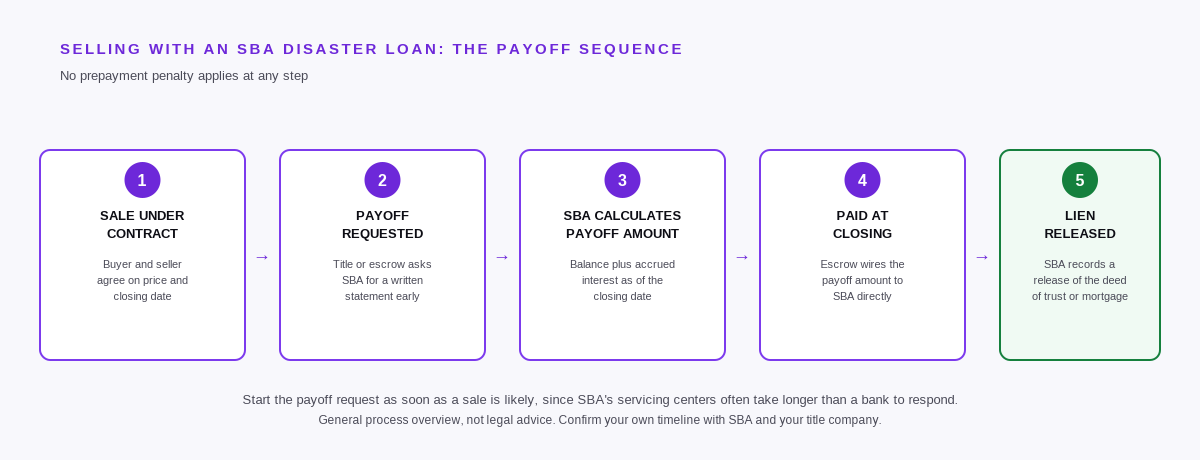
Where this can slow a closing down isn't the payoff math. It's the timeline. SBA disaster loans are serviced out of SBA's own disaster loan servicing centers rather than a private mortgage servicer's automated system, and getting a written payoff statement back can take longer than the day or two a bank typically needs. Order the payoff request as soon as you're seriously considering a sale date, not after you've already signed a purchase agreement with a tight closing deadline.
A deed of trust and the right to foreclose on it if a loan goes unpaid are real legal instruments, and exactly how a lien release gets recorded, and what happens if a title search turns up a recording error or an older unreleased SBA lien from a prior disaster loan on the same property, are the kind of details a real estate attorney or your title company should confirm for your specific situation before you rely on any of this.
A cash sale skips the back and forth of coordinating a payoff statement with a government servicing center against a buyer's own closing deadline, and it closes on your schedule rather than a bank's underwriting timeline. A repaired, retail-listed sale usually nets more once the SBA lien, commission, repairs, and holding costs are all subtracted, provided the house can qualify for a buyer's financing in the first place, which disaster-damaged homes often can't until repairs are done.
Example: a homeowner has an SBA disaster home loan with a $140,000 payoff balance after storm repairs were partially completed with loan funds. The house would sell for about $255,000 retail once $18,000 in remaining repairs (roofing, drywall, flooring) are finished, or about $205,000 as-is through a fast cash sale that doesn't require those repairs.
| Retail listing (after repairs) | Cash offer (as-is) | |
|---|---|---|
| Sale price | $255,000 | $205,000 |
| Remaining repairs | −$18,000 | $0 (sold as-is) |
| Agent commission (~6%) | −$15,300 | $0 |
| Seller closing costs (~2%) | −$5,100 | −$2,050 |
| Holding costs (repairs & listing period, ~3 months) | −$6,000 | −$200 |
| SBA loan payoff | −$140,000 | −$140,000 |
| Net to seller | $70,600 | $62,750 |
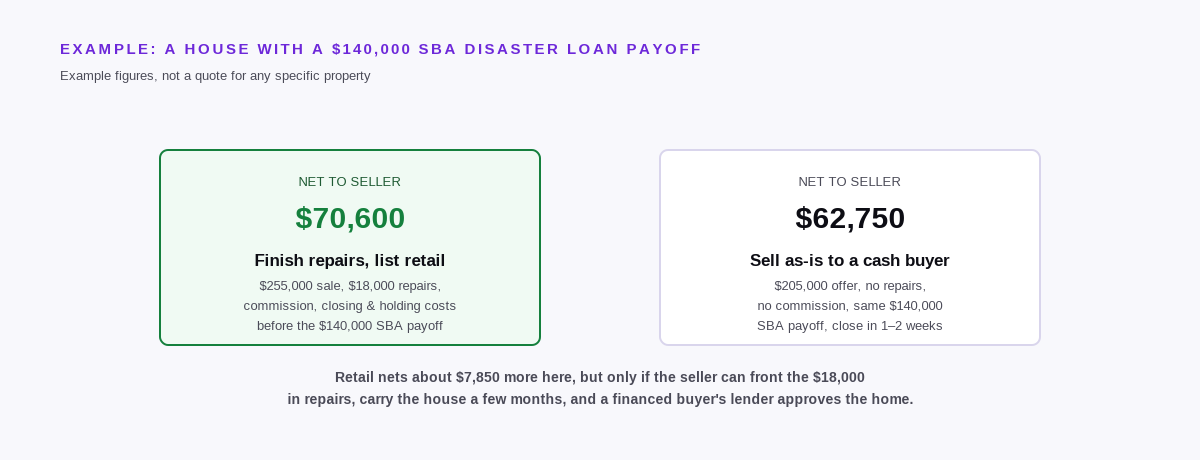
In this example, retail nets about $7,850 more, but that gap assumes the seller can front $18,000 in repairs, carry the house for roughly three months, and find a financed buyer whose lender will approve a home that was recently disaster-damaged. If any of those assumptions don't hold for your situation, the cash number is the more realistic one to plan around. Run your own numbers, with your own confirmed SBA payoff figure, before deciding either way.
List with an agent. If the repairs are affordable and the local market supports a retail sale, listing after repairs are complete is often the better financial outcome, as the example above shows. It takes longer and costs more upfront in repairs and commission, but it can net more at the finish line.
Ask SBA about deferment or restructuring instead of selling. If the reason you're considering a sale is the loan payment itself rather than wanting to move, SBA disaster loan borrowers can request a deferment through their loan servicing center with a written explanation of how the disaster (or a later hardship) affects their ability to make payments. SBA also uses financial hardship relief and loan modification tools, including adjusted payment amounts, before a loan goes to default. It costs nothing to call SBA's Disaster Assistance Customer Service Center and ask what's available before you assume a sale is the only option.
Rent it out. If you have somewhere else to live and the house is repaired enough to lease, renting it keeps the loan current with income instead of your own cash, while you decide whether to sell later. Confirm with your SBA servicing center whether renting the property changes anything about your loan terms, since disaster home loans are generally made for an owner-occupied residence.
A standard SBA disaster loan payoff, once requested, typically takes longer to get in writing than a conventional mortgage payoff because it routes through a federal servicing center rather than an automated lender system. Build in extra lead time between placing the payoff request and your target closing date, especially if you're working against a buyer's own financing deadline.
A cash sale that doesn't depend on buyer financing can close in as little as one to two weeks once the payoff figure is confirmed and title is clear. A retail sale that requires repairs first typically runs two to four months from repair start to closing, depending on the scope of work and how quickly a buyer's lender moves.
Restar Acquisitions buys houses directly, as-is, for cash, in 69 markets across Alabama, Arizona, Florida, Georgia, Indiana, Maryland, Michigan, Missouri, Nevada, New York, North Carolina, Ohio, Pennsylvania, and Texas. We give a written offer within 24 hours, there are no repairs to make and no commissions to pay, and you pick the closing date.
We work directly with title and escrow to confirm your SBA disaster loan payoff and get it cleared as part of closing, instead of letting it hold up your timeline. If the numbers on your specific property show that finishing repairs and listing retail would net you more, we'll tell you that directly. See our sell my house fast page for how the process works end to end.
Restar Acquisitions buys houses as-is, for cash, in 69 markets across Alabama, Arizona, Florida, Georgia, Indiana, Maryland, Michigan, Missouri, Nevada, New York, North Carolina, Ohio, Pennsylvania, and Texas. We give a written offer within 24 hours, there are no repairs to make and no commissions to pay, and you pick the closing date. We work directly with title and escrow to confirm your SBA disaster loan payoff and get it cleared as part of closing. If the numbers on your specific property show that finishing repairs and listing retail would net you more, we'll tell you that directly.
All guides · Selling a storm or fire damaged house · Cost of a mortgage prepayment penalty · How a cash sale works
Step 1 of 5
No obligation, no fees, no repairs. We respond the same day.
You’ll talk to Trevor McAmis, Owner & Acquisitions Lead
(313) 710-6129
Takes about two minutes. Your address is never shared.