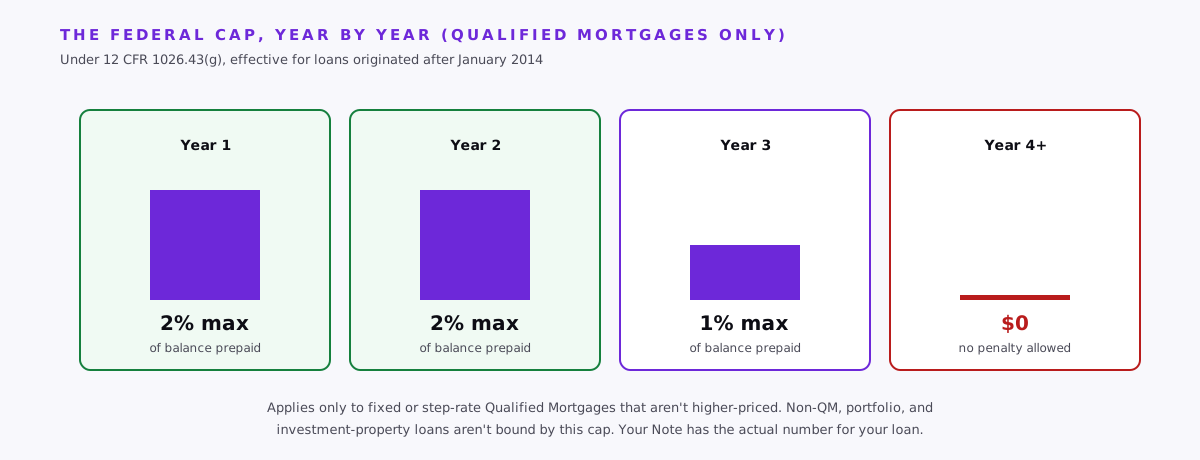
A mortgage prepayment penalty is a fee your lender charges for paying off the loan early, including by selling. Since 2014, federal rules ban them on most Qualified Mortgages. Where still allowed, they're capped at 2% of the balance prepaid in years one and two, 1% in year three, and gone after that. The only way to know for sure is to check your Note or request a payoff statement from your servicer.
Step 1 of 5
Tell us about the house and loan and we'll give you a written cash offer within 24 hours that accounts for any penalty that applies.
You’ll talk to Trevor McAmis, Owner & Acquisitions Lead
(313) 710-6129
Takes about two minutes. Your address is never shared.
Educational only. This explains how these situations generally work. It is not legal, tax or financial advice, and the rules differ by state. Talk to an attorney or CPA about your own situation before you act on any of it.
Most sellers who search for this don't have a penalty to worry about. But some do, and the fastest way to find out costs you nothing: pull your original loan documents or call your servicer for a payoff statement. Below is how the rule works, how the fee gets calculated when it exists, and the real arithmetic on what it costs you against a cash sale versus a retail listing.
A prepayment penalty is a charge your lender imposes for paying off all or part of your loan early, whether that's from a refinance, a payoff, or selling the house. The Consumer Financial Protection Bureau defines it as a fee tied to paying down the loan faster than the Note allows, usually within the first three to five years.
In January 2014, that changed for most loans, when the Dodd-Frank Ability-to-Repay and Qualified Mortgage rule capped any surviving penalty at 2% of the balance prepaid in the first two years. Under 12 CFR § 1026.43(g), a prepayment penalty is only allowed on a covered loan if that loan is a fixed-rate (or step-rate) Qualified Mortgage, isn't a higher-priced mortgage loan, and the lender also offers the same borrower a comparable loan with no penalty at all. Where a penalty is permitted, the rule caps it at 2% of the balance prepaid during the first two years after closing and 1% during the third year, and it must disappear completely after that three-year mark. No exceptions past year three.
That's why prepayment penalties are rare on a typical owner-occupied mortgage today. They still show up on loans originated before January 2014, non-QM loans (interest-only, bank-statement, asset-based, and similar programs), portfolio loans a bank keeps instead of selling, investment-property and DSCR loans, some commercial or business-purpose loans secured by real estate, and HELOCs and second mortgages with their own early-closure fees.
If your mortgage is a standard conventional loan taken out in the last decade on your primary residence, there's a good chance you don't have one. Don't assume either way. Check.
Three places tell you for certain, in order of how fast you can get the answer.
Your Note. The original loan document you signed at closing has a "Prepayment" or "Prepayment Penalty" section. If it says there's no penalty, or the section is blank, you're clear.
Your Loan Estimate or Closing Disclosure. Both TRID forms have a specific field asking "Does your loan have a prepayment penalty?" with the maximum dollar amount and the window it applies in, disclosed at origination. The CFPB's own Closing Disclosure explainer walks through exactly where that field sits on the form.
A payoff statement from your servicer. This is the fastest route if you can't find your closing paperwork. A payoff statement itemizes exactly what it costs to close out the loan as of a given date, and any prepayment penalty would be listed as a line item. We've got a full breakdown of what's on that statement and how it differs from your regular balance in our mortgage payoff statement guide.
If none of those are handy, a call to your servicer's payoff department settles it in one conversation.
There isn't one universal formula. The structure is whatever your specific Note says, and it varies by lender and loan type. Two structures show up most often in practice.
A flat percentage of the remaining balance. This is the structure the federal cap itself is written around: a percentage of what you still owe, commonly cited in the 1% to 2% range, charged if you pay off inside the penalty window.
A months-of-interest formula. Some notes, especially on portfolio and investment loans, calculate the fee as a set number of months' interest on the amount you prepay beyond what the loan allows penalty-free in a given year. The exact months, the allowed annual percentage, and whether it applies to a full payoff or just extra principal payments differ loan to loan.
Neither of these is a number you should assume applies to you. Your Note has the actual formula and the actual cap, if any. That's the only number that matters for your situation.
Example: Say you have a $220,000 remaining balance and your Note has a 2% prepayment penalty that still applies ($4,400). That penalty is triggered by paying off the loan inside the window, not by how you sell. It applies whether a cash buyer closes in three weeks or an agent lists the house for four months.
Say the house would sell for $265,000 on the retail market but needs about $18,000 in repairs and updates to get there, versus a cash offer of $228,000 as-is.
| Cash sale | Retail listing | |
|---|---|---|
| Sale price | $228,000 | $265,000 |
| Loan payoff | −$220,000 | −$220,000 |
| Prepayment penalty | −$4,400 | −$4,400 |
| Repairs/updates | $0 | −$18,000 |
| Agent commission (5%) | $0 | −$13,250 |
| Seller concessions (~2%) | $0 | −$5,300 |
| Holding costs (~4 months) | −$250 | −$2,000 |
| Net proceeds | $3,350 | $2,050 |
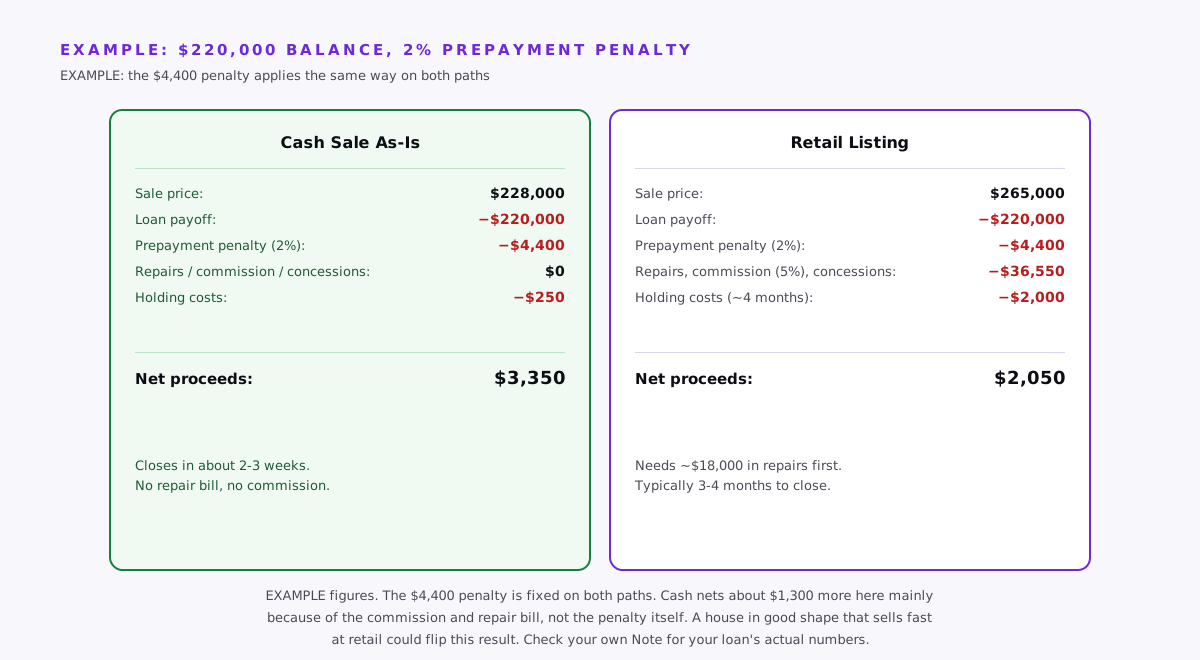
In this example, cash nets about $1,300 more, mostly because the commission, repair bill, and four months of taxes/insurance/utilities add up to more than the gap between the two sale prices. Change the inputs and the answer changes. A house in good shape that sells in three weeks on the retail market could easily flip that math the other way, penalty and all. For that fuller comparison on a house that doesn't need work, see our cash offer vs. listing net proceeds guide.
The one constant: the penalty is a fixed, known cost once you know your Note's terms. It doesn't grow or shrink based on who buys the house.
Check first. Most sellers researching this don't have a penalty at all. Confirm with your Note, Closing Disclosure, or a payoff statement before you build it into any decision.
Call your servicer. Some penalties are negotiable, especially if you're refinancing with the same lender or the servicer would rather keep the loan performing than fight over a few thousand dollars.
Run the numbers both ways. A penalty that costs $4,400 might still net you more through a retail listing if the house is in good condition and commissions and holding costs stay low. See our seller closing costs breakdown for what a typical listing costs beyond the agent fee.
List with an agent if it nets more. The penalty applies either way, so the decision comes down to the rest of the math, not the penalty itself.
For anything specific to your loan documents, your servicer or a real estate attorney can confirm what your Note allows. This isn't legal or lending advice, just the mechanics.
We'll give you a written cash offer within 24 hours, as-is, no repairs, no commissions, and you pick the closing date. If a penalty applies to your loan, we factor the real payoff number in up front so there's no surprise at closing. And if listing nets you more once the math is done, we'll tell you that too.
All guides · Mortgage payoff statement explained · Cash offer vs. listing net proceeds · Seller closing costs breakdown
Step 1 of 5
No obligation, no fees, no repairs. We respond the same day.
You’ll talk to Trevor McAmis, Owner & Acquisitions Lead
(313) 710-6129
Takes about two minutes. Your address is never shared.
