Every market page publishes the numbers behind its offer. See the math
Home › Guides › Selling a House Facing Tax Foreclosure: What Homeowners Need to Know
Guide
Selling a House Facing Tax Foreclosure: What Homeowners Need to Know
If you've fallen behind on property taxes, you may be facing tax foreclosure — a government process that's separate from mortgage foreclosure, and it can happen even to a homeowner who owns their house outright. If you stop paying, the county can eventually sell your home to recover the debt. How much time you have before that sale is final varies widely by state — from a few months to several years — depending on whether it's a tax lien or tax deed state, so your realistic options depend heavily on where you live.
Takes about two minutes. Or call
(313) 710-6129 — we answer.
Educational only. This explains how these situations generally work. It is not legal, tax or financial advice, and the rules differ by state — talk to an attorney or CPA about your own situation before you act on any of it.
Tax Foreclosure vs. Mortgage Foreclosure: Why the Difference Matters
Mortgage foreclosure happens because you stopped paying a private lender. Tax foreclosure happens because you stopped paying your county or municipal property taxes — it can happen even to a homeowner who owns their house outright with no mortgage at all. Different laws, different court process, different timelines, and often a different set of options apply. If your situation actually involves a missed mortgage payment rather than delinquent taxes, our mortgage foreclosure guide covers that process and the timeline before an auction date instead.
The two can also overlap: a mortgage lender will often pay delinquent property taxes on a borrower's behalf to protect its lien, then add that amount to the loan balance — which can trigger its own default. If you're unsure which process you're actually in, the notice you received will say "tax foreclosure," "tax sale," or reference your county treasurer or tax collector, not your mortgage servicer.
How Tax Foreclosure Works: Tax Lien States vs. Tax Deed States
Property tax collection is a state and county function, so the mechanics of tax foreclosure vary more than almost any other area of real estate law. Broadly, states fall into a few categories:
Tax lien states — the county doesn't sell your house directly. Instead, it sells a tax lien certificate to an investor, who pays your back taxes on your behalf. The investor earns interest, and if you don't repay them (redeem the lien) within the state's redemption period, they can eventually move to foreclose and take title.
Tax deed states — the county sells the property itself (or the right to eventually receive a deed to it) at auction to satisfy the tax debt.
Hybrid and redeemable deed states — some states blend the two models, selling a deed at auction but still giving the original owner a window afterward to redeem the property by paying what's owed.
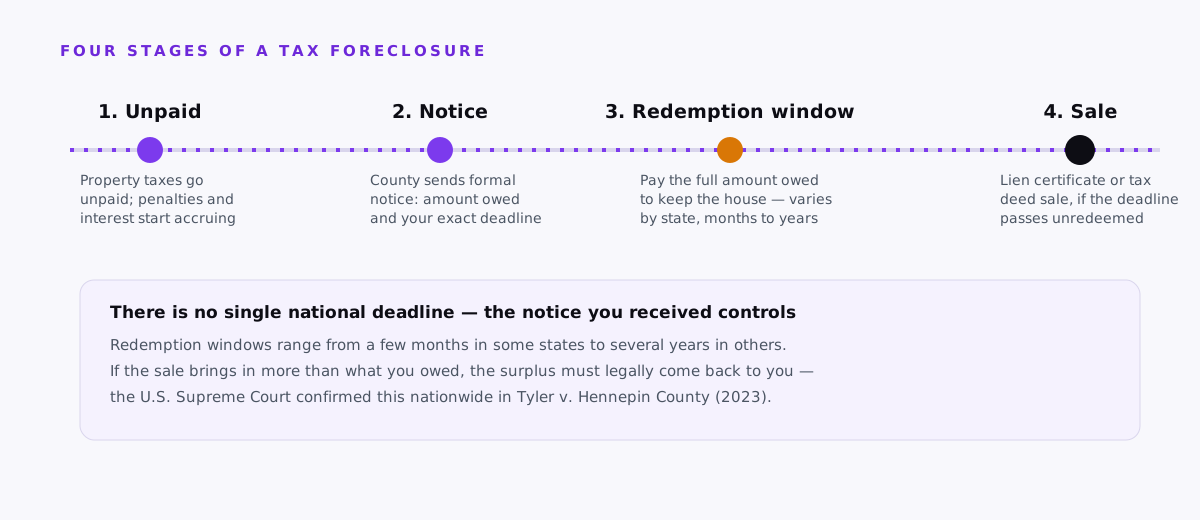
Redemption periods — the window during which a delinquent owner can pay off the debt and keep the house — vary enormously by state. Some states offer no redemption period at all once a tax deed sale is finalized; others allow a year or two; a handful stretch to three or four years. There is no single national deadline, so the notice you received from your county is the only document that tells you your actual date.
Michigan is a well-documented example of how long and structured this can get: delinquent real property taxes generally move through roughly a three-year forfeiture-to-foreclosure timeline, with formal notice and a court hearing required before title can transfer to the county. Other states move much faster or much slower — you can see Michigan's own published process on the Michigan Department of Treasury's property tax forfeiture and foreclosure page. If delinquent property taxes are the core issue rather than a completed foreclosure filing, our guide to selling with delinquent property taxes walks through how back taxes get handled at closing.
What a Notice of Tax Foreclosure Looks Like
Most states require the county treasurer or tax collector to send formal, certified notice before a tax foreclosure can proceed, typically including:
The parcel number and legal description of the property
The total amount owed, including taxes, penalties, interest, and administrative fees
The date by which you must pay to avoid the next step in the process (forfeiture, judgment, or sale)
Information about your right to a hearing, in states that provide one
What happens if the deadline passes — entry of a foreclosure judgment, a scheduled auction date, or transfer of a lien certificate
If you've received more than one notice over time, the amount owed typically increases at each stage as interest and fees accrue. Read the notice carefully for the specific deadline named — that date, not a general estimate, controls what options are still available to you.
There is no single national deadline — the notice you received controlsRestar Acquisitions · redemption windows vary by state, months to years
What Happens to Your Equity: Surplus Funds and Tyler v. Hennepin County
One of the most consequential — and least understood — parts of tax foreclosure is what happens when a property is worth more than what was owed in back taxes. For decades, a number of states allowed the county (or the private buyer at auction) to keep the entire sale proceeds, even the portion far exceeding the tax debt, penalties, and costs.
That changed in 2023, when the U.S. Supreme Court ruled unanimously in Tyler v. Hennepin County that a Minnesota county violated the Fifth Amendment by keeping the full $25,000 surplus after foreclosing on Geraldine Tyler's $40,000 condo to collect roughly $15,000 in delinquent taxes and fees. The Court held that a government can sell your property to collect what it's actually owed, but taking more than that without compensating the owner is an unconstitutional taking of property.
Michigan reached the same conclusion 36 months earlier on its own: in July 2020, the Michigan Supreme Court ruled in Rafaeli, LLC v. Oakland County that keeping tax-foreclosure surplus violated the state constitution, which is why Michigan already had a formal surplus-proceeds claims process in place by the time Tyler made it the law nationwide. Whether — and how — you can claim a surplus, and how long the claims window stays open, still depends on your state and county, so this is a case where reading your local treasurer's process (or asking an attorney) matters more than a general rule. You can read the Supreme Court's opinion summary directly via Oyez's case page for Tyler v. Hennepin County.
The Honest Price Tradeoff: Cash Sale vs. Retail Sale Before a Tax Deadline
This is the tradeoff worth being direct about: selling for cash to close quickly and with certainty will almost always net you less money than a successful retail sale would, if that retail sale actually closes before your redemption deadline. A cash sale trades some amount of money for speed and certainty. Whether that trade makes sense depends on how much time is actually left on your notice, and how confident you are that a retail listing would close in time.
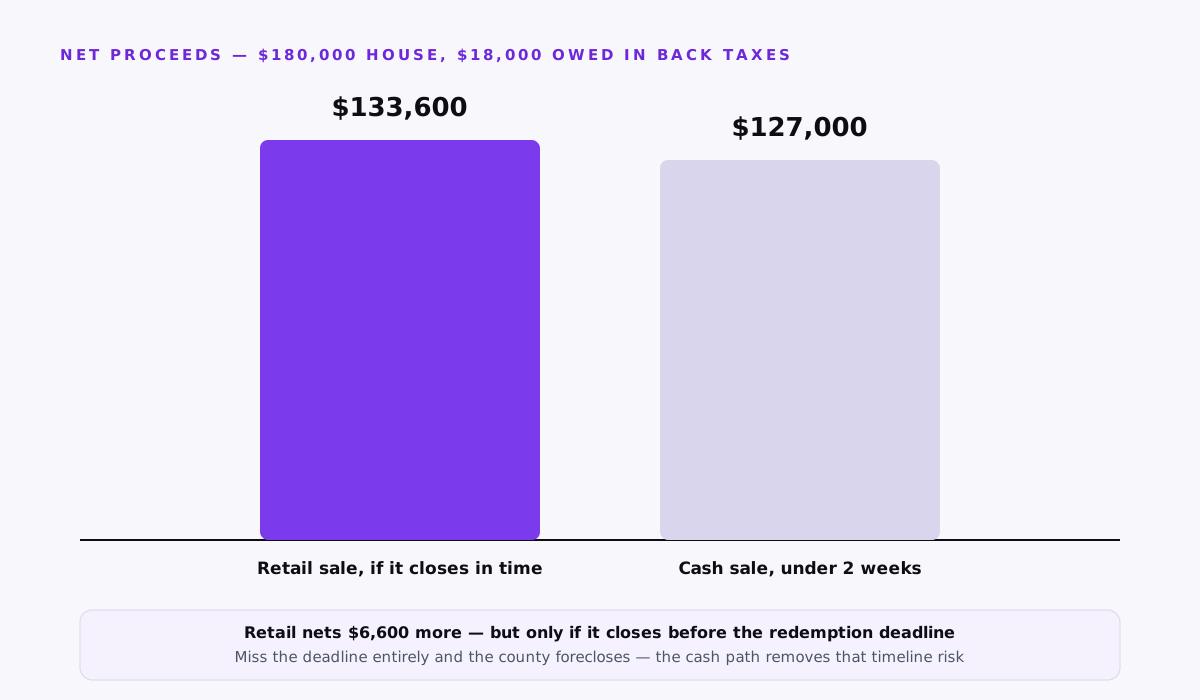
Here's a worked, illustrative example for a house worth roughly $180,000 with $18,000 owed in delinquent taxes, penalties, and interest. Actual numbers on any specific house will differ — this is meant to show the shape of the math, not a promise of what any specific offer would be.
Retail sale path (if it closes before the deadline)
Amount
Estimated sale price
$180,000
Agent commission (~6%)
−$10,800
Repairs/prep needed to sell at that price
−$12,000
Seller-paid closing costs/concessions (~2%)
−$3,600
Holding costs during a 60–90 day listing
−$2,000
Delinquent taxes, penalties & interest paid at closing
−$18,000
Net to seller, if the sale closes in time
$133,600
Risk if it does NOT close in time
County forecloses; owner may lose the house and must separately petition for any surplus
Cash sale path
Amount
Cash offer (illustrative, as-is condition)
$145,000
Agent commission
$0
Repair costs
$0
Seller-side closing costs
$0
Delinquent taxes, penalties & interest paid at closing
−$18,000
Net to seller
$127,000
Typical timeline to close
Under 2 weeks
Retail nets $6,600 more, but only if it closes before the deadlineRestar Acquisitions · worked example from this page
In this example, the retail path nets about $6,600 more — but only if it closes successfully before the redemption deadline, which requires finding a buyer, clearing inspection and financing contingencies, and reaching a closing table in a compressed window. The cash path nets less but removes the financing contingency and the timeline risk. Neither path is automatically "right" — it depends on how much runway is actually left before your specific deadline. Our guide comparing cash offers to listing net proceeds breaks down that comparison in more detail for other situations, not just tax deadlines.
Timeline and certainty, side by side:
Factor
Listing with an agent
Cash sale
Typical time to accepted offer
Weeks to months
Same day to a few days
Typical time to closing
30–60+ days after offer accepted
As little as 7–14 days
Financing contingency risk
Yes, common
Usually none (cash)
Repairs required before sale
Often yes
No
Commission paid
~5–6%
None to Restar Acquisitions
Net proceeds
Typically higher, if it closes in time
Typically lower, but timeline is predictable
Your Options When You're Behind on Property Taxes
There is more than one path, and the right one depends mostly on how much time is left before your deadline:
Set up a payment plan. Many counties and municipalities offer installment plans for delinquent property taxes, letting you catch up over months rather than paying the full balance at once. Contact your county treasurer's office directly to ask what's available. A HUD-approved housing counselor can also help you sort through options at no cost; you can find one through HUD.
Consider a property tax loan or lien transfer, with eyes open. Some private lenders will pay off your delinquent taxes and let you repay them over time. This can stop the foreclosure clock, but it typically carries higher interest than a conventional mortgage and creates a new lien on your home — trading one deadline pressure for another kind of debt obligation. Read the terms carefully, or have someone qualified review them, before signing.
Redeem after a tax sale, if your state allows it. In many (not all) states, you can still get your property back after a tax lien or tax deed sale by paying the full redemption amount within the statutory window. Confirm your exact redemption deadline and amount with your county.
List with a real estate agent, if there's enough time. If your deadline is genuinely months away, a traditional retail listing may net more money, as shown above. This only works if a sale can realistically close before the deadline.
Sell for cash, if time is nearly out. When a redemption deadline is close and a retail sale is unlikely to close in time, a direct cash sale can close in days rather than months, which removes the risk of losing the house for nothing. Restar Acquisitions buys houses as-is, with a written offer typically within 24 hours and no repairs or commissions required, across 30 markets in 11 states — though we are not a real estate broker and we don't represent you as an agent; we're simply a direct buyer presenting one option among several.
Common questions
What happens if I don't pay my property taxes?
Unpaid property taxes accrue penalties and interest, and after a period set by your state and county, the taxing authority can begin a formal legal process — tax foreclosure — that can end with the property being sold or title transferring to satisfy the debt. The exact steps and notices required vary by state.
How much time do I have before I lose my house to tax foreclosure?
There's no single national deadline. Depending on your state, the process from first delinquency to a final, unredeemable sale can take anywhere from under a year to several years. Your specific deadline is stated on the notice from your county treasurer or tax collector — that document controls, not a general timeframe.
What's the difference between a tax lien sale and a tax deed sale?
In a tax lien sale, the county sells a certificate representing your debt to an investor, who earns interest if you eventually repay it and may eventually be able to foreclose if you don't. In a tax deed sale, the county sells the property (or a deed to it) directly at auction. Some states use hybrid models that combine elements of both.
Can I get my house back after a tax foreclosure sale?
In many states, yes, if you act within the statutory redemption period and pay the full amount owed plus costs. Some states, however, offer no redemption period after a tax deed sale is finalized. Confirm your state and county's specific rules before assuming either way.
If my house sells for more than I owed in back taxes, do I get the difference?
It depends on your state, but the 2023 Supreme Court decision in Tyler v. Hennepin County held that a government cannot keep surplus proceeds beyond what was actually owed — that's an unconstitutional taking under the Fifth Amendment. Many states have since set up formal claims processes for former owners to recover a surplus. The deadlines and paperwork for these claims are state-specific, so check with your county treasurer or an attorney.
Should I sell my house myself, use an agent, or sell for cash before a tax foreclosure deadline?
It depends almost entirely on how much time is left. If your deadline is months away, a retail listing with an agent may net more money. If your deadline is close and a financed retail sale is unlikely to close in time, a cash sale trades some net proceeds for a fast, certain closing. Neither option is right for everyone — it's a real tradeoff, not a marketing claim. This is educational only — talk to an attorney or CPA about your specific situation.
If your deadline is genuinely months away, the arithmetic in our cash offer vs listing net-proceeds guide shows a retail listing usually nets more, and we would say so on the phone. Where we are useful is when time is nearly out and a financed sale is unlikely to close before your redemption deadline. Send the address and we will send a written offer within 24 hours. No cost, no obligation.
Every offer on this site is underwritten by a person, not a form. If the
numbers do not work for you, say so and I will tell you what would.
Also from Restar
Want the data behind all of this?
Restar Acquisitions is the acquisitions arm of Restar — a housing-market analytics
platform tracking 180+ metrics across every U.S. market, with composite scores and 12-month
price forecasts. The numbers on this page come from the same work.