A special assessment is a one-time bill your HOA or condo association levies on top of regular dues, usually for a major repair. It isn't a lien by itself, but an unpaid one becomes one. Who pays it at closing is negotiated in the contract, not fixed by law — and an unresolved structural assessment can block financing entirely.
Step 1 of 5
Tell us about the assessment and where it stands with your association. We'll give you a straight answer, including when paying it off and listing nets more.
You’ll talk to Trevor McAmis, Owner & Acquisitions Lead
(313) 710-6129
Takes about two minutes. Or call (313) 710-6129 — we answer.
Educational only. This explains how these situations generally work. It is not legal, tax or financial advice, and the rules differ by state — talk to an attorney or CPA about your own situation before you act on any of it.
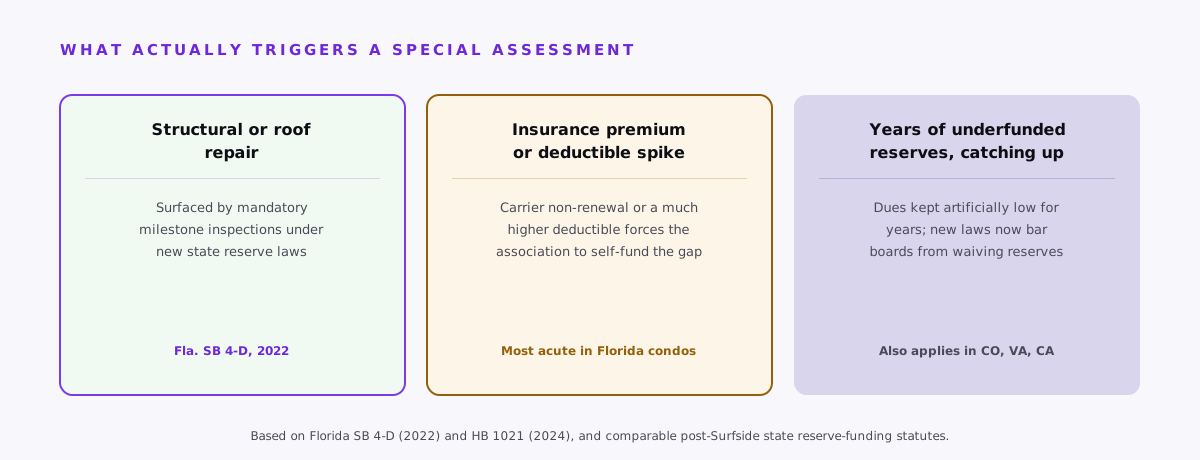
A special assessment is an extra charge your homeowners or condo association bills beyond your regular monthly or quarterly dues, to cover a cost reserves and regular income don't stretch to — a roof, a structural repair, an insurance deductible the association has to self-fund, or a reserve account that's been underfunded for years catching up all at once.
That's different from regular dues, which fund routine operating costs, and it's different from an HOA lien, which is what happens when dues — or a special assessment — go unpaid. A special assessment, paid in full, leaves no lien and no title problem. An unpaid one behaves exactly like unpaid dues: it clouds title and has to be cleared or disclosed before a clean closing. If you're dealing with an association lien that's already been recorded, our guide to selling a house with an HOA lien covers that mechanism directly.
You'll find out whether one exists, and how much, through the estoppel certificate (condos, especially Florida) or resale certificate (most other HOAs) — the association's written statement of your account status that lenders and title companies require before closing. Our guide to the cost of that certificate covers what it costs and how long it takes to get; this page is specifically about what happens once it comes back showing a special assessment.
There's no single rule. Allocating a special assessment between buyer and seller is contract-driven, not set by statute in most states — whatever the purchase agreement says controls. Three structures show up most often:
1. The seller pays it off in full before or at closing — cleanest, since the buyer takes clear title with nothing pending.
2. The seller credits the buyer the remaining balance at closing, and the buyer pays the association directly going forward.
3. The amount is prorated by a negotiated formula reflecting who benefits from the repair and when.
The case where it's not just a negotiation problem: unresolved critical repairs can make the property ineligible for financing. Fannie Mae's own Selling Guide states that if a special assessment is tied to a "critical repair" — defined as one that significantly affects the safety, soundness, structural integrity or habitability of the building — and the issue hasn't been remediated, the entire project is ineligible for financing, regardless of whether the individual seller's share has been paid. (Fannie Mae Selling Guide B4-2.1-03) Separately, Fannie Mae's full-review standard caps delinquency on any special assessment at 15% of units and requires the association to budget at least 10% of its income toward reserves. (Fannie Mae Selling Guide B4-2.2-02) A buyer relying on a conventional loan can get denied outright on a building the lender flags this way — which is exactly why this matters more than the dollar amount alone.
This is general information, not legal or financial advice. Confirm your specific association's status, your state's disclosure rules, and your contract's allocation language with a real estate attorney before you price or negotiate around a special assessment.
Special assessments have become more common and more visible since the June 2021 Champlain Towers South collapse in Surfside, Florida. In direct response, Florida passed Senate Bill 4-D in a May 2022 special session — signed into law requiring mandatory "milestone" structural inspections for condo and co-op buildings three stories and up, and a Structural Integrity Reserve Study (SIRS) every 10 years for the same buildings. (Fla. SB 4-D, 2022D) Associations existing as of mid-2022 had to complete their first SIRS by the end of 2024, and a 2024 follow-up law tightened the rules further: boards can no longer vote to waive or underfund reserves covering SIRS-identified structural components, starting with budgets adopted for fiscal year 2026.
Florida isn't alone. Colorado passed its own structural-integrity reserve law in 2022. Virginia requires reserve studies at least every five years. California has required reserve disclosures for years under the Davis-Stirling Act. The pattern across states: associations that spent decades underfunding reserves to keep dues low are now required to catch up — and catching up means a special assessment, often a large one, often with little warning to a seller mid-listing.
According to HOA management-software vendor Vantaca's 2025 data, the median special assessment reached $1,100 that year — the highest in its dataset — and nearly 10% of HOAs levied one in 2025, up from under 8% in 2021. Structural or major-component work can run far higher than that median; some reported Florida condo cases have reached well into five and even six figures per unit. Treat any specific extreme figure as anecdotal, not typical — but understand a "major" assessment and a "typical" one can be an order of magnitude apart.
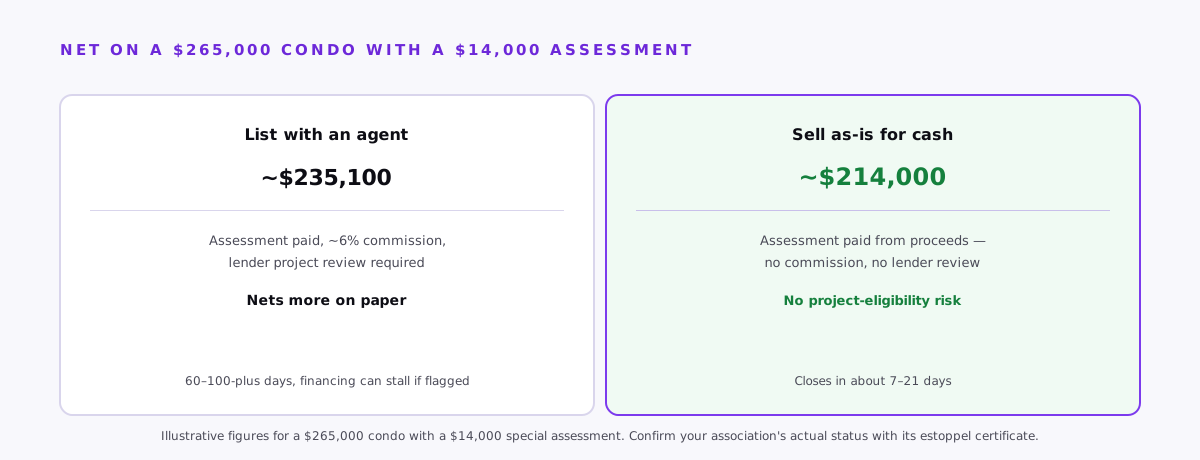
Take a $265,000 Florida condo with a $14,000 special assessment approved for a roof replacement, not yet paid, and not tied to a structural "critical repair" finding (so conventional financing is still available, just more complicated):
| Route | Gross price | Assessment handling | Commission/fees | Net to seller | Timeline |
|---|---|---|---|---|---|
| List with an agent, buyer gets financed-buyer mortgage | $265,000 | Seller pays in full at closing: −$14,000 | ~6% (−$15,900) | ~$235,100 | 60-100+ days; financing can stall or fall through if the lender flags the association |
| List with an agent, seller credits buyer | $265,000 | Credit at closing: −$14,000 | ~6% (−$15,900) | ~$235,100 (same net, different paperwork) | Same timeline; buyer takes on payment risk, which can scare off financed buyers |
| Sell as-is to a cash buyer | $228,000 (as-is discount reflects no repair contingency, no lender project review) | Buyer takes the unit subject to the HOA's own lien process, or seller pays it off from proceeds | $0 | ~$214,000 (seller pays assessment) | 7-21 days; no lender project review to fail |
The listing route nets roughly $21,000 more in this example — but it assumes the building actually clears a lender's project review while an unresolved assessment sits on the books, and it assumes 60 to 100-plus days most sellers facing a real structural issue don't have the patience, or the association doesn't have the time, to wait out. A cash sale skips the project-eligibility question entirely, since there's no mortgage underwriting a lender could kill the deal over — the tradeoff is a lower price in exchange for that certainty.
If the assessment is small relative to your price and the building clears a lender's project review, paying it off and listing usually nets more — we'd tell you that directly.
Where a cash sale earns its place is when the assessment is tied to an unresolved repair that could sink a financed buyer's loan, or you simply can't wait out a lender's project review. Send the address and we'll send a written offer within 24 hours. No cost, no obligation.
All guides · Selling a house with an HOA lien · Cost of an HOA resale certificate · Cash offer vs listing net proceeds
Step 1 of 5
No obligation, no fees, no repairs. We respond the same day.
You’ll talk to Trevor McAmis, Owner & Acquisitions Lead
(313) 710-6129
Takes about two minutes. Or call (313) 710-6129 — we answer.
