<b>Get the leak professionally located, have a licensed plumber tell you repair versus re-pipe, deal with any resulting water damage, find out in writing what your insurance will and won't pay for, and only then decide whether to repair-and-list or sell as-is.</b> If a high water bill, a warm damp spot on the floor, or a pre-listing inspection just turned up a leak underneath your home's concrete foundation, selling a house with a slab leak doesn't have to mean a surprise bill or a stalled closing if you work through it in the right sequence. Here's the real mechanics, the real costs, and an honest worked example comparing your options.

Step 1 of 5
Tell us about your property and we'll send a written cash offer within 24 hours, priced for the condition it's in today. No detection, repair, or commissions required.
You’ll talk to Trevor McAmis, Owner & Acquisitions Lead
(313) 710-6129
Takes about two minutes. Or call (313) 710-6129 — we answer.
Educational only. This explains how these situations generally work. It is not legal, tax or financial advice, and the rules differ by state — talk to an attorney or CPA about your own situation before you act on any of it.
A slab leak is a leak in a water line that runs underneath your home's concrete foundation slab rather than through an accessible wall or crawlspace. It can be a supply line or a hot water line, and because it's buried in or under concrete, you can't just look at it the way you'd look at a leaky faucet.
Most homeowners find out one of three ways: a water bill that jumps for no obvious reason, a warm or damp patch on an otherwise normal floor (warm if it's the hot water line), or a professional home inspection during a sale that flags moisture, a musty smell, or a sound of running water with no fixture running. However it's discovered, the next move is the same: get it located by someone who does this for a living, not by guessing where to start cutting into a slab.
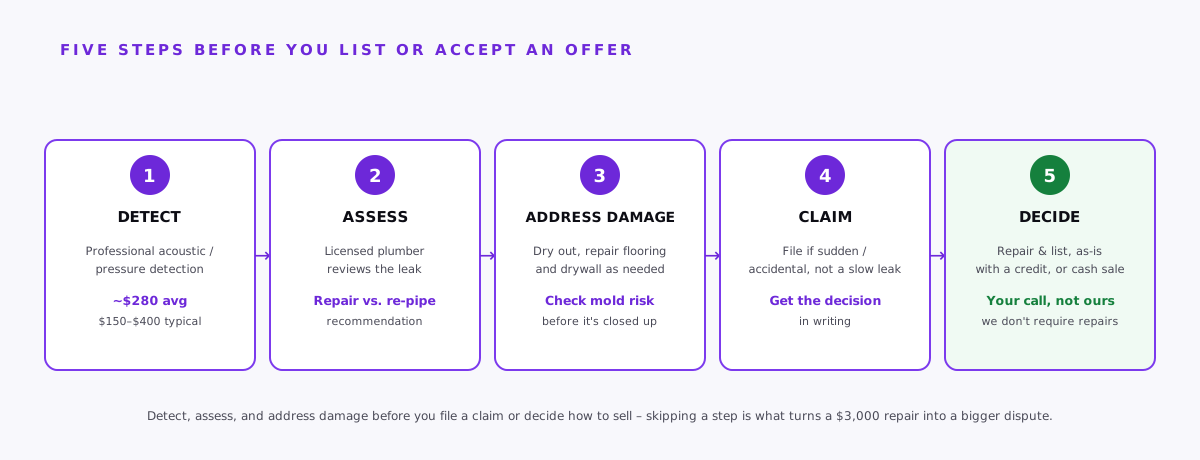
That order — locate, assess, treat the damage, check coverage, decide — is the backbone of selling a house with a slab leak without creating new problems along the way.
Slab leaks come up more often in regions where homes are built on a concrete slab-on-grade foundation rather than over a basement or crawlspace — that's most common in Sun Belt states, including several of the states we buy houses in, like Texas, Florida, Georgia, and Arizona. If you're in one of those markets, a slab leak showing up during a sale isn't unusual, and it's not a reflection of anything you did wrong as an owner.
If the leak has caused structural settling or cracking rather than just water intrusion, that can overlap with foundation issues — our guide to selling a house with foundation problems covers that related situation in more detail.
These are contractor-cost-aggregator figures for 2026, not a quote for your specific house, but they're the numbers that drive most of the decision-making in selling a house with a slab leak — your plumber's assessment of your actual leak and damage is what matters most.
Detection. Professional slab leak detection — acoustic listening equipment, pressure testing, sometimes infrared — runs about $280 on average, with most homeowners paying $150 to $400. This is the step that tells a plumber exactly where to work instead of opening up a large section of slab on a guess.
Repair. A straightforward repair — re-routing the line above the slab or making a single targeted penetration to patch the pipe — typically runs $2,000 to $4,000. That's the common scenario for a single, isolated leak in an otherwise sound plumbing system.
Re-pipe. If the home is older, has galvanized or otherwise corroded pipe, or has had more than one slab leak, a plumber may recommend a full re-pipe — replacing the home's water lines entirely rather than patching one spot. That can run up to $15,000 or more, since it's a much larger scope of work than a single repair.
Water damage. Whatever water reached flooring, drywall, or subfloor before the leak was found needs its own repair, separate from the plumbing fix. Reported costs range from roughly $500 for a minor, contained spot fix up to $15,000 or more for extensive damage, depending heavily on how long the leak ran undetected. Our guide to selling a house with water damage goes deeper on that side of the cost if the leak has been running a while.
This is where sellers often assume more coverage than they actually have when selling a house with a slab leak, so it's worth being precise rather than reassuring.
A standard HO-3 homeowners policy generally covers a sudden, accidental pipe burst under a slab as sudden/accidental water discharge. A long-term, slow leak or seepage is typically treated differently — insurers generally classify that as preventable wear-and-tear or a maintenance failure, which standard policies generally exclude. Timing is often the whole fight: an adjuster's read on whether your leak was sudden or gradual determines a lot of what happens next.
There's a second nuance that catches sellers off guard: many policies that do cover the resulting water damage, and the tear-out/access cost (the jackhammering or demolition needed to actually reach the pipe), still treat repairing or replacing the leaking pipe itself as a maintenance item that isn't covered. Some insurers sell an optional “service line coverage” endorsement specifically to help with that underground pipe-repair cost — worth asking your agent whether your policy has it. The Insurance Information Institute's overview of what disasters are covered and the CFPB's explainer on how home insurance companies pay out claims are both useful starting points before you call your carrier.
The practical message: don't assume a claim will cover everything. File it if the leak was plausibly sudden, but get the adjuster's coverage determination in writing before you plan your numbers around an insurance payout.
This is general education, not insurance or legal advice — insurance coverage depends on your specific policy language; have your claim reviewed by your carrier or a public adjuster, and consult a professional for your situation.
These five steps are the full playbook for selling a house with a slab leak, in the order that actually protects you:
The honest price tradeoff for selling a house with a slab leak comes down to three paths on the same house.
Illustrative example, not a quote. A $280,000 house has a slab leak found during a pre-listing inspection. Professional detection runs $280. A licensed plumber confirms it's a straightforward repair — not a full re-pipe — quoted at $3,000. Some water reached a bedroom closet and hallway, with flooring and drywall repair estimated at $2,500. To stay conservative, this example assumes the insurance claim does not reduce any of these out-of-pocket costs — pipe repair is commonly excluded as a maintenance item, and we're not counting on the water-damage portion being covered either, since that outcome depends on the adjuster's sudden-versus-gradual determination for your specific claim.
| Repair fully, then list retail | List as-is, credit at closing | Sell as-is to a cash buyer | |
|---|---|---|---|
| Sale / offer price | $280,000 | $280,000 | $260,000 |
| Detection | −$280 | $0 | $0 |
| Plumbing repair | −$3,000 | $0 (buyer handles after close) | $0 |
| Water damage repair | −$2,500 | $0 | $0 |
| Buyer credit at closing | $0 | −$7,500 | $0 |
| Agent commission (5.6%) | −$15,680 | −$15,680 | $0 |
| Seller closing costs | −$4,200 | −$4,200 | −$800 |
| Carrying costs during repair/listing | −$1,500 | $0 | $0 |
| Net to seller | ~$252,840, ~10–11 weeks | ~$252,620, ~7–8 weeks | ~$259,200, 1–2 weeks, certain |
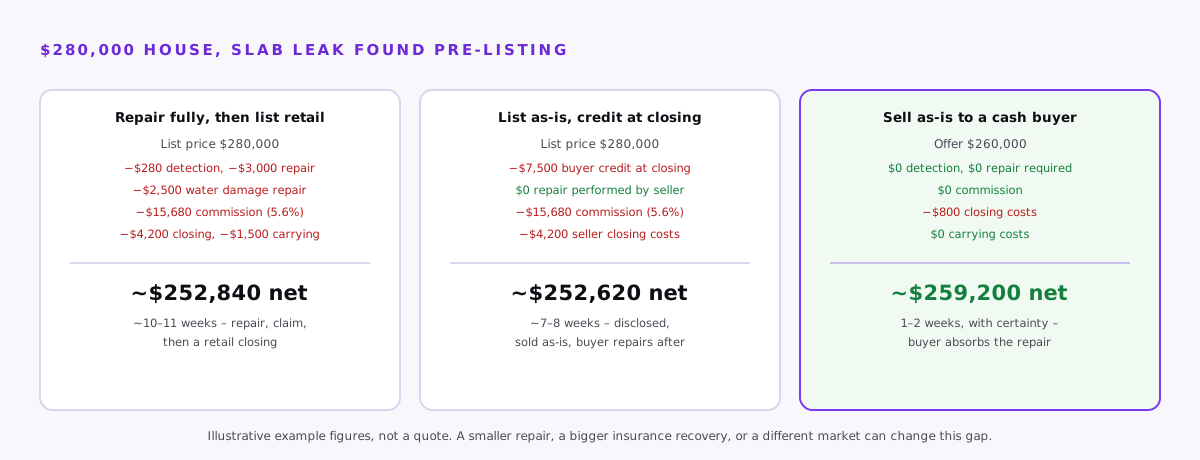
In this example, the cash sale comes out roughly $6,000 to $6,600 ahead of the other two paths — not because retail is a bad choice in general, but because detection, repair, water-damage repair, commission, and closing costs all stack up on top of each other in the retail paths, while the cash buyer's offer already accounts for the leak and its damage. A smaller repair, a faster insurance recovery, or a buyer willing to take a smaller credit than contractors quoted could narrow or erase that gap. Our cash offer vs. listing net proceeds guide walks through that same kind of math in more general terms if you want to run your own numbers.
Selling a house with a slab leak is exactly the kind of known-issue sale Restar Acquisitions is built to simplify. We buy houses as-is for cash across the states we serve, including Texas, Florida, Georgia, and Arizona, and we price in a known issue like a slab leak the same way we'd price in any other repair — before we give you a number, not after a buyer's inspector finds it and a financed deal falls apart. We give a written offer within 24 hours, no repairs or commissions required, and you pick the closing date. We're a direct buyer, not your real estate agent, and we don't represent you in the transaction.
Alternatives worth checking before you decide:
This article is for general education only and isn't a quote, an insurance determination, a legal opinion, or a substitute for a licensed plumber's or insurance professional's assessment. Costs vary by region, leak severity, and how long water damage went undetected. This is general education, not insurance or legal advice — insurance coverage depends on your specific policy language; have your claim reviewed by your carrier or a public adjuster, and consult a professional for your situation.
We factor a known issue like a slab leak into our offer the same way we factor in any other repair item — before we give you a number, not after a buyer's inspector finds it and a financed deal falls apart.
You'll get a written offer within 24 hours, no detection, repair, or commissions required, and you pick the closing date.
All guides · Selling a house with foundation problems · Selling a house with water damage · Cash offer vs. listing net proceeds
Step 1 of 5
No obligation, no fees, no repairs. We respond the same day.
You’ll talk to Trevor McAmis, Owner & Acquisitions Lead
(313) 710-6129
Takes about two minutes. Or call (313) 710-6129 — we answer.