Selling a house with a party wall dispute is possible, but an uncooperative neighbor, undocumented repairs, or an addition that encroaches on a shared wall can stall a financed buyer's loan long before the sale reaches a courtroom. Selling as-is for cash sidesteps the inspection and title requirements that usually stop these deals.
Step 1 of 5
Send the address and we will tell you what a cash, as-is sale looks like even with the dispute unresolved.
You’ll talk to Trevor McAmis, Owner & Acquisitions Lead
(313) 710-6129
Takes about two minutes. Your address is never shared.
Educational only. This explains how these situations generally work. It is not legal, tax or financial advice, and the rules differ by state. Talk to an attorney or CPA about your own situation before you act on any of it.
The wall your house shares with the house next door is not fully yours to control, and that is exactly what makes a dispute over it so hard to sell through. A cracked or bowed shared wall, a neighbor who will not pay their share of a repair, or an addition built over the boundary line can sit unresolved for years without anyone forcing the issue, until a sale forces it. A buyer's lender and title company will ask about it even if you and the neighbor have ignored it for a decade.
This is educational information, not legal advice. Party wall law is largely common law and varies by state, and some cities add their own building code requirements on top of it. Confirm your specific situation, and before you sign any cost-share agreement or file anything, with a real estate attorney licensed where the house sits.
A party wall is a single wall, usually masonry, that sits on or straddles the boundary line between two attached or semi-detached houses and physically supports or encloses both of them. It is standard in older rowhouse cities, including Baltimore and Pittsburgh, both real Restar Acquisitions markets, and in Philadelphia, where blocks of attached housing were built wall to wall from the 1800s through the mid 1900s.
A party wall gets its legal status one of two ways. Some deeds carry a recorded party wall agreement or covenant spelling out who built it, who maintains it, and how costs split. Many older rowhouses have no such document, and the wall is still a party wall under common law party wall doctrine. Pennsylvania courts, for example, look at the builder's intent, where the wall sits relative to the boundary, and how the wall has been used over time, not just whether paperwork exists (Turchi v. MCW Washington Square Partners, 2006). A wall does not even need to carry both buildings' roofs or floors to qualify, it is enough that it functions as a shared curtain wall protecting both structures from weather and fire (Sobien v. Mullin, 2001).
Under that doctrine, each owner generally holds what amounts to an easement of support in the other half of the wall and is entitled to a sound, solid wall. Neither owner can cut a new window, remove a section, or otherwise unilaterally alter the wall without the other owner's consent. When one owner has tried, Pennsylvania courts have granted injunctions to preserve the wall as it is while the dispute is sorted out, rather than letting one side make the change first and argue about it later (a Philadelphia real estate litigation firm's summary of the case law).
Each owner is normally responsible for maintaining their own side of the structure, but the wall itself is different, because both owners have a legal interest in it. When damage to the wall itself, cracking, bowing, water intrusion, settlement, affects both sides, responsibility for repair is typically shared between the owners, even when only one owner's negligence or construction work caused it.
The trouble starts when a neighbor will not pay their share or will not even respond. There is no single national rule for forcing the issue, but the realistic path looks similar almost everywhere: document the condition with a licensed structural engineer, send the neighbor written notice of what needs to happen and why, and if that gets no response, move to mediation or a civil action to recover your share of the cost (a contribution claim) or to compel repair and stop further damage (an injunction).
Baltimore's building code gives a concrete example of how a city treats this. Under Baltimore City Building Code, Section 3319, a cracked or bowed load-bearing wall, and any load-bearing wall only 4 inches thick, is presumed structurally unsafe unless a Maryland-licensed structural engineer certifies it safe. If a party wall is left unsafe when one owner demolishes or removes their structure, that owner is responsible for removing the dangerous portion and reconstructing it to properly enclose the adjoining house, under the Building Official's direction.
A party wall problem does not just sit on the surface, it reaches the paperwork that a sale depends on. Standard owner's title insurance policies commonly carry a survey exception or a specific party wall and encroachment exception. In a Pennsylvania federal case over a disputed boundary wall, the title insurer denied any duty to defend the owner's litigation costs, arguing that an accurate, complete survey would have disclosed the encroachment or boundary dispute in the first place. That is the exception doing exactly what it is written to do: shift the risk of exactly this kind of problem back onto the owner.
For a buyer paying cash, that gap matters less. For a buyer using a mortgage, it usually matters a lot. Lenders require clean, insurable title before they will fund, and an open party wall dispute, a neighbor's documented structural damage on the shared wall, or an addition that was built encroaching over the boundary tends to surface during the title search or the appraisal. Once it does, underwriting commonly pauses the file until the issue is resolved or at least formally addressed, which can add weeks or kill the deal outright if the closing date cannot move.
Example: A seller in Baltimore inherits a rowhouse where the neighbor's half of the shared wall has a visible bow and the neighbor refuses to discuss a repair. A fully marketed, dispute-free sale might bring around $225,000 in that neighborhood. Listed as-is with the dispute disclosed, financed buyers' lenders routinely ask for the issue to be resolved before closing, which can take months the seller does not have. A cash, as-is offer in the roughly $190,000 to $200,000 range skips the inspection contingency and the lender's title requirements entirely, trading part of the retail number for a sale that does not depend on the neighbor ever cooperating.
Step one: get it documented. A licensed structural engineer's report establishes the wall's condition, the likely cause, and what repair is needed. Without that, a demand letter, a mediation session, and a court filing all start from a weaker position.
Step two: put it in writing. Baltimore's own building code requires this for certain party wall work: if underpinning is to be done on a party wall, the city's underpinning notice rule requires the owner doing the work to give the adjoining owner written notice at least 10 days before filing the permit, with a copy to the Building Official, and the adjoining owner can formally challenge the permit in writing within 10 days after it issues. Even outside that specific permit process, putting the problem and the requested fix in writing, sent in a way you can prove was received, is the step that makes everything after it easier to enforce.
Step three: try mediation before litigation. A neutral mediator, often through a local bar association or community mediation program, can resolve a cost-sharing fight in a session or two for a fraction of what a contested lawsuit costs, and it does not require either owner to prove fault.
Step four: go to court if you have to. Where mediation fails, an owner can bring a civil action for contribution, to recover a fair share of repair costs already paid, or for an injunction, to stop unauthorized alterations or force a dangerous condition to be fixed. Pennsylvania courts have granted injunctions specifically to preserve a party wall's status quo while a dispute over unauthorized changes gets resolved, rather than letting the change stand because the case is still pending.
None of this is fast. A document, notify, and mediate path can wrap up in weeks. A contested civil action can run months to well over a year, which matters enormously if the real goal is to sell the house, not to win a judgment.
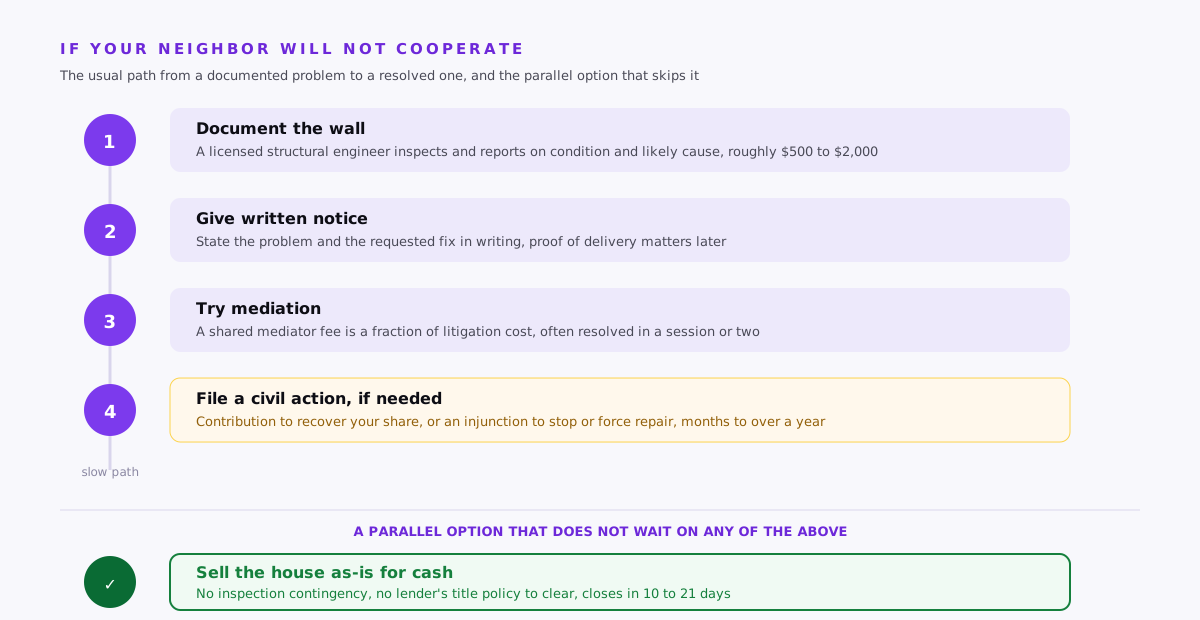
A structural engineer's assessment is usually the first real expense. Industry cost guides put a detailed assessment and written report in the range of roughly $500 to $2,000, with a narrower foundation-specific inspection often running $300 to $600, and the written report alone sometimes available for $100 to $200 if the inspection has already happened.
Mediation is the cheaper route by a wide margin. A shared mediator fee for a session or two is routinely a small fraction of what contested litigation costs once attorneys, discovery, and an expert witness, often the same structural engineer, get involved. A civil action that goes the distance can run into many thousands of dollars in legal fees before a judgment is even reached.
Repairing the wall itself depends heavily on scope. A partial repointing or masonry patch on a shared brick wall commonly runs from the hundreds of dollars into the low thousands. A full structural rebuild of a party wall section, the kind that follows real bowing or settlement, is a different category entirely and can run well into five figures depending on size, access, and whether underpinning is required. Get a written estimate for the actual wall before assuming either number applies.
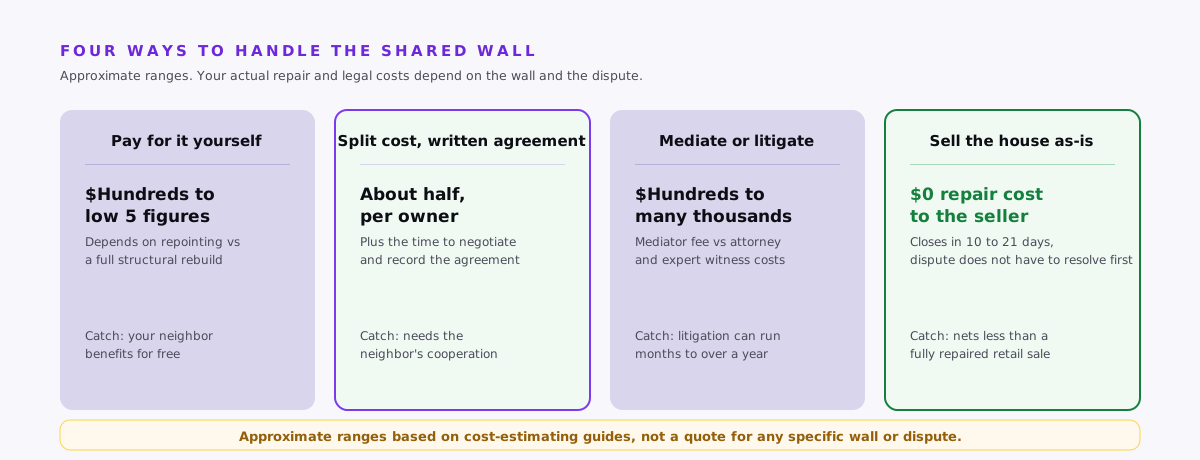
Selling as-is is not the only option, and it is worth ruling the others out, or at least pricing them, first.
A shared wall dispute does not have to stay your problem until a lawsuit or a cooperative neighbor resolves it. We buy as-is, including houses with an unresolved party wall issue, a deferred shared-wall repair, or a neighbor who will not engage. There is no inspection contingency and no lender's title policy that has to clear first, and we cover standard closing costs.
We can put a written offer in front of you in 24 hours and close in 10 to 21 days, you pick the date. Send us the property here.
All guides · Selling a house with foundation problems · Selling a house in Maryland
Step 1 of 5
No obligation, no fees, no repairs. We respond the same day.
You’ll talk to Trevor McAmis, Owner & Acquisitions Lead
(313) 710-6129
Takes about two minutes. Your address is never shared.