Selling a house with a pipeline easement is legal and common, but the easement itself does not disappear at closing. It runs with the land, restricts what can be built in the right-of-way, and shows up on every title search. Disclose it, confirm what is recorded, and price around it instead of trying to remove it.

Step 1 of 5
Tell us what's recorded against the land and we'll tell you straight whether it's a problem and what a cash offer looks like.
You’ll talk to Trevor McAmis, Owner & Acquisitions Lead
(313) 710-6129
Takes about two minutes. Your address is never shared.
Educational only. This explains how these situations generally work. It is not legal, tax or financial advice, and the rules differ by state. Talk to an attorney or CPA about your own situation before you act on any of it.
Pipeline and transmission easements originate one of three ways. PHMSA's own briefing on pipeline rights-of-way describes operators obtaining a right-of-way by purchasing the property outright, by negotiating a voluntary easement agreement with the landowner, or through court-ordered condemnation, since many pipeline and utility operators qualify as common carriers with eminent domain authority. Under the Fifth Amendment's just compensation requirement, that eminent domain power extends to easements and not just full ownership, which is exactly how most pipeline and transmission rights-of-way across older properties came to exist decades before the current owner bought the house.
Once that easement is recorded, it follows the land rather than the person who signed it. Cornell Law School's Legal Information Institute explains that an easement is a nonpossessory right to use someone else's land, and the burden of that easement transfers automatically to whoever buys the property next. That's the core fact sellers need to understand: you cannot simply decide you don't want the easement anymore and remove it. Ending one generally requires the pipeline or utility company to formally abandon and release it, which is rare and tied to the line's own retirement, or a landowner proving in court that the easement was never properly used, which is a question for an attorney rather than something to assume going into a sale.
The practical move for a seller is different from trying to fight the easement: confirm exactly what's recorded against the property, disclose it, and price the home around it.
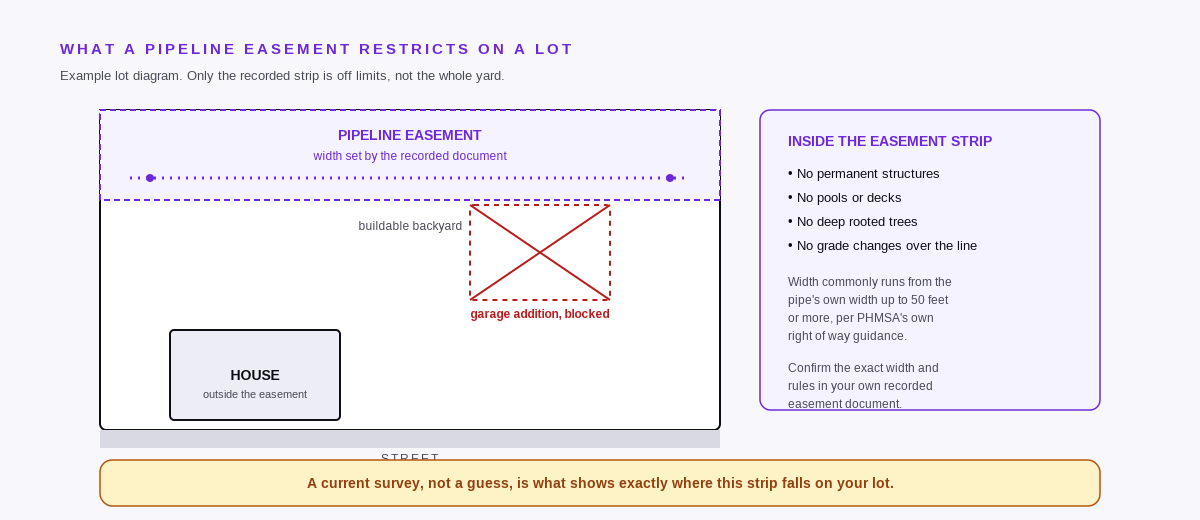
A pipeline easement typically prohibits permanent structures, pools, decks, and deep-rooted trees inside the recorded strip, along with grading changes that could remove or add soil cover over the line. Width varies by pipeline and by the specific recorded document. PHMSA's right-of-way briefing describes the range running "from as small as the width of the pipeline to 50 feet or more," and does not give one standard number because there isn't one.
For a real example tied to a single named operator rather than a guessed figure: Kinder Morgan's public right-of-way guidance describes a typical permanent easement of about 25 feet on either side of the pipeline, 50 feet total, while noting that width and terms are negotiated individually with each landowner and vary by agreement. Treat any number you've heard about your own property as a starting point, not a fact, until you've read your specific recorded easement.
Electric transmission line easements follow the same logic from the other direction. The utility that owns the line sets its own right-of-way width and restrictions in the recorded easement and its own engineering standards, and those vary by voltage and tower design rather than a single nationwide rule. Selling a house with a pipeline easement that cuts through part of the backyard doesn't mean the whole lot is affected, only the recorded strip. A current survey is the only reliable way to see exactly where that strip falls relative to the house, garage, septic field, or well.
Some landowners received a one-time payment when the easement was first granted, particularly in a negotiated deal rather than a condemnation. Electric transmission easements occasionally come with an ongoing annual payment. Neither is guaranteed, and the terms in each case are set entirely by the original agreement, not by any standard formula.
Before closing, a title company or a cash buyer will want to see the recorded easement document itself, plus any separate payment or maintenance agreement, so the terms transfer cleanly and nobody discovers an unrecorded side agreement after the sale. If you're receiving an annual payment tied to the easement, bring that agreement to closing. Buyers want to know whether the payment runs with the land to the new owner or stops when you sell, and that answer is in the document, not in memory.
If easement proceeds were paid to you directly at some point, IRS Publication 544 covers how amounts received for granting a permanent easement are generally treated: the payment typically reduces your basis in the affected land first, with any amount above that basis taxed as gain, and different rules can apply if the easement was granted under threat of condemnation. That's general tax information, not advice for your specific return. Confirm your numbers with a CPA before you file.
A pipeline or transmission easement doesn't disqualify a home from financing by itself. Buyers with a conventional mortgage close on homes with a utility or pipeline easement regularly, especially when the strip sits along a side or rear yard and doesn't touch the house or any realistic addition.
Lenders tend to get more cautious when the easement cuts across a meaningful share of the buildable lot, sits close to the structure, or would limit rebuilding the home if it were ever damaged. Appraisers are required to note recorded easements on the appraisal, and how much weight that gets in underwriting depends on the lender, the loan program, and the specific property, not a fixed industry rule.
That underwriting caution is a real reason a cash buyer can help here: a cash purchase doesn't depend on a lender's comfort with the easement, an appraisal contingency, or a buyer's loan surviving underwriting review. It isn't a reason to expect a cash offer to match what a financed retail buyer might eventually pay if that buyer's loan clears without issue. See the worked numbers below.
The Pipeline and Hazardous Materials Safety Administration (PHMSA), part of the U.S. Department of Transportation, regulates gas transmission and hazardous liquid pipelines and runs the National Pipeline Mapping System, where property owners and the public can look up pipeline locations by county. The mapping system covers PHMSA-regulated gas transmission and hazardous liquid lines; it does not include the smaller local gas distribution lines that run from the street to individual homes, so a property can sit near energy infrastructure that doesn't appear in that specific database.
Homeowners insurance generally still covers the structure the same way it would without an easement. A standard policy doesn't typically exclude damage just because a pipeline crosses part of the lot, though underwriting rules vary by carrier, so confirm that in writing with your own insurer if it matters to you. If you have questions about a specific line's pressure, product, or operator, the recorded easement document names the pipeline company, and most operators maintain a damage-prevention or public-awareness contact line for landowners before any digging or construction near the right-of-way.
A recorded pipeline or transmission easement shows up in a standard title search the same way a mortgage or lien would, and most state seller-disclosure forms ask directly about known easements, so disclosing it isn't optional even if a buyer never raises it first.
A current survey plots the easement strip against your actual structures, showing whether the garage, pool, shed, or septic field sits inside or outside the recorded boundary. That's the document to get before you list if you aren't certain exactly where the line falls. At closing, the title company confirms the recorded easement, any assignment or payment agreement tied to it, and that nothing built on the property violates its terms. If something does encroach, expect that to surface as a condition of closing with a financed buyer, and as a line item a cash buyer prices into the offer instead of walking away over.
Example: a $250,000 as-is home on a 0.4-acre lot with a 50-foot natural gas transmission easement crossing the back third of the yard, recorded decades before the current owner bought the house. The strip rules out the detached-garage expansion a comparable home nearby could support, and two agents have told the seller it will cost some financed buyers their loan approval.
| Listing (retail) | Cash offer | |
|---|---|---|
| Price | $262,000 | $250,000 |
| Repairs and staging | -$6,000 | $0 |
| Agent commission (5.5%) | -$14,410 | $0 |
| Seller closing costs | -$3,930 | -$500 |
| Extra carrying costs (longer, easement-cautious buyer pool) | -$2,800 | $0 |
| Net to seller | $234,860 | $249,500 |
| Timeline | 60-120+ days, financing risk | 10-14 days, no financing contingency |
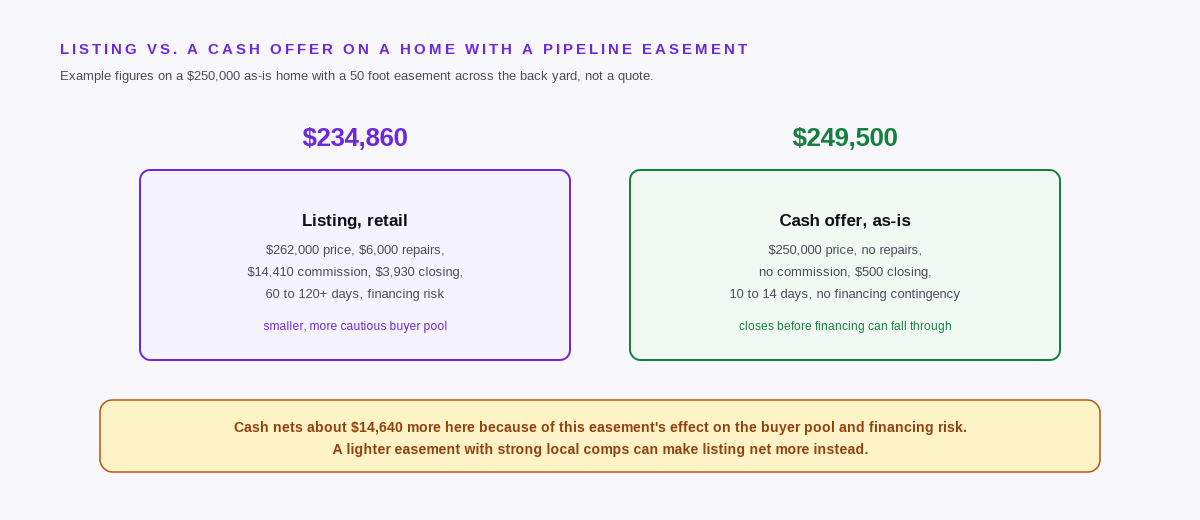
Cash nets more in this specific example, mainly because of what the easement does to the buyer pool and the timeline rather than because listing math is bad on its own. A smaller, financeable buyer pool means more days on market, more carrying cost, and real odds that a financed offer falls apart partway through underwriting, forcing a re-list.
That isn't true for every easement. If yours sits along a back fence line, doesn't touch any structure, and local comps show buyers routinely financing similar homes nearby, the gap between listing and a cash offer shrinks, and listing can net more once the higher sale price is counted. Run your own numbers with a local agent's net sheet against our cash offer vs. listing net proceeds guide before deciding, since every lot and every recorded easement is different.
Restar Acquisitions buys houses as-is for cash across 69 markets in 14 states, and we read the recorded easement before we give you a number, not after. You'll get a written offer within 24 hours, no repairs, no commissions, and you choose the closing date. If the math says listing nets you more, we'll tell you that too.
Alternatives worth checking before you decide:
We check the recorded easement, any payment agreement, and what's built near the right-of-way before we give you a number, not after a buyer's lender flags it mid-contract. You'll get a written offer within 24 hours, no repairs or commissions, and you pick the closing date.
If a financed retail sale would net you more once the easement is priced in, we'll tell you that instead of just making an offer.
All guides · Selling a house with a drainage or stormwater easement · Selling a house with a conservation easement · Cash offer vs. listing net proceeds
Step 1 of 5
No obligation, no fees, no repairs. We respond the same day.
You’ll talk to Trevor McAmis, Owner & Acquisitions Lead
(313) 710-6129
Takes about two minutes. Your address is never shared.