A nuisance abatement lien shows up when a city does work on your property, mowing, boarding up, demolishing, because you didn't, then bills you and attaches a lien for the cost. In many states that lien jumps ahead of your mortgage in priority. You can still sell, but the lien has to be paid or resolved at closing, and title companies will not skip past it.

Step 1 of 5
Tell us about the citation and the lien. We'll build it into a written offer instead of asking you to clear it first.
You’ll talk to Trevor McAmis, Owner & Acquisitions Lead
(313) 710-6129
Takes about two minutes. Your address is never shared.
Educational only. This explains how these situations generally work. It is not legal, tax or financial advice, and the rules differ by state. Talk to an attorney or CPA about your own situation before you act on any of it.
A nuisance abatement lien is different from the liens most sellers already know about. A mechanic's lien comes from an unpaid contractor. A judgment lien comes from a lawsuit. A nuisance abatement lien comes from your city government doing work on your property that code enforcement decided couldn't wait, then charging you for it.
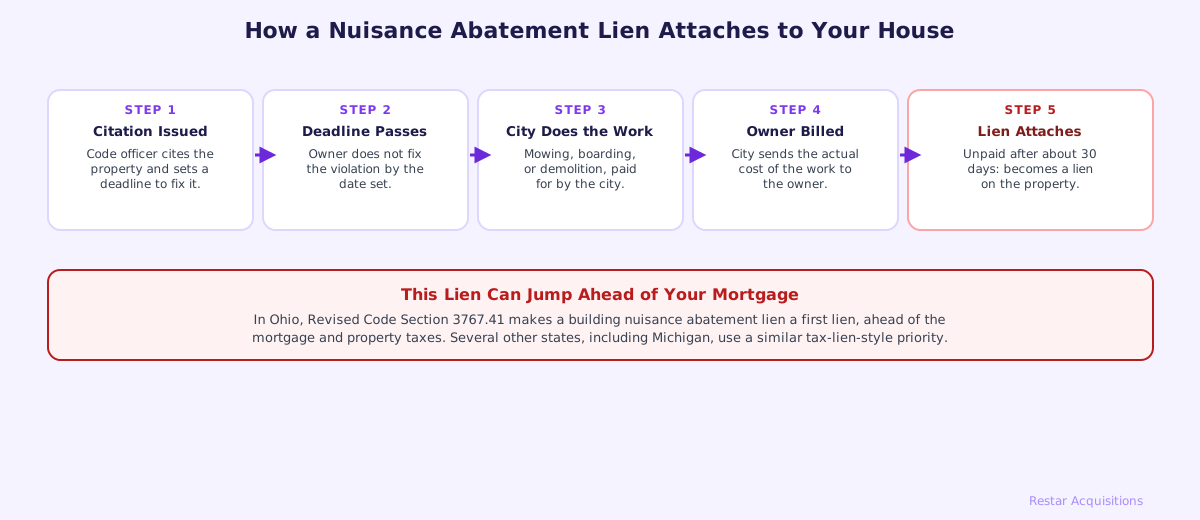
The pattern is consistent across the markets we buy in: a code officer cites the property (overgrown lot, open and dangerous structure, accumulated trash, a partially collapsed roof), gives the owner a deadline to fix it, and if nothing happens, the city or its contractor does the work itself, mowing, boarding, securing, or in the worst cases demolishing. The city then bills the owner for the actual cost of that work. If the bill goes unpaid, usually within 30 days of being sent, the city files a lien against the property for the amount.
This is the part that catches most sellers off guard: in several of the states we buy in, a nuisance abatement lien doesn't just sit behind the mortgage waiting its turn. Under Ohio Revised Code Section 3767.41, a lien created for abating a public nuisance building is a first lien on the property, with priority over every other lien or encumbrance, including the mortgage and property taxes. That version of the statute has been in effect since an October 2023 amendment, and it still gives the city only 30 days after certifying the cost before the lien is final and collectible. A related statute, Ohio Revised Code Section 715.261, lets the costs attach as a lien from the date the costs were incurred and be certified onto the property tax duplicate, where it's collected the same way delinquent taxes are.
Michigan municipalities, including Detroit under its property maintenance code, use a similar structure: emergency abatement or demolition costs become a special assessment lien, enforced the same way a tax lien is enforced, which again puts it ahead of a mortgage that would otherwise have first claim. Every state and even individual municipalities within a state set their own version of this, so the exact priority rule, interest rate, and payoff process in your city will differ from the next one over. Pull the actual lien payoff statement from your city's finance or code enforcement department before you assume anything about the balance or where it stands in line.
The amount is whatever the city or its contractor actually billed for the work, plus, in most jurisdictions, administrative fees and interest that keeps accruing until it's paid. A mowing or boarding citation might run a few hundred dollars. An emergency demolition can run tens of thousands. Because these liens are tied to the tax rolls in many cities, interest and penalties often compound the same way delinquent property tax does, which means a lien that sat unresolved for a year or two can be meaningfully larger than the original abatement bill.
Yes, but the lien has to be dealt with before or at closing, not after. A title company will find it during a title search, because it's recorded against the property, and will require it be paid off out of proceeds (or otherwise resolved) before insuring the new owner's title. If the lien is larger than the equity in the house, which happens more often than you'd expect on a neglected property, a retail sale can leave you writing a check at closing instead of walking away with money.
Example: a house in Toledo, Ohio is worth $140,000 fixed up and shown, but needs about $18,000 in repairs to pass a retail buyer's inspection. The city previously boarded and secured the property after a code violation went unaddressed and billed the owner $9,500, which became a first-priority lien under Ohio's abatement statute. The owner also owes $52,000 on the mortgage.
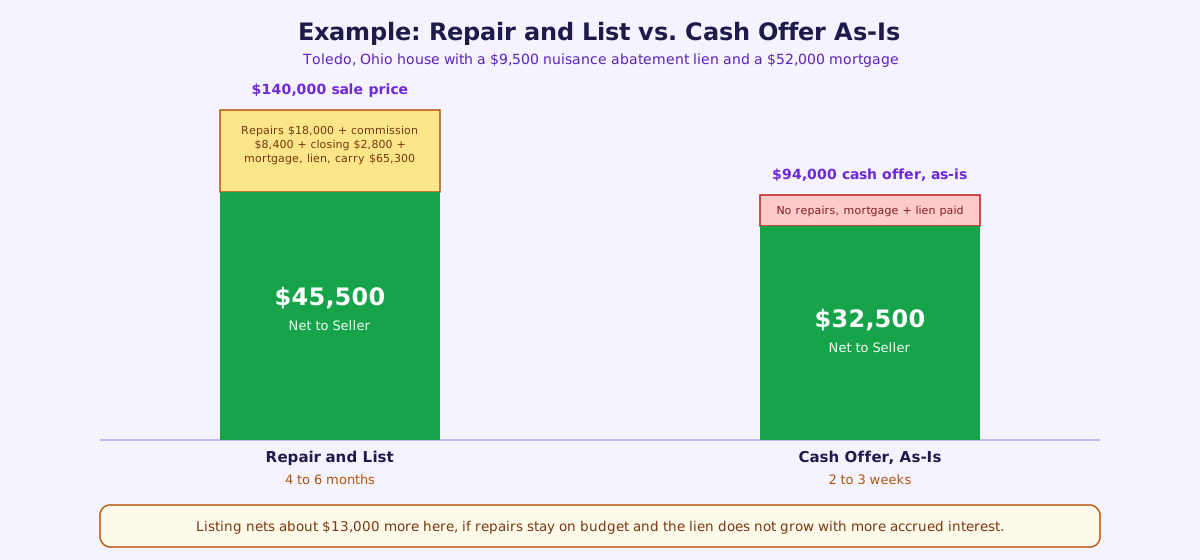
| Repair and List | Cash Offer, As-Is | |
|---|---|---|
| Sale price | $140,000 | $94,000 |
| Repairs | -$18,000 | $0 |
| Agent commission (6%) | -$8,400 | $0 |
| Closing costs (2%) | -$2,800 | $0 |
| Mortgage payoff | -$52,000 | -$52,000 |
| Nuisance abatement lien payoff | -$9,500 | -$9,500 |
| Carrying costs while repaired and listed (4 months) | -$3,800 | $0 |
| Net to seller | $45,500 | $32,500 |
| Timeline | 4 to 6 months | 2 to 3 weeks |
Listing nets roughly $13,000 more here if the repairs stay on budget and a buyer closes on schedule, which is a real possibility worth weighing, not a given. If the house needs more work than this estimate once a contractor is actually inside it, which is common on a property that sat neglected long enough to earn a city abatement bill, that gap narrows fast. A cash offer resolves the lien and the mortgage at a fixed price now, without betting on a repair budget holding.
Negotiate the lien amount directly with the city. Some municipalities will settle an abatement lien for less than the billed amount, especially if you pay promptly instead of letting interest accrue further. This varies entirely by city, so this is a local negotiation, not a legal right.
Make the repairs the citation actually required, if the underlying issue is fixable and affordable, which can sometimes get the lien reduced or released as part of compliance.
Check with a local housing attorney if you believe the lien amount is wrong or the city skipped required notice, since due process requirements for this kind of lien vary by state and are worth confirming before you pay a disputed amount.
Sell to a cash buyer who factors the lien into the offer, which lets you close without first negotiating the lien, making the repairs, or carrying the property through a listing. See our code violations situation guide for the earlier decision points, our guide on selling a house with code violations for the broader process, and our guide on vacant property registration if the citation is tied to a vacant-property ordinance. Send us the property and we'll factor the lien into a written offer.
We buy houses with a nuisance abatement lien on them, as-is, with a written offer in 24 hours. No repairs, no commissions, and you pick the closing date. We factor the lien and the mortgage into the offer instead of asking you to resolve either one first.
Send us the property here and we'll look at the lien and the numbers before you decide anything.
All guides · Code violations situation guide · Selling a house with code violations · Vacant property registration
Step 1 of 5
No obligation, no fees, no repairs. We respond the same day.
You’ll talk to Trevor McAmis, Owner & Acquisitions Lead
(313) 710-6129
Takes about two minutes. Your address is never shared.