<b>A MUD or PID tax doesn't follow you personally — it's tied to the property, and it transfers to your buyer at closing, the same way a mortgage payoff does.</b> What actually has to happen when selling a house in a MUD or PID is a specific written notice to the buyer before they sign a contract, and Texas law gives the buyer a real way out if you skip it: a 7-day right to cancel, for any reason, starting the day they actually receive it. Many sellers in newer Texas subdivisions — exactly the kind of exurban growth areas around Aubrey, Forney, Burleson, and Granbury where these districts are common — don't fully understand what their own MUD or PID tax is until it's time to sell and a title company starts asking questions. This guide covers what the two districts actually are, the exact notice the law requires, what happens to the debt when you sell, and the honest math on how it affects your net proceeds.
Step 1 of 5
Send the address and we'll tell you what the district actually costs and what a cash offer nets you after it.
You’ll talk to Trevor McAmis, Owner & Acquisitions Lead
(313) 710-6129
Takes about two minutes. Or call (313) 710-6129 — we answer.
Educational only. This explains how these situations generally work. It is not legal, tax or financial advice, and the rules differ by state — talk to an attorney or CPA about your own situation before you act on any of it.
Both are ways Texas lets developers build infrastructure — water, sewer, drainage, roads, sometimes parks — in unincorporated or newly-annexed land ahead of a city having the tax base to pay for it, by letting a special district issue bonds and repay them through charges on the homes built there. The two most common types a Texas seller runs into are not interchangeable.
A Municipal Utility District (MUD), created under Texas Water Code Chapter 49, is a true unit of local government with its own elected board. It issues bonds to build the water, sewer, and drainage systems, then levies an ad valorem property tax — a rate per $100 of assessed value, just like a school district or county — to repay that debt and fund operations. This tax shows up as its own line on your property tax statement, separate from the county and school district.
A Public Improvement District (PID), created under Local Government Code Chapter 372 (or Chapter 382 for certain counties), is not a government body — it's a financing mechanism a city or county creates inside its own boundaries. Instead of an ad valorem tax, a PID levies a fixed-dollar special assessment against each parcel, usually set at closing on the original new-construction purchase and paid down over a set term, often 20–30 years. Some PID assessments can be prepaid in a lump sum; many can't be, by the district's own terms.
A single property can sit inside both a MUD and a PID at once — common in larger master-planned developments — in which case both notices below apply, and both obligations transfer to your buyer.
This is the part that creates real closing risk if it's missed, and it's worth understanding precisely rather than assuming your title company will catch everything.
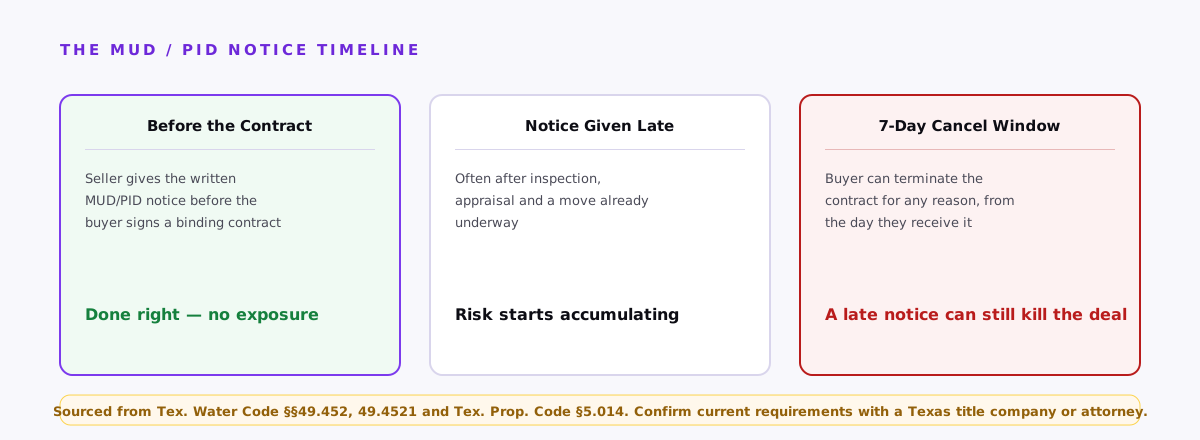
MUD notice — Texas Water Code §§ 49.452 and 49.4521. If the property is in a district governed by Water Code Chapter 49, the seller must give the buyer a specific, statutorily-worded notice disclosing the district, before the buyer signs a binding contract.
PID notice — Texas Property Code § 5.014. If the property is in a PID created under Local Government Code Chapter 372 Subchapter A or Chapter 382, a separate written notice is required, again before a binding contract is signed, either as a standalone document or as an addendum to the contract. The Texas Real Estate Commission maintains a standard PID notice addendum built for exactly this purpose.
The consequence of getting the timing wrong is specific and real: under both statutes, if the required notice isn't given before the contract is signed, the buyer gets the right to terminate the contract for any reason — not just because of the district — for seven days after they actually receive the notice. House Bill 1543, passed by the 87th Texas Legislature and effective September 1, 2021, is what added this specific protection to Property Code § 5.014: buyers get 7 days to cancel if the PID notice shows up late. A late notice doesn't retroactively fix anything; it just starts that 7-day clock, often after the buyer has already done inspections, ordered an appraisal, or started moving. That's a deal that can die in week six over a disclosure that should have taken five minutes in week one.
Your HOA (if any) or the district itself can usually confirm your district's name and governing statute, and your title company will typically pull this as part of a standard Texas title search — but the legal obligation to disclose is the seller's, not the title company's, so confirm it's actually been given rather than assuming it has.
Neither obligation is personal debt you carry with you — both run with the land, meaning your buyer takes over the payments the moment they take title, the same way a new owner inherits a school-district tax rate. That has two practical effects at closing:
MUD tax gets prorated between seller and buyer for the current year at closing, exactly like county and school taxes — you pay your share of the year up to the closing date, the buyer picks up the rest. There is nothing to pay off; the rate simply continues under new ownership.
PID assessment is different because it's structured as a long-term, parcel-specific installment debt rather than an annual tax. Some sellers can prepay the remaining balance at closing to deliver the property assessment-free; in many districts, by the terms set when the assessment was created, that's not an option, and the assessment simply continues against the property under the new owner. Check your specific district's assessment terms — usually available from the city or county that created the PID — before assuming either way.
What this means in practice: a MUD tax rate is disclosed and prorated, not something a seller writes a check to eliminate. A PID assessment may or may not be payable off, and that answer changes your net proceeds math directly if it is.
MUD rates vary enormously by how new the district is and how much bond debt it's still repaying — this is the single biggest driver, and it moves in one direction over time.
PID assessments are typically set as a fixed total per lot at the original new-home sale (sometimes tens of thousands of dollars amortized over 20–30 years), billed either as a lump annual charge on the tax statement or as part of the mortgage escrow. The remaining balance and payoff (if prepayment is allowed) is specific to the parcel and the district — there's no single typical number, which is exactly why it has to be looked up rather than assumed.
Neither a MUD rate nor a PID assessment is, by itself, a reason a house won't sell — most homes in Texas's fastest-growing exurbs carry one or both. The risk isn't the cost; it's an undisclosed cost that surfaces during underwriting and either re-trades the deal or kills it in the financing window.
A financed buyer's lender factors the full MUD tax rate and any PID assessment into the buyer's debt-to-income calculation — a high combined rate can push a marginal buyer's approval the wrong way late in underwriting, which is exactly when a deal falls through most expensively: after repairs, after an appraisal, after the seller has often already moved. A cash buyer isn't qualifying for a mortgage, so a high district rate that would spook a lender doesn't kill the deal the same way.
Here's what that looks like on a $310,000 home in a newer MUD/PID district with a combined $1.10/$100 rate (about $3,410/year) and $9,000 in deferred repairs:
| Retail listing | Cash sale | |
|---|---|---|
| List / offer price | $310,000 | $278,000 |
| Repairs before listing | −$9,000 | $0 (sold as-is) |
| Agent commission (~5.5%) | −$17,050 | $0 |
| Seller closing costs | −$3,800 | −$1,400 |
| Carrying costs while marketing (3–4 months) | −$4,200 | $0 |
| Financing/DTI risk from the district rate | Real risk of a late-stage fall-through | Not a factor |
| Net to seller | ~$275,950, in 3–4+ months, if financing holds | ~$276,600, in 1–2 weeks, with certainty |
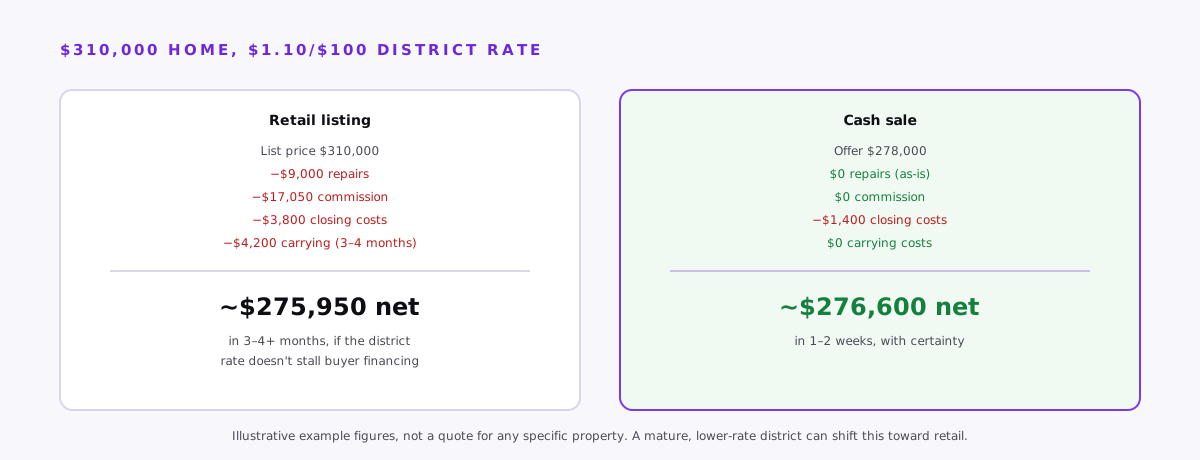
These numbers land close together on purpose — the real difference in this example is timeline and the risk that a lender balks at the combined tax burden late in the process, not a guaranteed dollar gap. A home with a mature, low-rate district and no repairs needed will often net meaningfully more by listing. Run your own numbers — see our breakdown of seller closing costs for what else factors into that math — before assuming either path wins.
Restar Acquisitions buys houses as-is for cash in 29 markets across 10 states, including the Texas MUD and PID corridors around Aubrey, Burleson, Forney, and Granbury, and we check the district's rate and assessment status before we give you a number, not after. We give a written offer within 24 hours, no repairs or commissions, and you pick the closing date. We're a direct buyer, not your real estate agent, and we don't represent you in the transaction.
Alternatives worth checking before you decide:
This article is for general education only and isn't legal or tax advice. MUD and PID rules, rates, and assessment terms vary by district and change over time. Confirm your property's specific district, rate, and notice requirements with the district, your title company, or a Texas real estate attorney before you sign a contract.
We underwrite MUD and PID obligations the same way we underwrite any lien — before we give you a number, not after. You'll get a written offer within 24 hours, and the district's paperwork won't be the thing that stalls your closing.
All guides · Cost of an HOA resale certificate and transfer fees · Seller closing costs · We buy houses in Texas
Step 1 of 5
No obligation, no fees, no repairs. We respond the same day.
You’ll talk to Trevor McAmis, Owner & Acquisitions Lead
(313) 710-6129
Takes about two minutes. Or call (313) 710-6129 — we answer.