Every market page publishes the numbers behind its offer. See the math
Home › Guides › Selling a House With a Lis Pendens Filed Against It
Guide
Selling a House With a Lis Pendens Filed Against It
Selling a house with a lis pendens attached to it is the rare case where our honest advice is to slow down. A lis pendens is not a lien and it does not take your house away. It is a recorded notice that somebody has sued over the property, and its practical effect is narrow and brutal: title companies will not insure around it, so a financed buyer cannot close. Almost every seller in this position is told to dump the house at a discount to somebody who will take the risk. On the worked example below that route costs $51,870 against simply resolving the thing first.
Takes about two minutes. Or call
(313) 710-6129 — we answer.
Educational only. This explains how these situations generally work. It is not legal, tax or financial advice, and the rules differ by state — talk to an attorney or CPA about your own situation before you act on any of it.
Selling a house with a lis pendens: the short answer
A lis pendens does not stop you selling a house, but it stops almost every buyer from closing. It is a recorded notice that a lawsuit affecting the property is pending, and title companies will not insure over it, so financed buyers cannot fund.
This is general educational information, not legal advice. A lis pendens is a live piece of litigation, procedures differ substantially between states, and the right move depends on facts a page cannot know. Talk to a real estate litigation attorney in your state before you do anything here.
What a lis pendens actually is
The Latin means pending suit, and the document is exactly what the name says: a notice, recorded in the county land records, that litigation touching this specific property is underway.
Michigan's statute is a clean example of the form. Under MCL 600.2701, a plaintiff files a notice with the register of deeds in the county where the land sits, containing the title of the cause, the general object of the action, and a description of the lands to be affected. Once recorded, it gives constructive notice to everyone who comes afterwards. A later buyer is legally treated as knowing about the lawsuit whether or not they actually did.
That statute also carries a detail worth knowing: the notice may be filed before the summons is served, but personal or substituted service must happen within 60 days of filing, or publication must begin or out-of-state service be completed in that window. A lis pendens recorded and then left unserved is vulnerable, and that is sometimes the fastest route to getting one off.
Three things a lis pendens is not. It is not a lien, so nobody is owed money because of it. It is not an injunction, so you are not barred from selling. And it is not a judgment, so nothing has been decided.
Why it blocks the sale even though it is not a lien
The obstacle in selling a house with a lis pendens on it is commercial, not legal, which is why it catches people out.
A buyer with a mortgage needs a lender's title insurance policy. The title underwriter, looking at a recorded notice that someone is litigating over this exact parcel, will not insure that risk — it will take exception to it, which means the policy expressly does not cover the thing most likely to go wrong. No lender accepts that exception. So the loan does not fund.
The result is that a lis pendens quietly removes the entire financed buyer market, which in most neighbourhoods is the great majority of buyers. It leaves cash buyers, and a cash buyer with any judgment is not enthusiastic either, because whatever the plaintiff wins could run with the land. The people who will buy through a lis pendens are the ones who price the litigation risk, and they price it hard.
This is the difference between a lis pendens and an ordinary lien on the property. A lien has a number on it, and a number can be paid off at closing from the proceeds. A lawsuit has no number until it ends.
Who files them, and what each one usually means
The identity of the plaintiff tells you most of what you need to know about how long this will take.
Filed by
Typical claim
What usually clears it
Mortgage lender
Judicial foreclosure
Reinstatement, payoff, modification, or the case concluding
A spouse
Marital interest in the property during divorce
The decree, or a stipulation letting the sale proceed with proceeds escrowed
A co-heir or co-owner
Partition, or a challenge to the estate
Agreement among the owners, or the partition action concluding
A contractor
Suit to enforce or foreclose a construction lien
Payment, bonding off where the state allows it, or settlement
An HOA
Assessment foreclosure
Paying the assessments and costs
A previous buyer
Specific performance, claiming you breached their contract
The last two are the ones sellers do not see coming. A buyer whose contract you terminated can record a notice claiming a right to force the sale, and that alone can freeze a property for months while you argue about whether the termination was proper. If you are mid-divorce, our guide on selling a house during divorce covers the escrowed-proceeds approach that often lets a sale close before the case does. Where the dispute is among heirs, when heirs cannot agree to sell covers partition.
The five ways a lis pendens comes off
1. The case ends. Dismissal, settlement or judgment, followed by a recorded discharge or release. This is the clean route and it is the one that restores full value.
2. The plaintiff withdraws it. Usually because you paid or settled the underlying claim. Get the withdrawal recorded; an agreement to withdraw is not a withdrawal, and the title company reads the land records, not your emails.
3. The court discharges or expunges it. Where the lawsuit does not genuinely affect title, or the claim is not properly founded, courts will remove the notice. Florida is explicit about the mechanism: under Fla. Stat. 48.23(3), the court shall control and discharge the recorded notice of lis pendens as the court would grant and dissolve injunctions. Some states also let the court require a bond as a condition of leaving it in place.
4. It expires. This is real, but it is narrower than it sounds and the scope is where people go wrong. Florida's section 48.23(2) provides that a notice is not effectual for any purpose beyond 1 year from the commencement of the action, unless the relief sought is founded on a duly recorded instrument or on a construction lien. That exception swallows most mortgage foreclosures and most contractor suits, so do not assume a one-year clock is running on yours. In New York, CPLR 6513 gives a notice of pendency three years, with the court able to grant an extension for good cause on motion before it expires.
5. Service failed. As above, some states impose a service deadline on the plaintiff after filing. Where it is missed, the notice is exposed.
Routes 3 and 5 are attorney work and cost money. They are also frequently the cheapest thing in this entire situation, which the arithmetic below makes obvious.
The honest comparison: resolve it, or sell into it
Here is the case that comes to us most often. A $240,000 house, needing about $9,000 of cosmetic work. A contractor has sued over $14,000 of disputed unpaid work and recorded a lis pendens. Carrying costs are $1,050 a month. Counsel's estimate is roughly six months to resolve, at about $6,500 in fees.
Line
Resolve, then list
Settle now, cash sale
Sell into the lis pendens
Price
$240,000
$189,000
$148,000
Settle the claim
—
−$14,000
—
Legal fees
−$6,500
−$3,000
—
Repairs
−$9,000
—
—
Commission at 5%
−$12,000
—
—
Seller settlement costs
−$2,880
—
—
Carrying costs
−$8,400 (8 mo)
−$2,100 (2 mo)
−$1,050 (1 mo)
Buyer concession
−$2,400
—
—
Net to you
$198,820
$169,900
$146,950
What each route leaves after costsRestar Acquisitions · worked example from this page
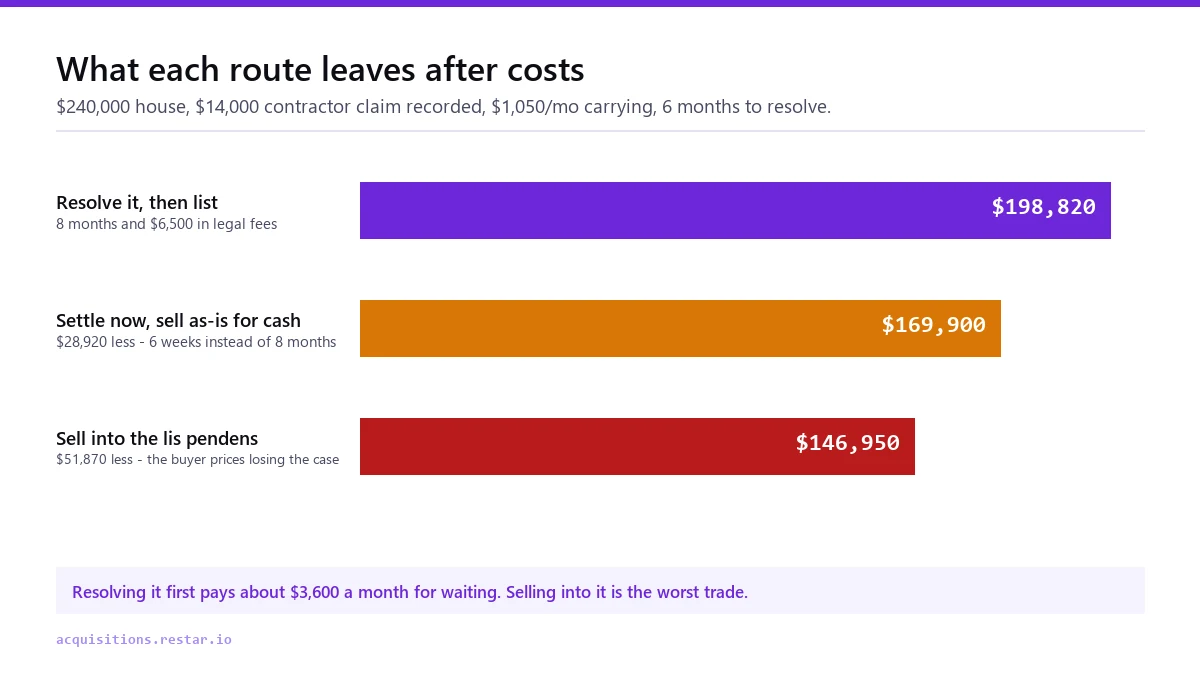
Resolving the lis pendens first nets $28,920 more than selling to us, and $51,870 more than selling into it. Eight months of patience and $6,500 of legal fees is, on these numbers, the best-paid work available to you — roughly $3,600 a month for waiting.
We are a cash buyer telling you not to sell to a cash buyer yet. That is not modesty, it is what the arithmetic says. A lis pendens is a temporary defect on an otherwise saleable house, and temporary defects should be fixed, not sold at a permanent discount. Clear the notice, then list it with an agent like any other house.
The third column is the one to be genuinely careful about. An operator offering to buy a house with an active lis pendens on it is pricing in the possibility of losing the litigation outright. That is why the number is so low, and it is why we do not usually make that offer.
When selling before it resolves is the right call
The arithmetic above flips in a few real situations, and they are worth naming plainly.
When the carrying cost outruns the gap. Eight months at $1,050 is $8,400. Eight months on a vacant house with two mortgages, high taxes and lapsing insurance can be three times that, and our guide to holding costs of a vacant house shows how fast that compounds.
When the lis pendens rides on a foreclosure with a sale date. Then the clock that matters is the auction, not the lawsuit. Our foreclosure page covers that timeline; the payoff at closing can dissolve the case, which is a different route entirely from litigating it.
When the underlying claim is small and you can just pay it. A $14,000 contractor claim settled and recorded as withdrawn is not litigation, it is a bill. Pay it, record the withdrawal, then decide about selling with a clean title.
When you cannot fund the legal fees. Route one assumes $6,500 you can spend before you get paid. If you do not have it, that column is not a route you have, and comparing against it is academic.
In every other case the conclusion is the same, and it is worth stating plainly: get the notice off first, then sell the house on the open market like anyone else would. Alternatives worth weighing before you sell at a discount include a payment plan or settlement with the plaintiff, renting the house out while the case runs, or a family sale once title is clear.
Common questions
Can you sell a house with a lis pendens on it?
Legally, yes. Selling a house with a lis pendens attached is not prohibited, but it almost never happens at a normal price. The notice does not bar a sale, but title underwriters take exception to it, lenders will not accept that exception, and so the financed buyer market disappears. What is left are cash buyers pricing the litigation risk, which is why offers into an active lis pendens come in so low.
Is a lis pendens the same as a lien?
No. A lien is a recorded claim for a specific amount of money, and it can be paid off at closing out of the proceeds. A lis pendens is notice of a pending lawsuit with no amount attached, and it cannot be paid off because nothing has been decided yet. That is precisely why it is harder to clear than a lien.
How long does a lis pendens last?
It depends on the state and the claim. In New York, CPLR 6513 gives a notice of pendency three years, extendable by the court for good cause on a motion made before it expires. In Florida, section 48.23(2) caps it at one year from commencement of the action, but only where the relief sought is not founded on a duly recorded instrument or a construction lien, which exempts most foreclosures and contractor suits.
How do I get a lis pendens removed?
Five routes: the case concludes and a discharge is recorded; the plaintiff voluntarily withdraws it, usually after settlement; the court discharges or expunges it, which Florida handles the way it would dissolve an injunction; the notice expires where a statutory limit applies; or the plaintiff missed a service deadline, which some states impose after filing. The last three are attorney work.
Will a cash buyer purchase a house with a lis pendens?
Some will, at a steep discount, because they are pricing the risk of losing the lawsuit. In the worked example on this page that route nets $146,950 against $198,820 for resolving the notice and then listing normally, a difference of $51,870. It is usually the worst available outcome and should be a last resort.
Does a lis pendens affect the title insurance?
Yes, and this is the mechanism that actually blocks the deal. The title underwriter will take an exception for the pending litigation, meaning the policy does not cover the risk that the plaintiff wins. No mortgage lender will accept a policy with that exception, so the buyer's loan cannot fund.
Send us the address and what you know about the filing. Within 24 hours we will tell you what we would pay as-is — and, as on this page, whether the numbers say you should clear the notice first and list it instead. We would rather tell you to wait than buy a house you should have kept another six months.
Every offer on this site is underwritten by a person, not a form. If the
numbers do not work for you, say so and I will tell you what would.
Also from Restar
Want the data behind all of this?
Restar Acquisitions is the acquisitions arm of Restar — a housing-market analytics
platform tracking 180+ metrics across every U.S. market, with composite scores and 12-month
price forecasts. The numbers on this page come from the same work.