Yes — you can sell a house with a lead water service line. There's no federal or, in most states, state law requiring you to disclose it or replace it before a sale, though that's changing fast under a new EPA rule. A cash buyer can move forward regardless; a seller who replaces the line first (often $2,500–$12,000+) and lists retail usually nets more, but has to front real money and wait on a utility-side permit and schedule. A lead service line is the underground pipe that carries water from the main in the street into your house — different from the interior plumbing, and different from lead paint. It's a genuinely common issue in older housing stock, and it's gotten more attention in the last two years because the EPA finalized a rule requiring most U.S. water utilities to replace essentially all of them within a decade. If your house is in an older neighborhood in one of our Rust Belt or Mid-Atlantic markets — Detroit, Flint, Toledo, Cleveland, Baltimore, and similar cities all have real numbers of lead lines still in the ground — this is worth understanding before you list. This guide covers what the new federal rule actually requires, how to find out if your line is lead, what you do and don't have to disclose, what replacement costs, and the honest math on replacing first versus selling as-is.

Step 1 of 5
Send the address and we'll tell you honestly whether replacing the line first and listing retail would net you more.
You’ll talk to Trevor McAmis, Owner & Acquisitions Lead
(313) 710-6129
Takes about two minutes. Or call (313) 710-6129 — we answer.
Educational only. This explains how these situations generally work. It is not legal, tax or financial advice, and the rules differ by state — talk to an attorney or CPA about your own situation before you act on any of it.
The EPA finalized the Lead and Copper Rule Improvements on October 8, 2024. The core requirement, in the agency's own words: “For the first time, the vast majority of water systems will be required to replace lead service lines within 10 years” (EPA: Final Rule Requiring Replacement of Lead Pipes). The rule also covers “galvanized requiring replacement” lines — galvanized steel pipe that sits downstream of a lead line and can keep shedding lead particles into the water even after the lead pipe itself is gone.
The clock isn't running from the announcement date. Water systems have until November 1, 2027 to finish an updated baseline inventory and replacement plan, and the 10-year replacement window is measured from there — which is why most secondary reporting on the rule cites a practical full-replacement deadline around 2037. Systems with an unusually high proportion of lead lines can get more time unless their state says otherwise; systems with fewer lines don't get to slow-walk it.
This is a requirement on the water utility, not directly on you as a homeowner — the utility replaces the public and, in most programs, the private-side portion of the line, sometimes at no cost to the homeowner and sometimes with a homeowner contribution, depending on the specific city's program. It does mean your line is far more likely to get addressed in the next several years than it would have been a decade ago, whether or not you sell first.
As part of the same regulatory push, every public water system had to complete and publicly post an initial service line material inventory by October 16, 2024, classifying every service line as lead, “galvanized requiring replacement,” non-lead, or unknown (EPA: Revised Lead and Copper Rule). Several of our own markets have public, address-level lookup tools you can check before you list:
If your city isn't one of these three, check your local water utility's website directly — most utilities serving mid-size and larger cities now have some version of this inventory online, and if not, they're required to be able to tell you your line's classification on request.
This is where it's easy to get bad information, so it's worth being precise. The federal Lead-Based Paint disclosure rule (Title X) only covers paint in homes built before 1978 — it does not mention water service lines at all, and it's not the rule that applies here.
Some online guidance claims Michigan's seller disclosure form specifically asks about lead service lines. It doesn't. The actual form, under Michigan's Seller Disclosure Act, asks a general plumbing-system question — “Type: copper, galvanized, other” — about the interior plumbing system, and the word “lead” doesn't appear on that line. What Michigan does require is a notification obligation on the water utility's side: under the state's Lead and Copper Rule, a water supplier has to notify a property's owner or occupant if its records show the service line is lead, galvanized requiring replacement, or of unknown material, and keep notifying until it's replaced or confirmed to be something else. That's a utility-to-resident notice, not a seller-to-buyer disclosure requirement.
Michigan and Ohio, checked directly against their actual disclosure statutes and forms, have no such requirement as of this writing — the obligation runs from the utility to the resident, not from the seller to the buyer. We have not individually confirmed the same for every one of our other markets, and this is a fast-moving area given the new federal replacement mandate, so don't assume either way — confirm the current status in your specific state with a real estate attorney before you sign a disclosure form.
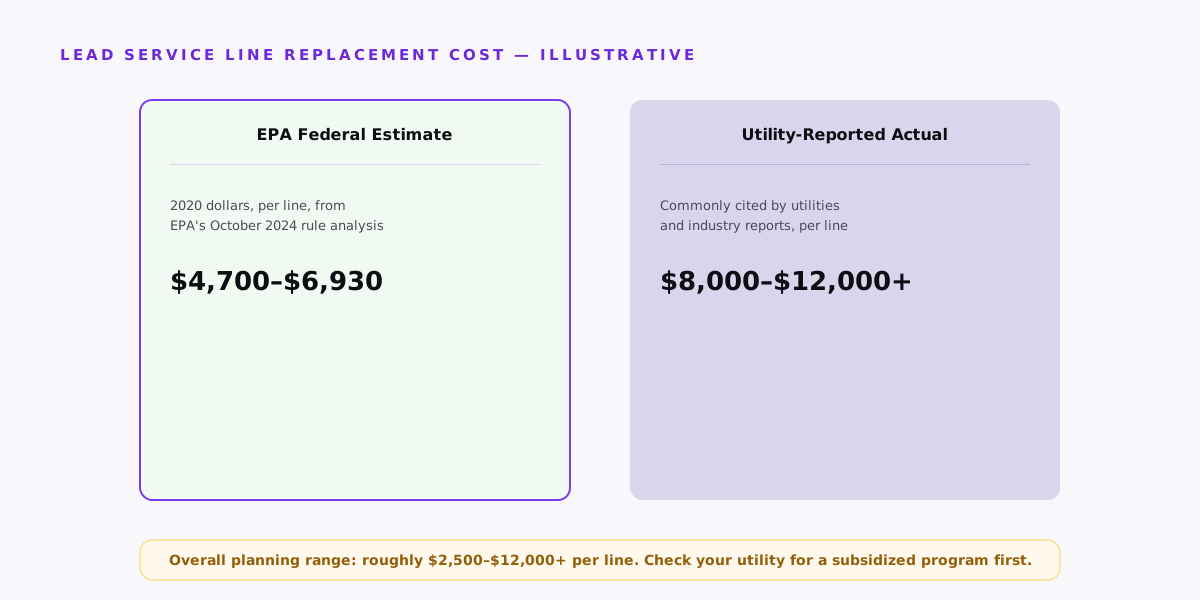
Cost estimates vary depending on whether you're looking at a federal-level average or what utilities actually report spending. In its October 2024 economic analysis for the new rule, the EPA estimated full lead service line replacement at roughly $4,700–$6,930 per line in 2020 dollars. Utility-reported and industry figures tend to run higher — commonly $8,000–$12,000 or more per line, depending on the city, depth of the line, and whether it runs under a driveway or street that needs to be cut and repaved. A reasonable range to plan around is $2,500–$12,000+ per line, with the wide spread driven mostly by local labor costs and how disruptive the dig is.
If your city has an active utility-funded or subsidized replacement program, your actual out-of-pocket cost could be far lower than these figures — check with your local water department before assuming you'd pay the full amount yourself. Flint's decade-long replacement effort finished in July 2026, having replaced lead lines in roughly 11,600 homes out of about 32,000 properties inspected, at no direct cost to residents while the program was running — worth knowing if your house happens to be there, though going forward any new lead-line work in Flint falls to the property owner now that the program has concluded.
The reason any of this gets regulatory attention traces back to a single, well-established public health position. The CDC states it plainly: “There are no safe levels of lead in the blood” (CDC: About Childhood Lead Poisoning Prevention). Lead exposure is cumulative and disproportionately harms children's developing nervous systems, which is the reason behind both the aggressive federal replacement timeline and the growing buyer awareness that makes this worth addressing before a sale rather than after.
FHA's minimum property standards require a safe, potable water supply free of health hazards, but there's no lead-service-line-specific clause in HUD's guidance — the standard is general, not material-specific, so whether a known lead line becomes a financing issue depends on whether an appraiser or inspector flags it as a health-and-safety concern on your specific file, which is inconsistent and largely at the appraiser's discretion. That inconsistency is itself part of the problem for a seller: you can't predict in advance whether a lender will require it be addressed, which makes a financed sale on a known-lead-line house harder to plan around than a cash sale, where that appraisal-driven requirement doesn't apply.
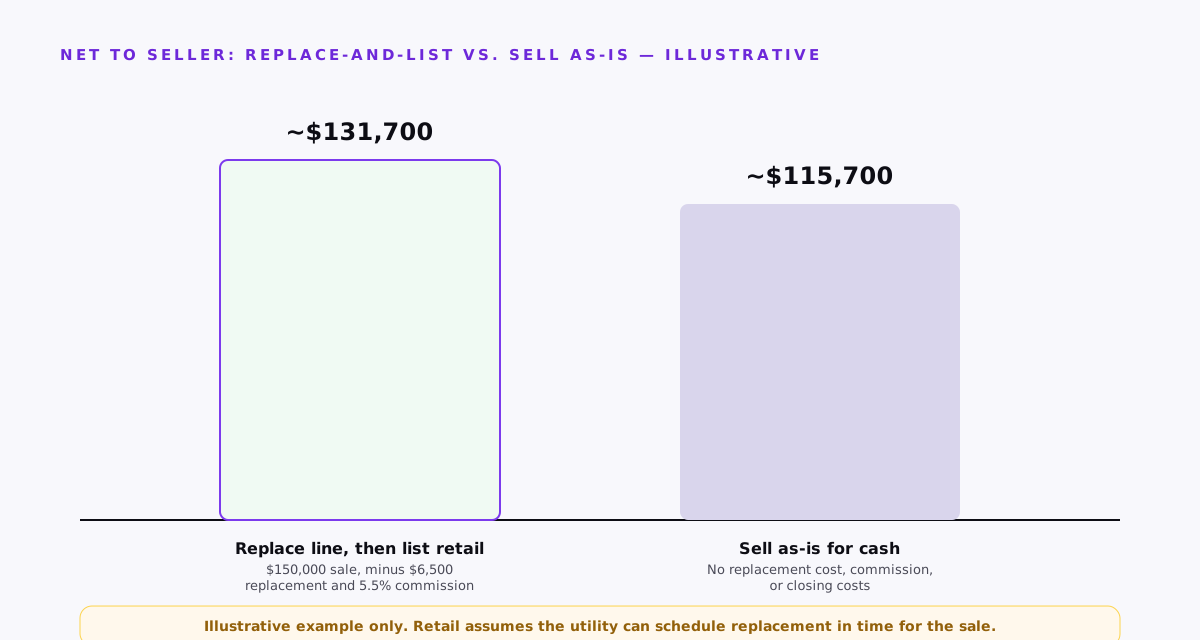
These numbers are illustrative only, built around a hypothetical $150,000 house in an older Midwest market with a confirmed lead service line needing replacement, not a quote for your property.
| Replace Line, Then List Retail | Sell As-Is for Cash | |
|---|---|---|
| Sale price | $150,000 | — |
| Replacement cost before sale | ~$6,500, paid up front | $0 — buyer takes on the line |
| Commission | ~$8,250 (5.5%) | None |
| Closing costs | ~$2,250 (1.5%) | $0 — we cover standard closing costs |
| Holding costs while awaiting utility scheduling | ~$1,300 (about a month) | — |
| Timeline risk | Utility permitting and scheduling, not fully in your control | No utility-side dependency for the sale itself |
| Time before you have cash | Weeks to months waiting on utility scheduling, then a listing period | Days to a few weeks |
| Illustrative net proceeds | ~$131,700 | ~$115,700 |
On this hypothetical house, replacing the line first and listing retail nets roughly $16,000 more than an as-is cash sale. That gap is real, but notice what's different about this repair compared to most others on this site: you don't fully control the timeline. A foundation repair or a repipe is scheduled with a private contractor on your own calendar; a lead service line replacement usually has to go through your water utility's permitting and work-order process, which can take months depending on the city's backlog — even if you have the cash ready on day one. Our how cash home buyers calculate offers guide covers how that kind of condition issue factors into a cash figure. If your sale has a deadline that a utility's schedule can't meet, that's a legitimate reason to sell as-is rather than wait — our selling a house in Michigan guide covers more state-specific process notes if your property is there.
Replacement and cash sale aren't the only two paths.
Check your city's inventory and replacement program first. Before assuming you'll pay full replacement cost out of pocket, find out whether your utility has an active subsidized or no-cost replacement program — this varies enormously by city and changes as programs launch and close.
Replace the line, then list retail. If the utility can schedule it in time and you have the cash, a confirmed non-lead line removes the issue entirely and puts the house on equal footing with a comparable property.
Disclose what you know and let the buyer decide. Even without a specific disclosure mandate in most states, telling a retail buyer what your utility's inventory shows is the straightforward, defensible approach, and some buyers won't mind at a fair price.
Sell as-is to a cash buyer. If the utility's timeline doesn't work for your sale, or you don't want to front the replacement cost, an as-is sale hands the issue to a buyer who isn't waiting on a mortgage appraiser's judgment call.
Restar Acquisitions buys houses directly, as-is, for cash, in 45 markets across Alabama, Arizona, Florida, Georgia, Indiana, Maryland, Michigan, Missouri, New York, North Carolina, Ohio, and Texas — including several older cities, like Detroit, Flint, Toledo, and Cleveland, where lead service lines are a real and common issue. If your property is in one of those markets, we can typically give a written offer within 24 hours, and a known or suspected lead line doesn't take you out of consideration, because we're not waiting on a mortgage appraiser's health-and-safety judgment call the way a financed buyer's lender might be.
We are not real estate agents, brokers, plumbers, or environmental consultants, and we do not represent you as a seller — we're a direct buyer, and our interests in a transaction are our own, not yours. As the comparison above shows, replacing the line first and selling retail usually nets more, if the utility's timeline and your cash allow for it. If that's the better fit for your situation, we'll say so.
This article is for general educational purposes only and is not legal, environmental, or financial advice. Lead service line regulations, local utility programs, and disclosure practices are changing quickly and vary by city and state. Check your water utility's current inventory and program status, and talk to a real estate attorney about your specific disclosure obligations, before making a decision.
We'll give you a written offer within 24 hours and can work with a known or suspected lead service line that would typically complicate a financed retail sale — and if replacing it first and listing nets you more, we'll say so.
All guides · How cash home buyers calculate offers · Selling a house in Michigan · Cash offer vs listing net proceeds
Step 1 of 5
No obligation, no fees, no repairs. We respond the same day.
You’ll talk to Trevor McAmis, Owner & Acquisitions Lead
(313) 710-6129
Takes about two minutes. Or call (313) 710-6129 — we answer.
