Yes, you can sell a house with a home equity investment agreement in place. The company that gave you the lump sum is generally paid out of your sale proceeds, based on a formula tied to your home's value at the time you sell — not simply the amount you originally received. Get a payoff estimate early, because that number can be larger, and slower to obtain, than most sellers expect. A home equity investment agreement doesn't feel like a mortgage, and that's partly the point — it was probably marketed to you as something different: no monthly payments, no interest rate, cash today in exchange for a slice of your home's future. That pitch is accurate as far as it goes. What it tends to leave out is what happens at the other end, when you sell or the contract term runs out and the company wants its share back. That's usually where confusion — and sometimes an unpleasant surprise — shows up. This guide walks through what a home equity investment (HEI) agreement actually is, how the payoff is calculated when you sell, why it isn't a traditional recorded lien but still has to be cleared at closing much like one, how it compares to a HELOC or second mortgage, and what your options are if the payoff is eating more of your equity than you planned for.

Step 1 of 5
Send the address and we'll show you both paths — cash and listing — net of your estimated home equity investment payoff.
You’ll talk to Trevor McAmis, Owner & Acquisitions Lead
(313) 710-6129
Takes about two minutes. Or call (313) 710-6129 — we answer.
Educational only. This explains how these situations generally work. It is not legal, tax or financial advice, and the rules differ by state — talk to an attorney or CPA about your own situation before you act on any of it.
A home equity investment — sometimes called a home equity sharing agreement, or marketed under a company's own product name — is a contract, not a loan. An investment company gives you a lump sum of cash today. In exchange, you agree that when the contract ends — usually at sale, refinance, or a set term of somewhere between 10 and 30 years — you'll pay the company back based on a formula tied to your home's value at that time, not a fixed repayment schedule.
For a closer look at how a HELOC or second mortgage payoff works when you sell, see our guide on the cost of a HELOC or second mortgage when you sell — this article focuses specifically on equity-sharing agreements, which work differently.
The Consumer Financial Protection Bureau has reviewed these products directly and describes the basic mechanic this way: the homeowner gets an upfront payment, and in exchange must make a single lump-sum repayment in the future that is based, in part, on the home's value (CFPB: Issue Spotlight on Home Equity Contracts). Companies in this space often market the product as having “no interest” and “no monthly payments” — which is true in the narrow sense that you're not making payments and there's no stated interest rate. It is not, however, free money. The cost shows up later, in the size of the repayment, and it can be substantial.
When you sell — or when the contract term ends for any other reason — the HEI company is generally entitled to a share of your home's value at that point, calculated according to whatever formula is in your specific contract. Common structures include a straight percentage of the home's appraised or sale value, sometimes with a minimum guaranteed return to the company built in even if your home didn't gain much value, and sometimes with a cap limiting how much the company can collect even if your home's value jumped. Some contracts also include an “option period,” during which the company can require an independent appraisal before you're allowed to sell or refinance, which takes time to schedule and complete.
Because the payoff is calculated from your home's value rather than from a fixed loan balance, it moves with the market. If your home appreciated significantly since you signed the agreement, you can end up owing meaningfully more than the amount you originally received — sometimes several multiples of it, depending on how much time has passed and how much the home gained in value. The CFPB has documented that the effective cost of these contracts can run well above what a typical home equity loan or HELOC would have cost over the same period, particularly in the early years of a contract, and it has received consumer complaints describing surprise at how large the final repayment turned out to be (CFPB: Issue Spotlight on Home Equity Contracts). That's a genuinely different risk profile than a fixed-rate loan, and it's worth understanding well before you're under contract to sell.
A home equity investment agreement usually isn't recorded as a mortgage or deed of trust the way a purchase loan or a HELOC is. Instead, most HEI companies record some form of memorandum or notice of agreement in the county land records to put future buyers and lenders on notice of their interest, without it functioning as a traditional secured lien with a fixed payoff balance.
In practice, that distinction matters less at the closing table than you might expect. A title company handling your sale will typically require a written payoff statement or demand from the HEI company, just as it would for a mortgage payoff, and will need a recorded release or satisfaction once the company is paid before it can issue clean title to your buyer. If your contract has an appraisal or option-period requirement, that step needs to happen with enough lead time to avoid delaying your closing date — which is exactly why getting a payoff estimate early, before you're deep into a sale, is worth doing rather than skipping.
Homeowners often reach for a HELOC, a second mortgage, or a home equity investment agreement to solve a similar problem — accessing cash without selling — but the two paths work very differently at exit, and the difference matters most when your home has gained value.
| HELOC / Second Mortgage | Home Equity Investment Agreement | |
|---|---|---|
| What it is | A loan secured by a recorded lien on your house | A contract for a share of your home's future value |
| Monthly payments | Yes — principal and/or interest, on a set schedule | Typically none during the term |
| What you owe at payoff | Remaining principal, plus accrued interest and fees | An agreed share of your home's appraised or sale value at exit, sometimes with a minimum return or a cap |
| How the payoff is calculated | Fixed by the loan's terms and amortization schedule, independent of home value | A percentage applied to your home's value at the time you sell or the term ends |
| Risk if your home appreciates a lot | Payoff amount doesn't change — the appreciation is yours | Payoff amount rises with your home's value, and can end up well above the original amount received |
| Risk if your home's value drops or stays flat | You still owe the full remaining loan balance | Some contracts still guarantee the company a minimum return, so you can owe more than a simple percentage of value would suggest |
The CFPB's consumer explainer on HELOCs lays out the loan-side mechanics — a fixed credit line, a draw period, and a repayment period with interest — which is a useful baseline for comparison (CFPB: What Is a Home Equity Line of Credit (HELOC)?). The short version: a HELOC or second mortgage payoff is a number you can calculate from your statement today. An HEI payoff is a number that depends on what your home is worth on the day you sell — which means it can only be estimated in advance, not locked in.
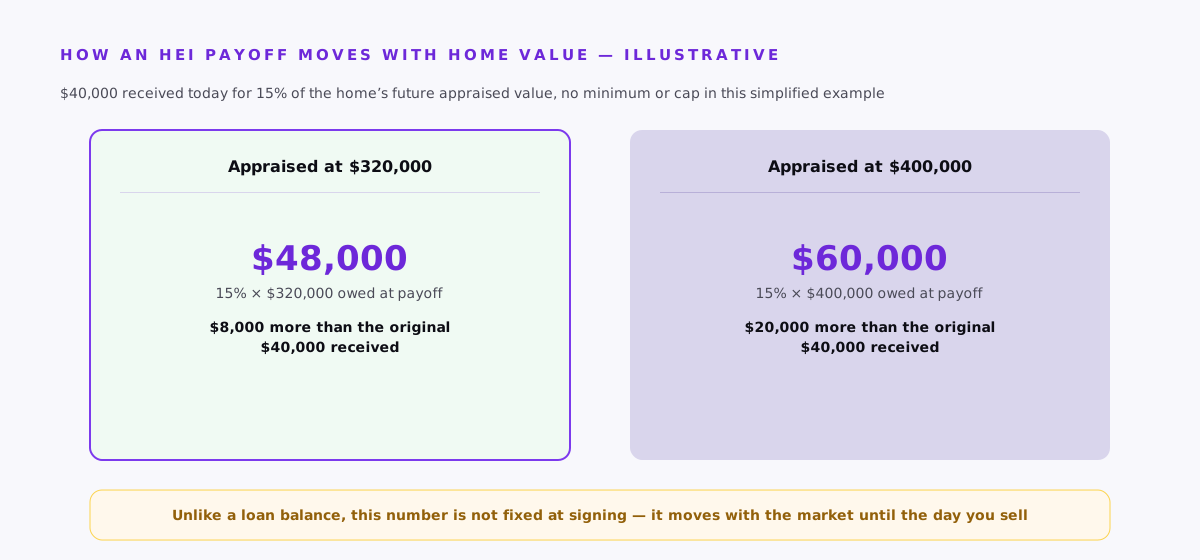
These are illustrative example figures only, meant to show how the math typically works — not a quote for any specific contract or property. Say a homeowner received a $40,000 lump sum from a home equity investment company in exchange for 15% of the home's future appraised value, with no minimum-return floor or cap in this simplified version.
Several years later, the homeowner decides to sell. An independent appraisal — required under the contract before payoff — comes in at $320,000. The payoff owed to the HEI company is calculated as 15% of that appraised value:
15% × $320,000 = $48,000 owed at payoff
That's $8,000 more than the original $40,000 the homeowner received, reflecting the home's appreciation over the life of the agreement. If the home had instead appraised at $400,000, the same 15% share would mean a payoff of $60,000 — $20,000 more than what was originally received, from the same contract, purely because the home gained more value. This is the core mechanic worth understanding: unlike a loan balance, this number is not fixed at signing, and it moves with the market between the day you take the money and the day you sell.
The home equity investment payoff doesn't disappear if you choose a fast, as-is cash sale instead of a retail listing — it comes out of proceeds either way, and it's worth seeing both paths side by side using the same illustrative $48,000 payoff from the example above.
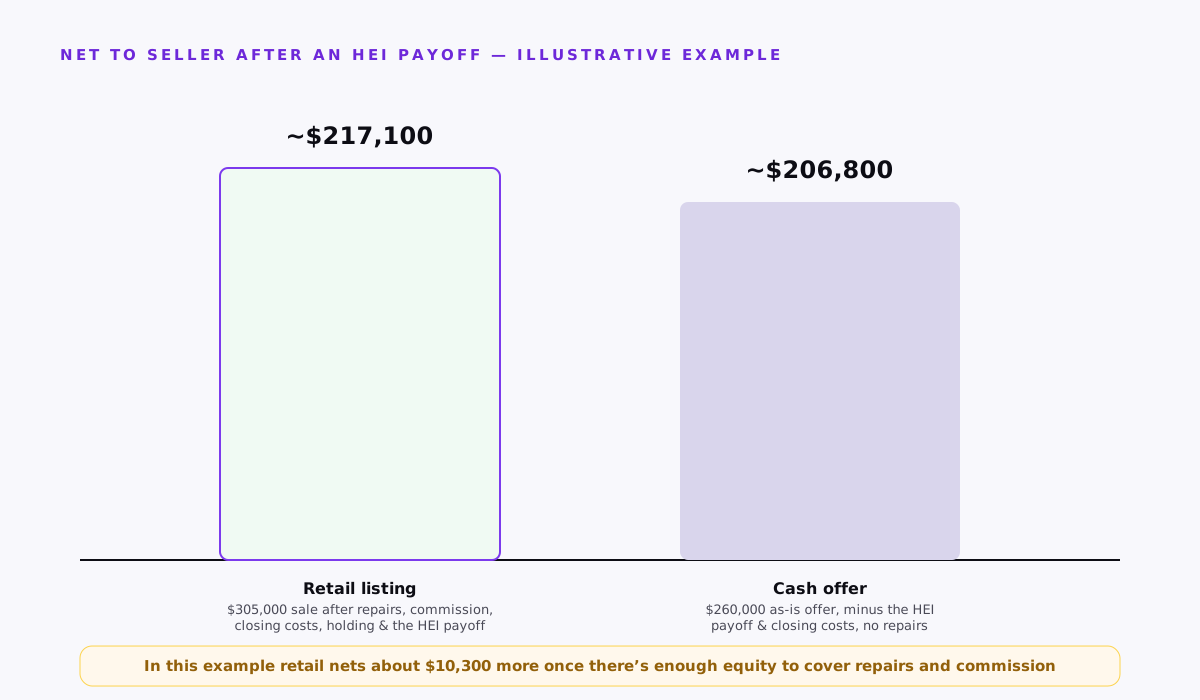
| Retail Listing (after repairs) | Cash Offer (as-is) | |
|---|---|---|
| Estimated sale price | $305,000 | $260,000 |
| Repair costs before listing | −$13,000 | $0 (sold as-is) |
| Agent commissions (~6%) | −$18,300 | $0 |
| Seller closing costs (~2%) | −$6,100 | −$5,200 |
| Time on market / carrying costs (est.) | −$2,500 | $0 |
| HEI payoff (illustrative, per contract formula) | −$48,000 | −$48,000 |
| Estimated net to seller | $217,100 | $206,800 |
In this illustrative example, the retail listing nets more — roughly $10,300 more — for the same reason it usually does in any as-is-versus-repaired comparison: a fully repaired, agent-marketed sale tends to command a higher price even after commissions, repairs, and carrying costs come out. The HEI payoff itself doesn't change which path nets more; it just reduces both totals by the same amount, which means it eats a proportionally bigger bite out of a smaller cash-offer number. That's the honest tradeoff — a fast, as-is sale skips the repair bill and the waiting, but if there's enough equity left after the HEI payoff to make a repaired listing worthwhile, listing will typically put more in your pocket. Run your own numbers before deciding — our cash offer vs. listing net proceeds and seller closing costs breakdowns go deeper on what actually comes out of a sale on each path.
Selling isn't the only way to resolve a home equity investment agreement, and it isn't always the right first move. A few real alternatives worth weighing:
Get a payoff quote early. Many HEI contracts require an independent appraisal or a formal option period before you're allowed to sell or refinance, and that process can take real time. Requesting a payoff estimate as soon as you're considering a sale — not after you're under contract — gives you an accurate number and avoids a scramble near your closing date.
Refinance to buy out the HEI, if you have the equity and credit for it. If a traditional mortgage lender will refinance you for enough to pay off the HEI company's share directly, you keep the house and convert the equity-sharing arrangement into a fixed, predictable loan balance instead.
List with a real estate agent if it nets more. As the worked example above shows, a repaired retail listing can put more cash in your pocket than a fast sale once there's meaningful equity left after the HEI payoff, repairs, and selling costs — it just takes longer and asks more of your time and money upfront.
Sell as-is for cash if speed matters more than maximizing proceeds. If the home needs work you can't afford to do, or you need certainty on timing more than the last available dollar, an as-is cash sale skips repairs and a listing period, with the HEI payoff still settled directly at closing.
If you're unsure how your specific contract's payoff formula works, or whether a minimum return or cap applies to your agreement, your HEI company is required to provide payoff information on request, and the CFPB accepts complaints from consumers who feel a company isn't providing accurate or timely information (CFPB: Submit a Complaint).
Restar Acquisitions buys houses directly, as-is, for cash, in 45 markets across Alabama, Arizona, Florida, Georgia, Indiana, Maryland, Michigan, Missouri, New York, North Carolina, Ohio, and Texas. If your property is in one of those markets, we can typically give a written offer within 24 hours of seeing it, require no repairs, and charge no commissions — you also pick the closing date. We work directly with title and escrow on home equity investment payoff statements and releases so the agreement doesn't derail your closing timeline.
We are not real estate agents or brokers, and we do not represent you as a seller — we're a direct buyer, and our interests in a transaction are our own, not yours. We are also not financial advisors, and nothing here is advice about your specific contract. As the worked example above shows, a cash sale usually nets less than a well-executed retail listing when there's enough equity left after the HEI payoff to make repairs and a full listing worthwhile. If your numbers work out better with an agent — or a refinance makes more sense than selling at all — we'll say so. A fast sale isn't the right fit for everyone.
This article is for general educational purposes only and is not legal, tax, or financial advice. Home equity investment agreements vary significantly by company and by contract, and payoff formulas, minimum returns, caps, and option-period requirements differ from one agreement to the next. Review your specific contract and talk to a real estate attorney or financial advisor about your situation before making a decision.
We'll give you a written offer within 24 hours and work directly with title/escrow on the home equity investment payoff statement and release so it doesn't hold up your closing date — and if listing nets you more, we'll say so.
All guides · Cost of a HELOC or second mortgage when you sell · Cash offer vs listing net proceeds · Seller closing costs
Step 1 of 5
No obligation, no fees, no repairs. We respond the same day.
You’ll talk to Trevor McAmis, Owner & Acquisitions Lead
(313) 710-6129
Takes about two minutes. Or call (313) 710-6129 — we answer.
