A demolition order means a city official has ruled your house must come down, after an unsafe finding, fire or storm damage, or an unresolved nuisance case. Options: appeal it, request more time, sell to a buyer who takes on the structure, demolish it and sell the land, or let the city demolish it and lien the property. If the city has issued one on your house, the repair-and-recertify path is gone, and that single fact changes everything about how you sell, what the house is worth, and how much time you have left.
Step 1 of 5
Tell us about the property and the order, and we'll give you a written cash offer within 24 hours that accounts for the lot value and what's left standing.
You’ll talk to Trevor McAmis, Owner & Acquisitions Lead
(313) 710-6129
Takes about two minutes. Your address is never shared.
Educational only. This explains how these situations generally work. It is not legal, tax or financial advice, and the rules differ by state. Talk to an attorney or CPA about your own situation before you act on any of it.
Most demolition orders trace back to one of five triggers: an unsafe-structure finding, fire or storm damage judged too costly to repair, an escalated nuisance abatement case, an unpermitted partial collapse, or prolonged vacancy that a city's housing code treats as a public hazard on its own. The authority behind the order is almost always a state statute that cities apply through local ordinance, and each city's exact process and deadlines differ.
A building inspector finds the structure unsafe during a routine or complaint-driven inspection (collapsed roof, failing foundation, compromised load-bearing walls). A fire or storm leaves a structure that inspectors judge too damaged to repair economically or safely. A nuisance abatement case, usually started over the kind of code violations tied to prolonged vacancy, trash, or pest infestation, escalates when the owner doesn't respond. An unpermitted partial collapse (a wall, porch, or section of roof comes down on its own) triggers an emergency inspection. Or a property sits vacant and deteriorating long enough that the city's housing code treats it as a public hazard on its own.
Michigan's Housing Law, for example, lets a hearing officer order a building demolished after a hearing, and sets a 60-day compliance deadline for most dangerous buildings, shortened to 21 days for structures "substantially destroyed" by fire or other cause (MCL 125.541). Texas gives municipalities the same basic authority under Local Government Code Chapter 214, with a default 30-day compliance window that a municipality can extend to 90 days if the owner submits a credible repair plan. Ohio's version (ORC 715.26) requires at least 30 days' certified-mail notice to owners and lienholders before a city removes or repairs an unsafe building, with a shorter window allowed in a declared emergency.
Every city's version is a little different. Some call the document a "demolition order," others a "notice of unsafe structure" or "order to vacate and demolish." Check your local building or code enforcement department's website, or the notice itself, for the specific ordinance section and deadline that applies to your property.
Almost every demolition order comes with a right to appeal, but the window is usually short and it starts running from the date on the notice, not from when you happen to read it. Detroit gives an owner 10 business days to file a notice of appeal after a standard order, emergency orders require a hearing request within 10 days, and Texas gives an owner, lienholder, or mortgagee 30 calendar days to file a court petition challenging the decision.
Detroit's property maintenance code, for instance, gives an owner 10 business days to file a notice of appeal with the city's board of appeals after a standard demolition order. Emergency demolition orders move faster: a request for a hearing has to be made within 10 days of the notice, and the city can proceed with the demolition in the meantime if it determines the hazard can't wait. Texas gives a longer runway: an owner, lienholder, or mortgagee has 30 calendar days from notice of the final decision to file a verified petition in district court challenging the order as illegal, arbitrary, or unsupported.
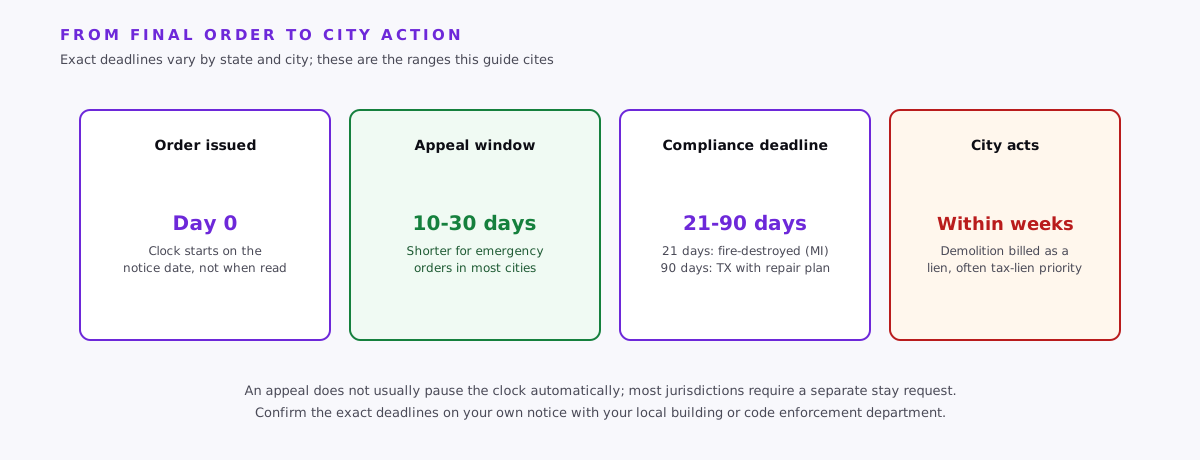
An appeal does not usually pause the clock automatically. In most jurisdictions you have to specifically request a stay, and even then, an active safety hazard (visible structural failure, fire damage with exposed wiring, a roof at risk of collapse) can override a stay request. If you're considering an appeal, especially one tied to a lien dispute or a contested hazard finding, local code enforcement matters move fast and the filing rules are strict. A missed filing deadline usually forecloses the appeal entirely.
If the compliance deadline passes and the structure isn't demolished, repaired, or vacated as ordered, the city has the authority to do the work itself and bill the owner. This isn't a vague threat. It's written into the same statutes that create the order.
The pattern across states is consistent even though the statute numbers differ: the city fronts the demolition cost, then attaches a lien that rides at or near the same priority as property taxes, meaning it can jump ahead of your mortgage and most other debt against the property. HomeAdvisor's 2026 cost data puts the average house demolition at roughly $15,800, with most jobs falling between $6,000 and $25,000 and a wider range of $4,800 to $50,000 depending on size, materials, and hazardous-material abatement. A city-contracted demolition can land anywhere in or above that range, and some ordinances add administrative fees and civil penalties on top of the raw demolition cost.
Once a structure is under a final demolition order, the house itself generally isn't worth much to a buyer planning to use it as housing. What's for sale at that point is the land, plus whatever salvage value remains, since a buyer who wants to keep the structure standing has to successfully appeal the order or get a new engineering sign-off first.
The remaining structure is worth something for salvage, reclaimed brick, lumber, fixtures, or scrap metal, but that rarely amounts to much against demolition cost. A buyer who intends to keep the structure standing has to either successfully appeal the order themselves or get a new structural engineering sign-off that satisfies the city, which is a long and uncertain process on someone else's timeline.
Insurance usually complicates this further. Most homeowner policies exclude or sharply limit coverage once a structure is uninhabitable or under a demolition or vacate order, and a policy written for an occupied dwelling may lapse or be canceled once the insurer learns of the order. If there's an outstanding mortgage, the loan doesn't go away because the house does. The debt stays with the borrower (or transfers with the property, depending on the sale structure), and a lender will want its lien addressed at closing regardless of what's standing on the lot.
A buyer can, in some jurisdictions, take over a demolition order by agreement with the city (essentially stepping into the same compliance deadline the seller was facing), but this isn't universal and depends entirely on the local ordinance and the building department's willingness to work with a new owner. It's a question for the city's building department, not an assumption to make on your own.
Example: a 1,400-square-foot house sits on a $45,000 lot in a market where teardown lots in decent condition sell for close to that. The city issues a final demolition order after a fire, with a 60-day compliance deadline. Demolition for a house this size, contracted privately, runs an estimated $12,000 to $18,000 based on HomeAdvisor's per-project averages. If the owner does nothing, the city performs the demolition, typically at the higher end of that range or above once administrative fees are added, then files a lien for the full cost. If that lien runs $20,000 and sits ahead of a $15,000 mortgage balance, the owner could walk away from a closing with less than the $45,000 lot value, after taxes, fees, and the lien are paid: roughly $10,000 or less, depending on exactly what the city bills.
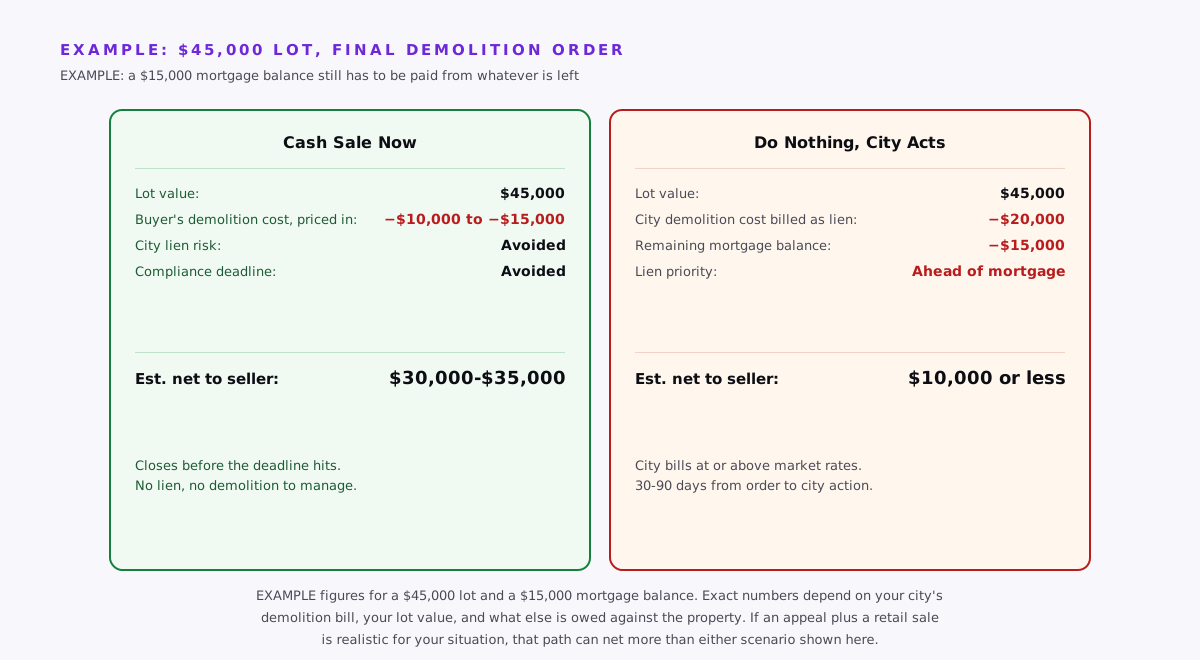
Compare that to a cash sale now, priced to reflect land value minus the cost a buyer will sink into demolition and cleanup, maybe $30,000 to $35,000 net to the seller depending on the buyer's own demolition estimate. That's a meaningfully better outcome than waiting for the city to act, without the lien, without the compliance deadline hanging over the sale, and without the mortgage holder getting first call on a shrinking pool of equity.
There's also a scenario where doing some work pays off. If the order was triggered by a fixable issue (a partial collapse that turns out to be a contained structural problem, or a nuisance finding over debris and vacancy rather than true structural failure), and the cost to stabilize or clean up the property is modest relative to the home's retail value, appealing the order and then listing on the open market can net more than any version of a teardown sale. That only works if the appeal succeeds and the timeline allows for it. It's not the right call if the structural damage is real and extensive, because retail buyers and their lenders won't touch a house under an active demolition order, appeal or not, until it's resolved.
Appeal the order. Works when the hazard finding is disputable or procedural (wrong notice, no real safety issue, a fixable cause). Needs to happen inside the filing window, often 10 to 30 days depending on the city.
Request more time. Some ordinances (Texas's among them) let an owner extend the compliance deadline past the default 30 or 60 days by submitting a credible repair or demolition plan with a contractor's timeline attached.
Sell to a buyer who takes on the structure. A buyer who closes with the demolition order still in place inherits the deadline and the cost. This only works with a buyer who can move fast and has already weighed the demolition math into their offer, which is the position Restar is built for.
Demolish it yourself and sell vacant land. Keeps you in control of the contractor and the cost, and avoids the lien entirely, but requires cash up front and enough time before the deadline to get permits and a crew scheduled.
Let it go to the city. Usually the worst option. The city isn't shopping for the cheapest contractor, it's acting on its own schedule, and the lien that results often exceeds what a private demolition would have cost, with tax-lien-level priority against your remaining equity.
| Path | Who pays for demolition | Lien risk | Rough timeline |
|---|---|---|---|
| Appeal the order | Nobody yet, pending outcome | Avoided if appeal succeeds | 30–90+ days, outcome uncertain |
| Request extension, repair or self-demolish | You, on your schedule | Avoided | Depends on extension granted |
| Sell to a buyer who assumes the structure | Buyer, after closing | Avoided for you | As fast as the buyer can close |
| Demolish yourself, sell the lot | You, before selling | Avoided | Weeks to permit and complete, then list |
| Do nothing, city demolishes | City, then bills you | Lien filed, often at or near tax-lien priority | 30–90 days from final order to city action |
Demolition orders move faster than most code or condemnation cases. From a final order, cities commonly set compliance deadlines in the 21-to-90-day range (21 days for fire-destroyed structures in Michigan, 30 days by default in Texas and under Ohio's notice statute, up to 90 days in Texas with an approved repair plan). Appeal windows are shorter still, sometimes just a handful of business days for emergency orders. Once the deadline passes without action, cities generally move to bid out or schedule the demolition within weeks, not months, because unsafe structures carry liability for the city too.
This article is for general information only and isn't legal advice. Demolition order procedures, appeal deadlines, and lien priority rules vary by state and city. Talk to a local attorney about your specific notice and deadline.
Restar buys houses as-is, including houses under active demolition orders, in all 65 of our markets across 14 states. We give a written offer within 24 hours, there are no repairs to make and no commissions to pay, and you pick the closing date. We're not agents and we don't list your house. We buy it directly. If running the numbers shows that appealing the order and listing on the open market would net you more, we'll tell you that instead of pushing a sale that doesn't serve you.
All guides · Selling a condemned house · Selling a house with fire damage · Selling a house with code violations
Step 1 of 5
No obligation, no fees, no repairs. We respond the same day.
You’ll talk to Trevor McAmis, Owner & Acquisitions Lead
(313) 710-6129
Takes about two minutes. Your address is never shared.