<b>A documented crawl space moisture or mold problem can genuinely block FHA financing, and remediation commonly runs $1,000 to $15,000 depending on scope — but the EPA's own position on mold health risk is more measured than most people assume.</b> If an inspector crawled under your house with a flashlight and came back talking about standing water, a sagging vapor barrier, or a musty smell pulling up into the living space, selling a house with a crawl space moisture problem comes down to three things: what's actually causing it, what it costs to fix, and what you're required to tell a buyer. Here's the honest version of all three.
Step 1 of 5
Tell us what the inspection turned up and we'll walk through the real numbers — no remediation or FHA appraisal contingency required on our end.
You’ll talk to Trevor McAmis, Owner & Acquisitions Lead
(313) 710-6129
Takes about two minutes. Or call (313) 710-6129 — we answer.
Educational only. This explains how these situations generally work. It is not legal, tax or financial advice, and the rules differ by state — talk to an attorney or CPA about your own situation before you act on any of it.
If you're selling in Atlanta, Durham, or Birmingham, there's a good chance your house sits on a crawl space rather than a basement — and that's not an accident of local taste, it's largely driven by frost depth. HUD's own guide to foundation and support systems notes required footing depth runs as little as 6 to 12 inches across much of Georgia and essentially zero in southern Florida, versus 36 inches or more across the Midwest and Northeast.
Where frost depth is shallow, there's no structural need to dig a full basement — a crawl space or slab does the job for a fraction of the cost. That's exactly why basements are the default further north and crawl spaces are the default across most of the Southeast, including the bulk of our own markets there: Atlanta, Savannah, Macon, and Columbus in Georgia; Durham, Greensboro, Winston-Salem, High Point, Fayetteville, and Wilmington in North Carolina; and Birmingham, Alabama.
The tradeoff is that a crawl space is a vented, semi-exposed space sitting directly over bare or thinly-covered soil, in a climate with high ambient humidity for much of the year — which is a genuinely different moisture environment than a sealed, conditioned basement.
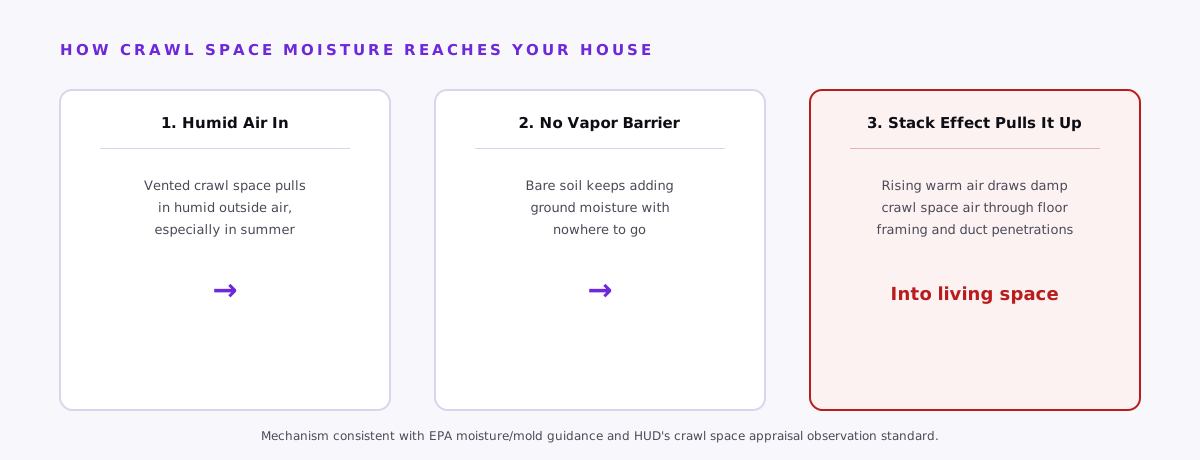
The mechanics are straightforward once you see them laid out. A vented crawl space pulls in humid outside air, especially in summer; that moisture has nowhere productive to go once it's under the house, especially if the ground itself isn't covered by a vapor barrier. Add a building's natural “stack effect” — warm air rising up through the house pulls crawl space air up into the living space through gaps, ductwork penetrations, and floor framing.
Add a drainage problem too — poor grading, a gutter dumping water next to the foundation — and the crawl space can end up with actual standing water rather than just humidity. The EPA's general guidance on moisture and mold is useful here regardless of where in the house the moisture is: keeping indoor humidity below 60% (ideally 30–50%) and drying out any wet material within 24 to 48 hours of a leak are the two things that most reliably prevent mold growth in the first place. A vented, uncovered, poorly drained crawl space routinely runs well above that humidity threshold for months at a time, which is exactly why this is such a recurring issue in the region. Water damage and freezing combined accounted for roughly 22.6% of all homeowners insurance claims in 2023, the most recent year tracked by the Insurance Information Institute — and a chronically wet crawl space is one of the most common places that kind of loss starts.
It's worth being precise here, because a lot of marketing around mold remediation overstates the health risk. The EPA's own consumer guidance is measured: common reactions are allergic and irritant in nature — “hay fever-type symptoms, such as sneezing, runny nose, red eyes, and skin rash,” along with irritation of the eyes, skin, nose, throat, and lungs — and the agency is explicit that “symptoms other than the allergic and irritant types are not commonly reported as a result of inhaling mold.”
People with asthma, mold allergies, or weakened immune systems are at greater risk of a stronger reaction; most people are not at risk of a severe illness from ordinary household mold exposure. This isn't a reason to ignore it — it's a reason to describe it accurately to a buyer instead of either hiding it or overselling how dangerous it is.
The more consistently serious consequences of a chronic crawl space moisture problem are structural, not medical: sustained dampness rots wood framing, degrades sill plates and floor joists over years, attracts termites, and provides a pathway for soil-gas radon to move into the living space — the EPA's own radon-reduction guidance specifically describes sealing a crawl space with a vapor barrier, a vent pipe, and a fan as a standard method for reducing radon entry through a crawl space foundation.
FHA financing. This is a real, documented loan-blocking issue, not a soft concern. HUD Handbook 4000.1's crawl space observation requirement is explicit: “If the observation reveals evidence of a deficient condition (such as excessive dampness, insufficient ventilation, or smell of mold, etc.), the Appraiser must render the appraisal subject to inspection or subject to repairs, in compliance with the Repair Requirements.”
In plain terms, an FHA appraiser who smells mold or sees standing water under the house is required to flag it, and the loan can't close on that appraisal until it's inspected and, if needed, repaired. VA appraisals are generally understood to apply a similarly strict standard around crawl space ventilation and standing water, though the exact VA provision is less precisely documented in public sources than the FHA requirement above — treat it as comparably strict rather than citing a specific clause.
Disclosure. This varies more by state than most defects, because a few of our Southeast markets still run on very different disclosure rules. Georgia has no mandatory disclosure form. Instead, Georgia law treats concealment of a known material fact as fraud under O.C.G.A. § 23-2-53, which covers “intentional concealment of a fact for the purpose of obtaining an advantage” where there's a duty to disclose it. North Carolina requires a statutory disclosure statement under N.C. Gen. Stat. § 47E-4, and the North Carolina Real Estate Commission's actual disclosure form (REC 4.22) asks sellers directly: “Is there water seepage, leakage, dampness, or standing water in the dwelling's basement, crawl space, or slab?” — so while the statute itself doesn't name “mold” as a line item, the practical form you'll actually fill out asks about crawl space moisture by name. Alabama follows caveat emptor (buyer beware) as the default rule, per Ray v. Montgomery (Ala. 1980), with a recognized exception from Fennell Realty Co. v. Martin (Ala. 1988): a seller who knows of a material defect affecting health or safety that isn't readily observable to the buyer has a duty to disclose it, and a seller can't lie if asked directly. Florida imposes an affirmative disclosure duty under Johnson v. Davis (Fla. 1985) — “when a seller of a home knows of facts materially affecting the value of the property, which are not readily observable and are not known to the buyer, the seller is under a duty to disclose them” — and an “as-is” sale contract waives the buyer's inspection contingency, not this disclosure duty.
The practical rule across all four: if you know about a crawl space moisture or mold problem, treat it as a known material fact and disclose it, regardless of which of these frameworks technically governs your sale.
Reported figures below come from industry contractor-cost aggregators rather than a government source, so treat them as planning ranges rather than a quote for your specific crawl space — actual cost depends heavily on size, access, and how much active water intrusion is involved.
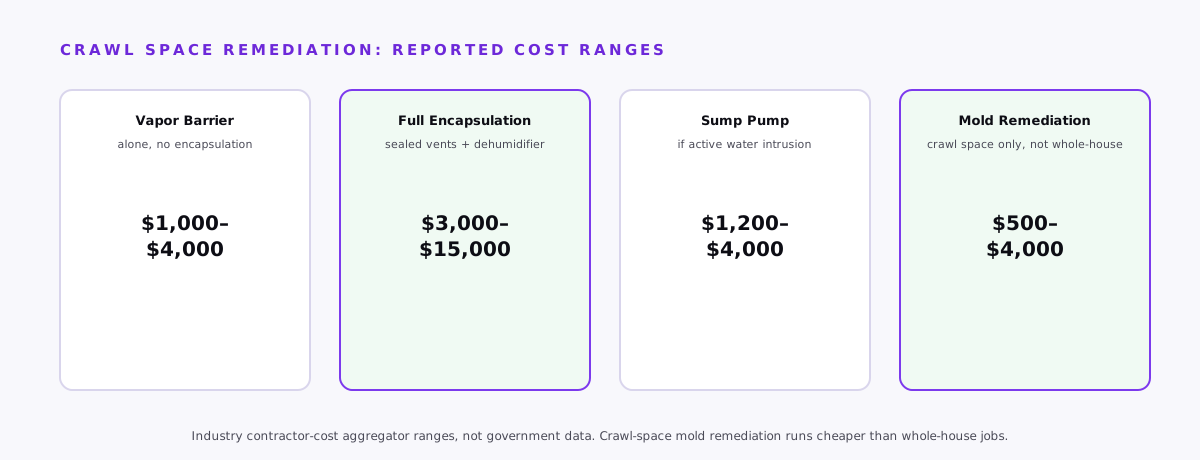
Worked example: a $235,000 house in one of our Southeast markets where a pre-listing inspection finds standing water and visible mold growth in the crawl space. A remediation contractor quotes a combined job — full encapsulation, a sump pump, and crawl-space mold remediation — at $10,000.
| Remediate, then list retail | List as-is, credit at closing | Sell as-is for cash | |
|---|---|---|---|
| Sale / offer price | $235,000 | $235,000 | $205,000 |
| Remediation | −$10,000 | $0 | $0 |
| Buyer credit at closing | $0 | −$11,000 | $0 |
| Agent commission (5.5%) | −$12,925 | −$12,925 | $0 |
| Seller closing costs | −$3,525 | −$3,525 | −$1,000 |
| Carrying costs during remediation/marketing | −$1,400 | $0 | $0 |
| Net to seller | ~$207,150, ~10 weeks | ~$207,550, ~8 weeks | ~$204,000, 1–2 weeks, certain |
Retail nets a few thousand dollars more than cash in this example, because the remediation cost here is bounded and known — a contractor has already quoted it. Cash would likely close the gap or pull ahead on a house where the moisture has been there longer and a contractor finds real wood rot or joist damage once the crawl space is actually opened up, since that's exactly the kind of hidden-scope risk a cash offer is pricing in up front. The honest answer depends on how confident you are that the quoted scope is the real scope, not an assumption either way.
Restar Acquisitions buys houses as-is for cash in 12 states, and we price in crawl space condition the same way we'd price in any other known issue — before we give you a number, not after a buyer's FHA appraiser flags it and the deal falls through. We give a written offer within 24 hours, no repairs or commissions required, and you pick the closing date. We're a direct buyer, not your real estate agent, and we don't represent you in the transaction.
Alternatives worth checking before you decide:
This article is for general education only and isn't a quote, a medical opinion, a legal opinion, or a substitute for a licensed contractor's assessment. Costs vary by region and crawl space size. Disclosure rules vary by state and change over time — confirm your own state's current requirement with a real estate attorney before you sign anything.
We factor crawl space condition into our offer the same way we factor in any other repair item — before we give you a number, not after a buyer's FHA appraiser flags it and the deal falls through.
You'll get a written offer within 24 hours, no remediation or commissions required, and you pick the closing date.
All guides · Selling a house with mold · Selling a house with foundation problems · Cash offer vs. listing net proceeds
Step 1 of 5
No obligation, no fees, no repairs. We respond the same day.
You’ll talk to Trevor McAmis, Owner & Acquisitions Lead
(313) 710-6129
Takes about two minutes. Or call (313) 710-6129 — we answer.