A lot of advice online treats cesspools as a single national problem with a single national rule. They aren't. A cesspool blocks financing almost everywhere, but whether selling the house itself legally forces an upgrade depends entirely on your state — and getting that distinction right matters more than any generic checklist. Here's what's actually true, state by state, plus the honest math on cash versus listing.

Step 1 of 5
Tell us about the property. We'll give you a straight cash number that already accounts for it — no upgrade required before closing.
You’ll talk to Trevor McAmis, Owner & Acquisitions Lead
(313) 710-6129
Takes about two minutes. Or call (313) 710-6129 — we answer.
Educational only. This explains how these situations generally work. It is not legal, tax or financial advice, and the rules differ by state — talk to an attorney or CPA about your own situation before you act on any of it.
A cesspool itself rarely blocks a sale outright, but it blocks financing for most retail buyers and can trigger a mandatory, costly upgrade — sometimes within 12 months of the transfer itself, depending on your state. A cash sale removes the financing problem but doesn't erase a statutory upgrade obligation where one exists; that cost usually just gets priced into the offer instead.
A cesspool is an unlined or minimally-lined pit that lets raw or barely-settled sewage leach straight into the surrounding soil — there's no real treatment step. A septic system is a two-stage process: a tank where bacteria break down solids and separate the liquid, then a drain field where soil microbes provide further treatment before water reaches groundwater. Our failed septic system guide covers a tank-based system that's broken; a cesspool was never built with a tank in the first place, which is why the fixes and the law treat them differently.
The federal hook for regulating cesspools is the Safe Drinking Water Act, not the Clean Water Act — EPA classifies cesspools as Class V injection wells under the Underground Injection Control program, because untreated sewage leaching into the ground threatens groundwater and drinking water supplies (EPA, Cesspools in Hawaii). In December 1999, EPA banned new large-capacity cesspools nationwide — those serving 20 or more people a day, i.e. multi-unit, commercial, or community systems — and required existing ones to close by April 5, 2005, with no waivers. Single-family residential cesspools were explicitly excluded from that federal ban (EPA, Ban on Large-Capacity Cesspools). Whatever restricts a single-family cesspool today comes from state or county law, not a blanket federal rule — and that patchwork is the whole story for a seller.
This is the detail that gets flattened in a lot of online advice, and it matters for an honest answer:
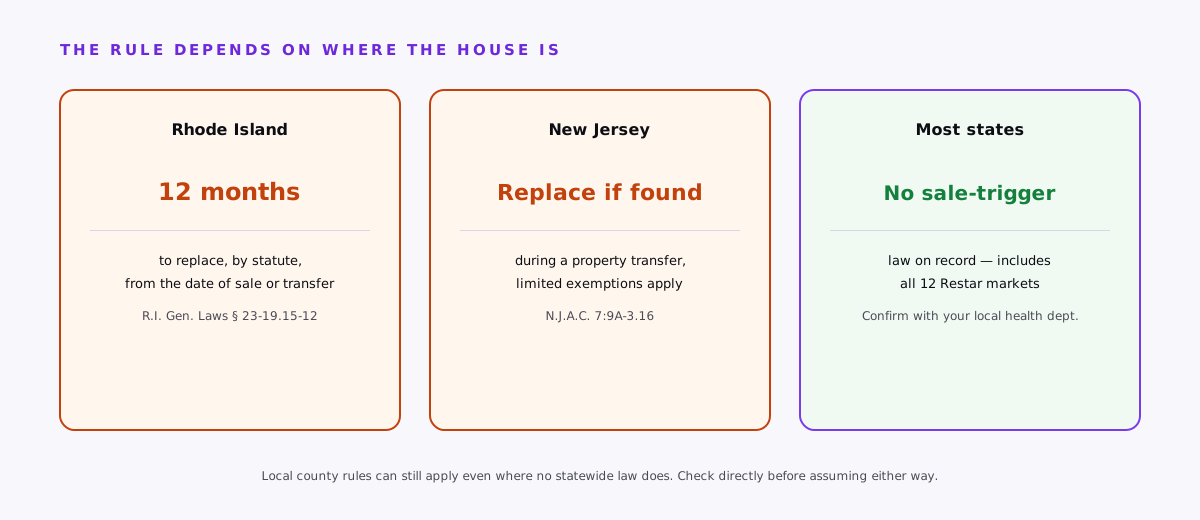
None of our 12 markets include Rhode Island or New Jersey, and our New York market is Rochester, not Suffolk County — so most sellers reading this will not be under a statutory transfer-trigger law like the ones above. But cesspools exist in older housing stock well outside those states too, and the honest takeaway holds everywhere: check with your county or state health department before you assume a sale is a clean exit. The rule that actually governs your house is local, and a national rule of thumb will mislead you in either direction.
Abandoning a cesspool and installing a conventional septic system typically runs $8,000 to $30,000 or more, depending on soil conditions, lot size, and whether local rules require a basic conventional system or an advanced nitrogen-reducing system. Nitrogen-reducing systems — the kind Long Island-type programs push for — generally land at the high end of that range or above it.
If your property happens to sit in Suffolk County, New York, two stacked grant programs can offset a meaningful share of that cost: the county's own Septic Improvement Program covers up to $20,000, and New York State's expanded Septic System Replacement Program, as of July 2025, reimburses 75% of eligible costs up to $25,000 — up to $45,000 combined if you qualify for both (RiverheadLOCAL, July 2025). That's a real, documented example of assistance existing somewhere in the country; it is not evidence that every state offers anything like it, and most of our own markets don't have an equivalent program that we could confirm.
Neither FHA, VA, nor Fannie Mae has a named, blanket rule banning cesspools. FHA's own guidance states it “will accept individual sewage systems that are acceptable to the local health authorities,” and that list explicitly includes cesspools, provided the local health authority signs off (HUD Archives, Single Family Housing Reference Guide). Fannie Mae's Selling Guide doesn't mention cesspools by name at all — it requires any private disposal system to meet “community standards” and be “acceptable to area residents” (Fannie Mae Selling Guide, B4-1.3-04).
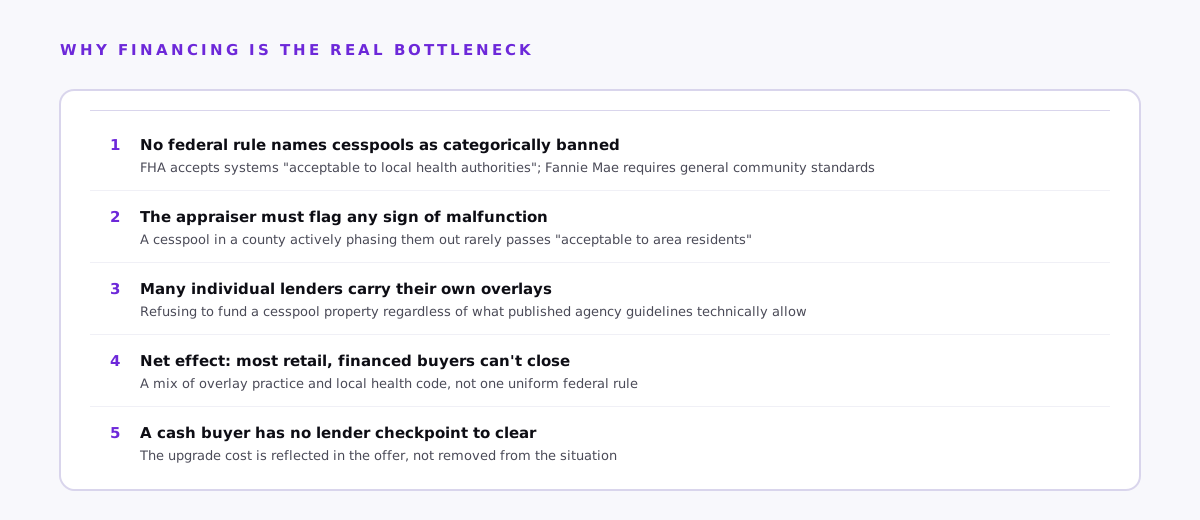
In practice, that general language does most of the damage. Appraisers are required to flag any sign of malfunction, and in a county actively phasing cesspools out, a cesspool is unlikely to pass the “acceptable to area residents” test as a practical matter even though no document says the word “cesspool.” On top of that, many individual lenders carry their own overlays refusing to fund a cesspool property at all, regardless of what FHA or Fannie Mae's published rules technically allow. The net effect for most retail, financed buyers is close to a flat no — even though the mechanism is a mix of overlay practice and local health code, not one single uniform federal rule.
A cash sale solves the financing problem. It does not make a legal upgrade obligation disappear where one exists. In Rhode Island and New Jersey, the statutory language is triggered by “sale or transfer,” full stop — not by whether the transfer was financed. A $0-financing, all-cash closing still counts.
What a cash sale genuinely avoids: the lender-mandated repair conditions, the overlay rejections, and the shrunken buyer pool that comes from most retail buyers needing a loan a cesspool property likely can't get. In practice, listing a cesspool house at full retail value typically requires paying for the upgrade before listing, just to have a workable buyer pool at all — which means the $8,000–$30,000+ cost isn't avoided by listing either; it's just paid up front instead of priced into an offer.
| List retail (upgrade done first) | Sell as-is for cash | |
|---|---|---|
| Who pays the $8,000–$30,000+ upgrade | You, upfront, before listing | Built into the offer as a discount |
| Can most buyers finance it | Yes, once upgraded | N/A — no financing involved |
| Timeline | Weeks for permitting/install, then a normal 30–60+ day retail sale | Typically 2–3 weeks to close |
| Statutory transfer obligation (e.g. RI/NJ) | Satisfied before your sale | Still attaches to the transfer — confirm responsibility before signing |
Neither path makes the cost vanish. The real choice is whether you'd rather spend the money and the time upfront to sell at full retail value, or let a cash buyer absorb that cost into a lower, faster offer.
This is educational information, not legal or engineering advice — talk to your local health department and an attorney about what applies to your specific property.
A cash sale doesn't erase a statutory upgrade obligation where one exists, but it does remove the financing-side friction — no lender overlay, no appraisal condition, no shrunken buyer pool.
Send us the property here and we'll give you a straight number.
All guides · Selling a house with a failed septic system · Selling a house with a private well · Sell my house fast
Step 1 of 5
No obligation, no fees, no repairs. We respond the same day.
You’ll talk to Trevor McAmis, Owner & Acquisitions Lead
(313) 710-6129
Takes about two minutes. Or call (313) 710-6129 — we answer.
