If a wireless carrier leases part of your roof, yard, or an easement across your land for an antenna or small cell site, selling the house doesn't end that lease. The lease transfers with the property automatically, the rent keeps paying out to whoever owns the house, and the only real decisions you have are whether to disclose it properly, whether a buyer's lender cares, and whether to cash out the lease itself before or after you sell.
Step 1 of 5
Send the address. We will tell you what we would pay, lease and all.
You’ll talk to Trevor McAmis, Owner & Acquisitions Lead
(313) 710-6129
Takes about two minutes. Your address is never shared.
Educational only. This explains how these situations generally work. It is not legal, tax or financial advice, and the rules differ by state. Talk to an attorney or CPA about your own situation before you act on any of it.
Most cell site leases on residential property are recorded as a memorandum of lease or an easement, usually running 20 to 30 years with renewal options built in, giving the carrier or tower company long-term certainty for equipment that's expensive to move.
Recorded instruments like this attach to the property itself, not to the person who signed them. In real estate law this is what makes an easement "run with the land": once it's recorded, it binds whoever owns the property next, automatically, without anyone re-signing anything. A buyer's title company will find it in a title search, list it as an exception on the title commitment, and that's normally the end of the conversation unless there's a specific concern about where the equipment sits relative to the house.
It can, but mainly around proximity, not the lease itself. HUD's FHA Handbook 4000.1 requires an appraiser to specifically note if a dwelling sits within the easement area of a cell phone tower, radio or TV transmission tower, high-voltage line, or similar structure, flag it as a possible deficiency, and comment on how it affects marketability.
An underwriter can waive that concern only with a letter from the tower's owner or operator confirming the house sits outside the tower's engineered fall zone. In practice, this mostly comes up for ground-mounted towers near the house, not a small rooftop antenna or a tower lease on a back corner of a larger lot. Fannie Mae and Freddie Mac's guides require appraisers to flag adverse easements and encroachments generally, but neither guide calls out cell towers by name the way FHA's does, so how much scrutiny you get often depends on the specific appraiser and how visible the equipment is.
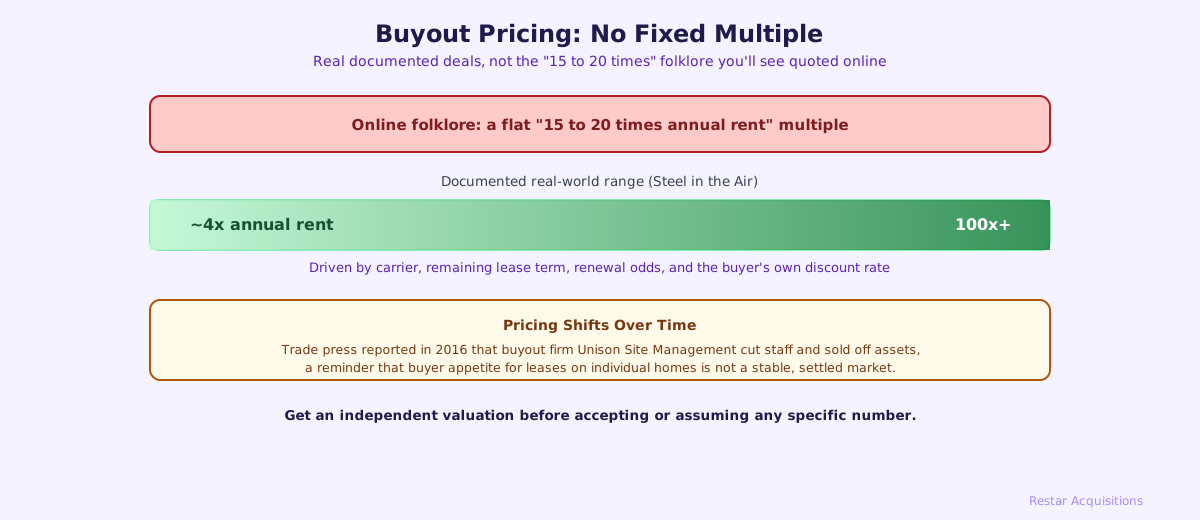
A small industry exists around buying landowners' future cell site rent for a lump sum, and companies like Landmark Dividend have built a real business on it. You'll see claims online that a buyout is worth some fixed multiple of your annual rent, commonly 15 to 20 times. Treat that as folklore, not a fact.
Steel in the Air, an independent consultancy that doesn't buy leases itself and has tracked actual deals for two decades, calls a flat multiple "a massive oversimplification" and has documented real buyout pricing ranging anywhere from about 4x annual rent to well over 100x, depending on the carrier, the lease term remaining, renewal likelihood, and the discount rate the buyer applies, which tends to favor the buyer over the landowner. Trade publication WirelessEstimator reported in 2016 that one well-known buyout firm, Unison Site Management, had cut staff and sold off assets, a reminder that buyout appetite for leases on individual homes shifts over time and across companies, not a stable market with one settled price. If you're approached with an unsolicited buyout offer, or you're considering shopping one, get an independent valuation before assuming any number you're quoted is close to fair.
A lump-sum lease buyout is generally treated as a capital gain rather than ordinary rental income, because it's typically structured as selling an interest in real property, not collecting rent. The usual legal basis cited is Internal Revenue Code Section 1241, which treats the cancellation of a lease as an exchange for tax purposes. But this isn't a blanket guarantee: the actual treatment depends on how the specific deal is structured, and some tax advisors have recommended ordinary-income treatment on deals set up differently. This is squarely a talk-to-a-CPA-before-you-sign situation, not a DIY tax call.
Disclose the lease. You generally have a duty to disclose a known, active lease or easement affecting the property, the same as any other recorded encumbrance.
Hand the recorded lease or easement document to your title company early. This lets them list it correctly on the title commitment and resolve any questions before you're in the middle of a 30-day closing window.
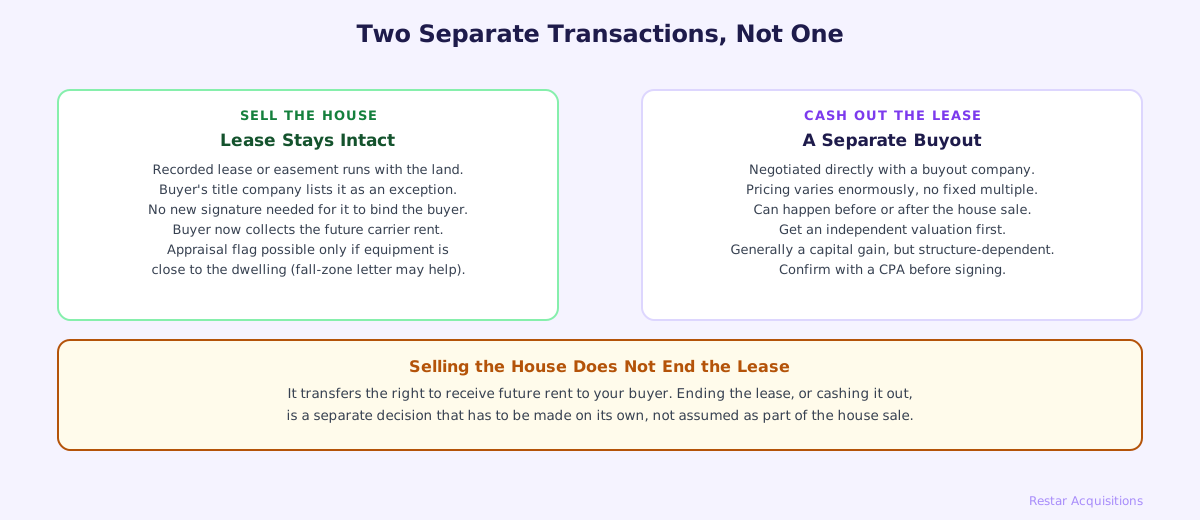
Understand that selling the house and cashing out the lease are two separate transactions. Selling the house transfers the right to receive future rent to your buyer; it does not, by itself, end the lease or pay you a lump sum. If you want cash now instead of handing a future income stream to your buyer, that's a buyout, negotiated separately, and it can happen before or after the house sale depending on timing and what your buyer wants.
If the equipment sits close to the house, ask the carrier or tower owner for a fall-zone confirmation letter in advance. Having it ready before a retail buyer's appraiser asks for it can save weeks mid-contract.
This is one of several property rights separate from the house itself that can complicate a sale. If your situation is closer to a leased rooftop solar system or a severed mineral interest instead, see our guides on selling a house with leased solar panels and selling a house with severed mineral rights.
| Retail sale, lease intact | Cash sale, as-is | |
|---|---|---|
| Lease transfers automatically | Yes, no extra paperwork needed either way | Yes |
| Appraisal/financing risk | Possible delay if equipment is close to the house and a fall-zone letter isn't ready | None, no lender involved |
| You keep future rent potential | Transfers to buyer along with the house | Transfers to buyer along with the house |
| Time to close | Weeks to months, longer if financing flags the easement | Days to a couple weeks |
Example: a $230,000 house with a rooftop antenna lease paying $600 a month, equipment mounted on the house itself rather than freestanding nearby. A retail buyer's FHA appraiser flags the rooftop equipment and the file sits for three weeks waiting on a fall-zone letter from the carrier, adding real carrying cost and risk the deal falls through if the letter is slow or the carrier is unresponsive. A cash sale skips that step entirely, at a lower offer price. If the carrier responds quickly and the letter is easy to get, the retail path is very likely worth more once that risk is handled. If the carrier is slow, unresponsive, or the lease paperwork is unclear, that risk has a real cost, and it's worth pricing that risk in rather than assuming the retail number is automatically the better one.
Restar Acquisitions buys houses as-is, for cash, in 69 markets across 14 states, including houses with existing cell tower or antenna leases. We'll give you a written offer within 24 hours with no financing contingency to stall over an easement, no fall-zone letter to chase down, and no commissions. If listing it retail and working through the appraisal would net you more, we'll say so.
This article is for general educational purposes and is not legal or tax advice. Lease terms, financing requirements, and tax treatment vary by situation. Talk to a real estate attorney and a CPA before deciding how to handle an existing cell tower or antenna lease.
If you send us the address we will tell you within 24 hours what we would pay for it as-is, with no financing contingency to stall over an easement and no fall-zone letter to chase down. We will also tell you if listing it retail would net you more once that risk is handled.
All guides · Selling a house with leased solar panels · Selling a house with severed mineral rights · Cash offer vs listing net proceeds
Step 1 of 5
No obligation, no fees, no repairs. We respond the same day.
You’ll talk to Trevor McAmis, Owner & Acquisitions Lead
(313) 710-6129
Takes about two minutes. Your address is never shared.