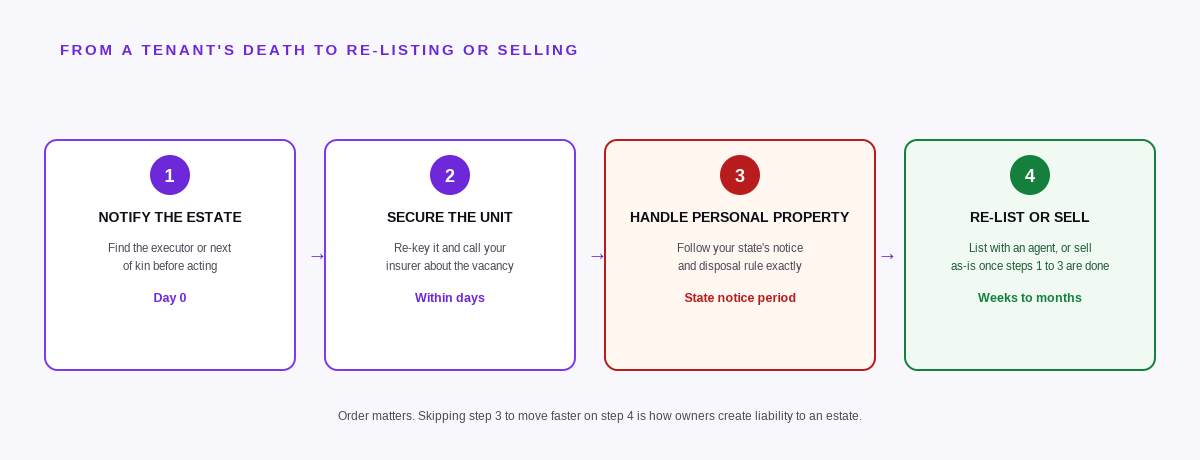
Selling a house when a tenant dies before you can sell it is first a legal-authority problem, then a property problem, and only last a disclosure problem. The estate's appointed executor or administrator, not you, usually controls the question of ending the tenancy. Until that happens, you still have real duties: secure the unit, notify your insurer, and handle the tenant's belongings exactly the way your state's law requires, not the way feels fastest. This guide walks through those duties in order, then points to the separate disclosure question at the end.
Step 1 of 5
Send the address. We buy single-family rentals as-is, including recently vacated units, once the estate and legal steps are in motion.
You’ll talk to Trevor McAmis, Owner & Acquisitions Lead
(313) 710-6129
Takes about two minutes. Your address is never shared.
Educational only. This explains how these situations generally work. It is not legal, tax or financial advice, and the rules differ by state. Talk to an attorney or CPA about your own situation before you act on any of it.
Your tenant's death doesn't hand you the keys back. Legally, a deceased person's rights and obligations, including a lease, pass to their estate. Until a probate court appoints a personal representative (an executor if there's a will, an administrator if there isn't), nobody has clear legal authority to end the lease, authorize disposal of the tenant's property, or sign anything on the estate's behalf.
In practice, that leaves a gap. If the tenant named a contact for exactly this situation, start there. If not, you're often dealing informally with next of kin who showed up to grieve and clean out a closet, not with anyone who has been granted legal authority yet. A family member telling you “throw it all out, we don't want it” is not the same as an appointed executor telling you that, and only one of those protects you if a dispute surfaces later.
This is the point where a probate attorney earns their fee. Before you dispose of anything of value, change the locks against family members who have a plausible claim, or make any judgment call that isn't spelled out in your state's statute, get a real answer from an attorney licensed where the property sits. The rules differ by state in ways that matter, and the cost of guessing wrong is higher than a short consultation. This article is general information, not legal advice.
Generally, no. A lease is a contract, and in most states a contract doesn't dissolve just because one party died. The lease typically becomes an obligation of the estate: rent keeps accruing, and the estate, through its personal representative, is who can formally end it, not you unilaterally and not a grieving relative.
A few states build in a faster off-ramp. Nevada, for example, gives a surviving cotenant who is 60 or older, or who has a qualifying disability, the right to end the lease with 60 days' written notice given within three months of the death, under NRS 118A.340. That's a narrow, specific right, not a general “death ends the lease” rule, and most states don't have an equivalent provision at all. Don't assume your state works the same way; check your own state's landlord-tenant statute, or ask the estate's representative for a straight answer before you act.
If there's a surviving co-tenant or occupant (a spouse, a roommate on the lease, an adult child who also signed), the lease generally continues for them. You're still a landlord to that person, with all the normal obligations, even while the estate question for the deceased tenant is unresolved.
This is the part landlords get wrong fastest, usually by trying to move quickly out of discomfort rather than slowing down to check the rule. The belongings in the unit are not yours and not abandoned the moment the tenant dies. Most states require specific notice, often by mail to a named contact or next of kin, before you can store, sell, or discard what's left behind.
The specifics vary a lot by state, and this is exactly the kind of detail worth confirming against your own state's statute rather than guessing from a neighbor's experience:
If your property is in Alabama, Arizona, Georgia, Indiana, Maryland, Michigan, Missouri, New York, North Carolina, Ohio, or Pennsylvania, the same idea applies even though the specific notice period and procedure differ: don't throw anything out, sell it, or hand it to whoever asks first without checking that state's landlord-tenant statute. Keep what's there, keep it secure, and write down what you find and when, in case anyone later asks.
Call your insurer the same week you learn of the death, not after you've decided what to do with the property. Two separate things change at once: a death occurred on the property, and the unit is likely now vacant, and most landlord and dwelling-fire policies treat an unoccupied property very differently from an occupied rental.
Many standard landlord policies include a vacancy clause that reduces or suspends certain coverage, commonly things like vandalism and glass breakage, once a property has sat vacant for a set period, often somewhere in the 30 to 60 day range depending on the carrier and the policy. Some carriers will ask you to add a vacant-property endorsement once the unit is empty. Ask your carrier directly what your specific policy does and by what date, rather than assuming it matches a number you read somewhere. Getting this wrong is how an owner finds out, after a break-in or a pipe freeze, that the claim is denied.
Once you've confirmed who has authority to let you in, ideally the executor, or documented next of kin while that's pending, treat the property like any vacant home you're responsible for:
Once the unit is secured, the lease question is resolved, and the belongings are handled under your state's law, a separate question comes up: does a buyer need to be told a tenant died in the house? That's a disclosure-law question, not an operational one, and the answer depends on your state and, in most states, on whether a buyer asks directly. We cover that in depth, state by state, in our guide to selling a stigmatized house. This guide won't repeat it. Read that one before you talk to any buyer about the history of the house.
Here's the math most of this situation comes down to once the legal and insurance steps are done. A retail listing, done right, usually nets more money than a fast cash sale. The real question is whether the months of being a landlord-of-record on a property with a recent death, an unresolved estate, and a vacancy clause ticking down are worth that extra money to you.
Example: a single-family rental worth $230,000 as-is and unaffected in value (a natural death carries little to no price discount on its own, unlike a violent one). The tenant was the sole occupant.
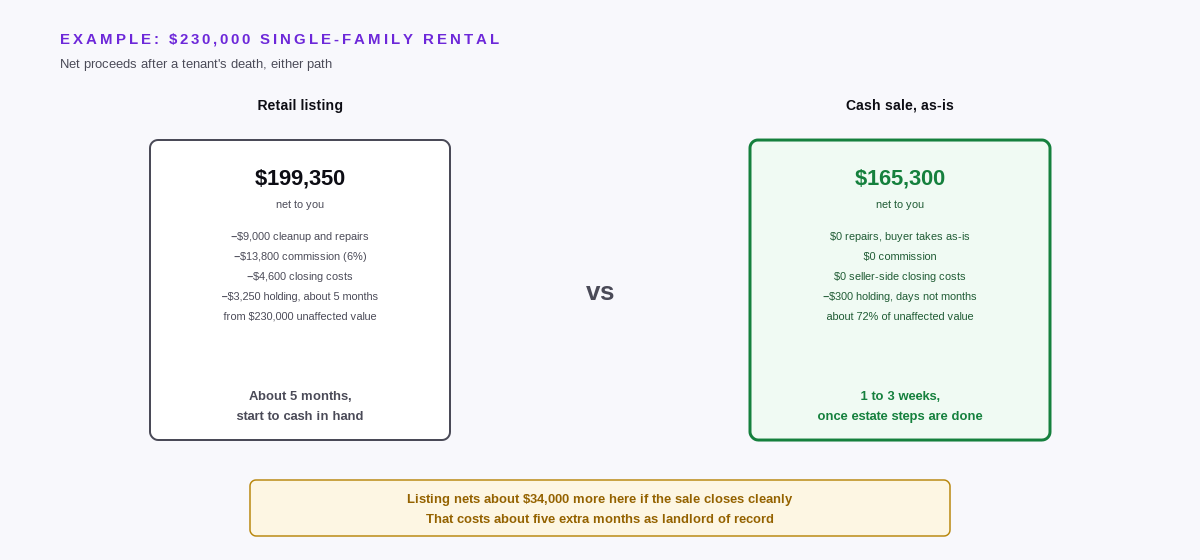
Retail listing path. Before it can go on the market, the unit needs cleanup, fresh paint, and carpet after years of tenancy: call it $9,000. Clearing the personal-property notice period, settling who can authorize the listing, and then running a normal market cycle takes roughly five months start to close. Holding costs (insurance, utilities, upkeep on a vacant unit) run about $650 a month, or $3,250 over that stretch. A 6% commission on the $230,000 sale is $13,800, and closing costs run roughly 2%, or $4,600. $230,000 − $9,000 − $3,250 − $13,800 − $4,600 = $199,350 net, in about five months.
Cash sale path. A cash offer on a property still carrying this kind of complication typically runs around 72% of unaffected as-is value, here about $165,600, with no repairs, no commission, and no closing costs charged to you. Holding costs are minimal, call it $300, because the sale closes in one to three weeks once the estate authority and personal-property steps are done. $165,600 − $300 = $165,300 net, in one to three weeks.
| Retail listing | Cash sale | |
|---|---|---|
| Cleanup and repairs | $9,000 | $0 |
| Commission | $13,800 | $0 |
| Closing costs | $4,600 | $0 |
| Holding costs | $3,250 | $300 |
| Net to you | $199,350 | $165,300 |
| Time to cash in hand | About 5 months | 1 to 3 weeks |
Listing nets about $34,000 more here if the sale closes cleanly. That's the real tradeoff. What it costs you is roughly five more months of being the landlord of record on a property with an unresolved estate, a shortening insurance window, and all the showings and buyer questions that come with marketing a house where a tenant recently died. If that trade isn't worth it to you, a cash sale settles it in weeks instead of months.
We buy single-family houses as-is across the 69 markets we operate in, including tenant-occupied and recently vacated rentals. Written cash offer within 24 hours, no commissions, no repairs required, and you pick the closing date once the estate and personal-property steps are squared away.
If listing it once that's done would net you more, we'll tell you that instead.
All guides · Selling a rental property with tenants · Selling a stigmatized house · Tired landlord
Step 1 of 5
No obligation, no fees, no repairs. We respond the same day.
You’ll talk to Trevor McAmis, Owner & Acquisitions Lead
(313) 710-6129
Takes about two minutes. Your address is never shared.