<b>Yes — in most states, a dissolved LLC can still sell real estate it owned before dissolution</b>, because state LLC law generally lets a dissolved entity finish “winding up” its affairs, which includes selling remaining property. The catch is practical: title companies and a buyer's lender often won't insure or fund the deal until the entity issue is fixed.

Step 1 of 5
Tell us about the property and we'll send a written cash offer within 24 hours, with a closing date that gives you time to reinstate or complete a wind-up transfer, no repairs, no commissions.
You’ll talk to Trevor McAmis, Owner & Acquisitions Lead
(313) 710-6129
Takes about two minutes. Or call (313) 710-6129 — we answer.
Educational only. This explains how these situations generally work. It is not legal, tax or financial advice, and the rules differ by state — talk to an attorney or CPA about your own situation before you act on any of it.
If that's exactly the wall you've hit, you're not alone. A lot of owners in this spot put a rental into an LLC years ago on a lawyer's or accountant's advice, then simply stopped thinking about it — no annual report, no franchise tax payment, no renewed registered agent — until a title search for a sale turned up a dissolved LLC sitting on title where a seller is supposed to be. This guide covers what administrative dissolution actually means, what a dissolved LLC can and can't do with the house it still technically owns, the two realistic ways to fix it, and the honest math on selling now versus waiting to clear it up first.
This is the companion piece to our broader guide on selling a house titled in an LLC, which covers the mechanics of an active, good-standing LLC selling a house — operating agreements, member resolutions, due-on-sale risk, disclosure law, and tax treatment. Read that one for the baseline sale process. This one is only about the layer that gets added when the LLC itself has lapsed.
Almost nobody dissolves an LLC on purpose in this situation — it happens by default. Every state requires an LLC to keep doing a short list of upkeep items to stay in good standing: filing an annual or biennial report, paying a franchise tax or annual fee, and maintaining a registered agent. Miss enough of those and the Secretary of State (or, in some states, the taxing authority) typically sends a delinquency notice, gives a grace period to cure it, and — if nothing is filed or paid — administratively dissolves or revokes the entity's authority.
The LLC doesn't disappear from the county's property records when that happens. The deed into the LLC years ago is still sitting in the chain of title exactly where it was. What changes is the entity's legal standing with the state: it's no longer authorized to transact ordinary business, its liability shield can become shakier, and — this is the part that actually affects a sale — whoever wants to sign a deed on its behalf no longer has an obvious, unquestioned source of signing authority.
This is the part most sellers get wrong in both directions. Some assume a dissolved LLC is frozen and can't touch its own property at all; others assume dissolution is just paperwork that doesn't affect the sale. Neither is quite right.
Most state LLC statutes are built around the idea that dissolution isn't an instant shutdown — it starts a “winding up” period. During wind-up, the LLC generally retains authority to do exactly the things needed to close out its affairs: pay or settle remaining debts, collect what's owed to it, and dispose of its remaining property, including real estate, before distributing whatever is left to the members. In other words, selling the house is usually one of the specific things a dissolved LLC is still allowed to do — it's ordinary new business (signing a new lease, taking out a loan, buying another property) that dissolution cuts off.
So the legal defect here is usually narrower than people assume. It's an authority problem, not necessarily a title problem: the land is still legally owned by the LLC, and someone connected to the LLC almost certainly still has the right to sign for it during wind-up. The hard part is proving, to a skeptical title company or a cautious buyer's lender, exactly who that person is and that their authority is real — especially if years have passed, members have scattered, or nobody kept clean records of who was managing the LLC when it lapsed.
One thing administrative dissolution does not automatically do is cancel the LLC's federal EIN or change how the IRS classifies it for tax purposes — state good-standing status and federal entity classification (see the IRS's basics on single-member LLCs for how that classification works) are separate questions, which matters when you're sorting out who signs tax documents at closing versus who signs the deed.
Procedures and the specific scope of wind-up authority vary by state, and some states are noticeably stricter than others about documenting it. Don't assume your state works exactly like a story you read online — confirm the specifics with your state's Secretary of State or a real estate attorney licensed there before you rely on any of this.
There are two realistic paths out of this, and which one makes sense usually comes down to time, cost, and how clean your LLC's old paperwork is.
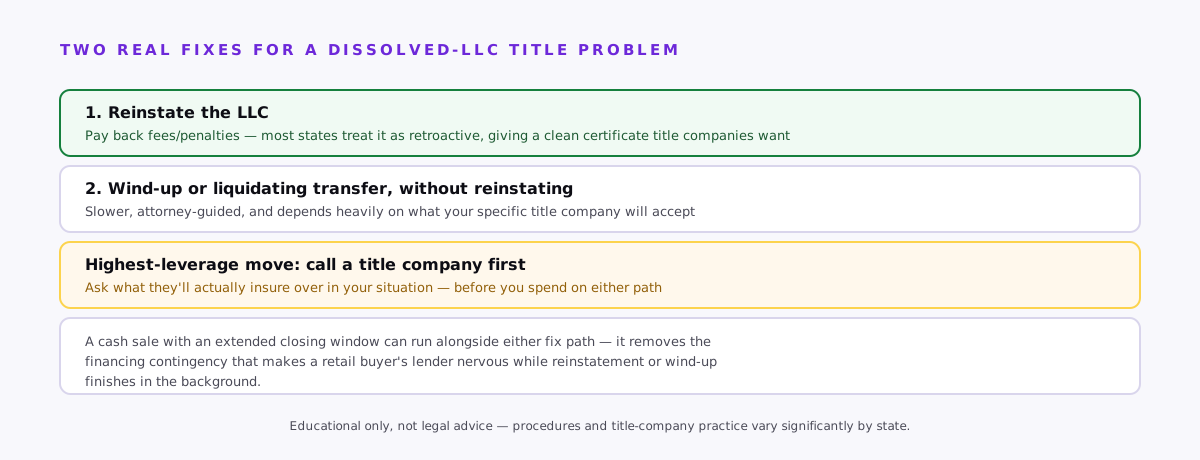
Option 1: Reinstatement. This is filing whatever reports were missed, paying the back fees, penalties, and any back franchise tax owed, and submitting a reinstatement application to the state. Most states that allow reinstatement treat it as retroactive — once approved, the LLC is treated as if it had stayed in good standing the whole time, which restores its signing authority cleanly and is exactly the kind of unambiguous paper trail a title company wants to see. The exact process and fees are state-specific — for example, Texas requires a tax clearance letter from the Comptroller's franchise tax reinstatement page before the Secretary of State will reinstate, while Florida runs its reinstatement filing directly through the Division of Corporations' online reinstatement portal. Reinstatement fees and back-tax amounts vary significantly by state and by how many years were missed, so get the exact numbers from your own state's Secretary of State or comptroller before you budget for it, and note that some states cap how long after dissolution you're allowed to reinstate at all.
Option 2: Proceed under a wind-up or liquidating transfer, without reinstating. If reinstatement isn't realistic — the back taxes are large, the deadline to reinstate has passed, or a member is deceased or unreachable — some states allow the remaining members (or a court-appointed representative) to execute the sale directly under the wind-up provisions of the state's LLC act, sometimes supported by a signed affidavit establishing who holds that authority. This path is slower and far more title-insurance-dependent than reinstatement, and in harder cases it can require a court proceeding to appoint someone with clear authority to sign.
Either way, this is not a do-it-yourself project. A real estate attorney who handles entity issues in your state can tell you quickly which path is realistic for your situation and roughly what it costs.
Even where the law clearly permits a wind-up sale, title insurance underwriters tend to be conservative about actually insuring one, because they're the ones on the hook if the authority to sign turns out to be wrong. Many underwriters would simply rather see a reinstated, good-standing entity sign the deed than independently evaluate a wind-up authority argument.
In practice, that means some title companies will insure a straightforward, well-documented wind-up transfer, and some won't without reinstatement first or a court order behind it. This varies by title company and by state, which is exactly why the smart early move — before you list, before you sign a purchase contract, before you spend money on either path — is to call a title company directly and ask what they'd actually require to insure your specific situation. That one phone call can save weeks.
The dissolved-entity problem adds a real-world complication that a standard LLC sale doesn't have: a retail buyer's lender will frequently refuse to fund at all until the entity issue is fully resolved on paper, and that review can take weeks. A buyer who was excited about the house two months ago can get nervous and walk while that clears up.
Here's how that plays out on a $230,000 rental held by a dissolved LLC, illustrative figures only.
| Retail listing (after reinstating first) | Cash offer (extended closing window) | |
|---|---|---|
| List / offer price | $230,000 | $196,000 |
| Repairs before listing | −$10,000 | $0 (sold as-is) |
| Agent commission (~5.5%) | −$12,650 | $0 |
| Reinstatement / back fees | −$1,800 (illustrative) | −$1,800 |
| Seller closing costs | −$3,000 | −$1,200 |
| Carrying costs | −$4,800 | $0 |
| Net to seller | ~$197,750 | ~$193,000 |
| Typical timeline | 3–4+ months | 4–6 weeks |
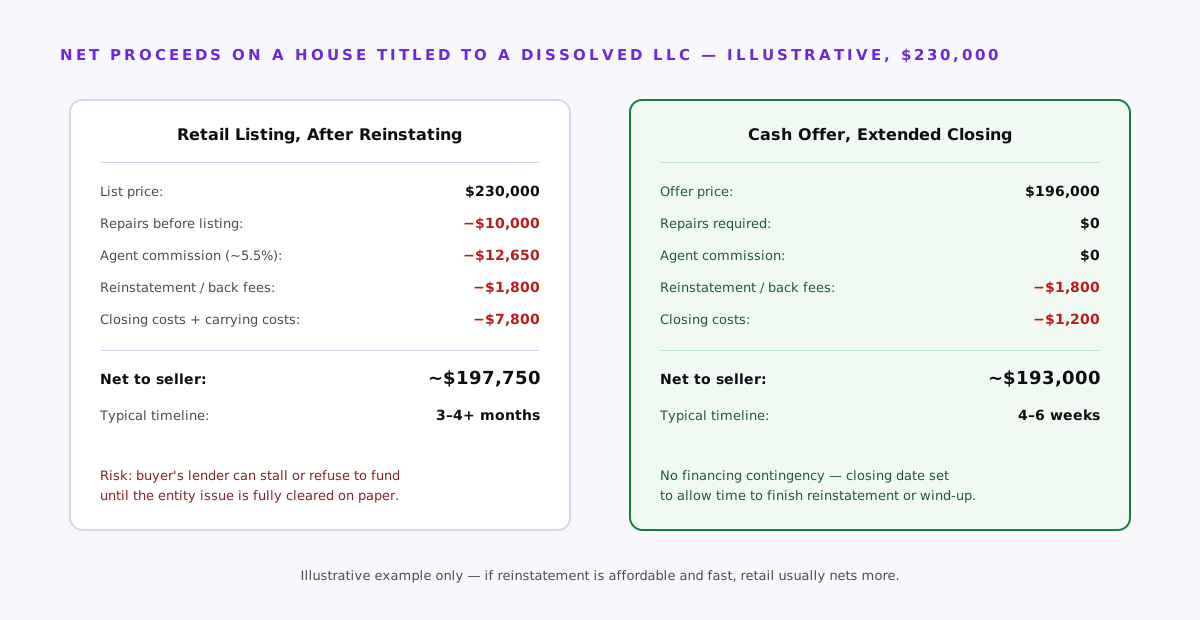
Counted honestly, listing after you've reinstated usually nets more on a house like this — reinstatement plus an agent's price typically outweighs the discount a cash buyer prices in for speed and certainty. The retail path is the better math here if reinstatement is affordable and fast enough for you, and if your buyer's financing actually closes without a scare. The cash path is the better fit if you can't front the reinstatement cost right now, the back taxes are large enough to make reinstatement impractical, a member is unreachable and you're looking at a wind-up path instead, or you simply can't carry the property through a multi-month retail process. For a deeper look at the general cash-vs-retail math, see our guide on cash offer vs. listing net proceeds.
Reinstate the LLC, then list normally with an agent. The cleanest path if the back fees are affordable and you're not in a hurry. Sell via the wind-up/liquidating-transfer path with a real estate attorney, if reinstatement isn't realistic. Call a title company early, before you commit to either path, and ask directly what they'll insure over in your situation — the single highest-leverage phone call you can make here. A cash sale with an extended closing window, which gives you time to complete reinstatement or a wind-up transfer while the sale itself moves forward.
Restar Acquisitions buys houses as-is for cash in 45 markets across Alabama, Arizona, Florida, Georgia, Indiana, Maryland, Michigan, Missouri, New York, North Carolina, Ohio, and Texas. We give a written offer within 24 hours, there are no repairs or commissions, and you pick the closing date — including a longer one if you need the extra weeks to clear the entity issue.
If your situation also involves a trust rather than (or alongside) an LLC, our guide on selling a house held in a trust covers that separate set of mechanics.
A cash offer with an extended closing date lets reinstatement or a wind-up transfer finish in the background, without a financed buyer's lender sitting on a clock while you sort out the entity issue.
You'll get a written offer within 24 hours, no repairs or commissions required, and you pick the closing date. We're a direct buyer, not a real estate agent or broker, and we don't represent you in the transaction. Nothing here is legal or tax advice — talk to a real estate attorney and a CPA about your specific LLC.
All guides · Selling a house titled in an LLC · Selling a house held in a trust · Cash offer vs. listing net proceeds
Step 1 of 5
No obligation, no fees, no repairs. We respond the same day.
You’ll talk to Trevor McAmis, Owner & Acquisitions Lead
(313) 710-6129
Takes about two minutes. Or call (313) 710-6129 — we answer.