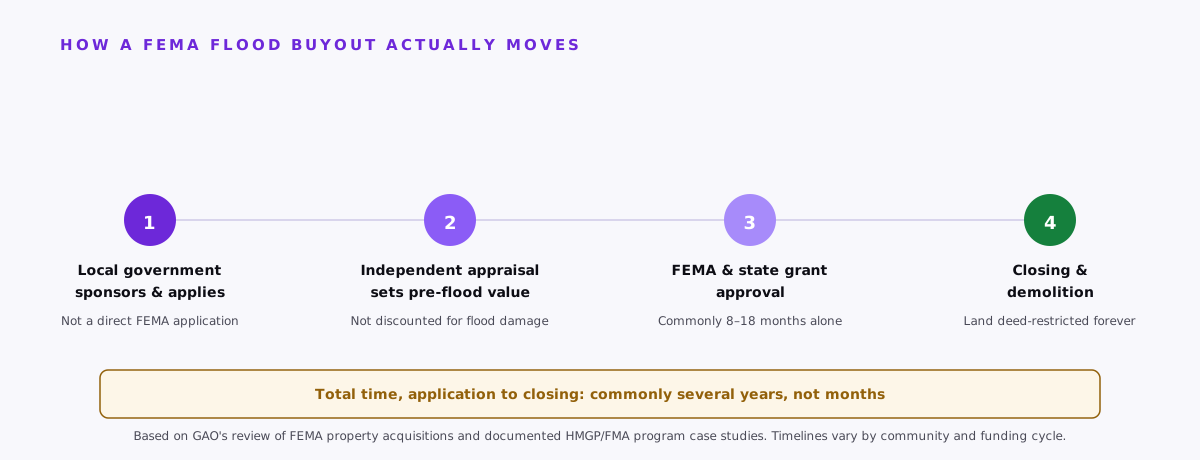
A FEMA-funded flood buyout pays a homeowner the home's pre-flood fair market value, then demolishes the house and permanently deed-restricts the land as open space. It's real, voluntary, and often pays better than a damaged-condition sale — but it runs through your local government, not FEMA directly, and typically takes years, not weeks.

Step 1 of 5
Tell us about the flooding and whether a buyout application is even active in your area. We'll give you a straight cash number.
You’ll talk to Trevor McAmis, Owner & Acquisitions Lead
(313) 710-6129
Takes about two minutes. Or call (313) 710-6129 — we answer.
Educational only. This explains how these situations generally work. It is not legal, tax or financial advice, and the rules differ by state — talk to an attorney or CPA about your own situation before you act on any of it.
If your house has flooded more than once, you may have heard the government will "buy out" homes like yours. That's real, but it's a specific, separate mechanism from flood insurance and from the flood-zone disclosure obligations covered in our guide to selling a house in a flood zone. This guide is about the actual acquisition program: FEMA money, channeled through your state and local government, used to purchase a flood-prone home outright and take it off the map for good.
You can't apply to FEMA directly. This is the single most common misunderstanding, and it's worth correcting up front: a homeowner cannot file for a buyout with FEMA. Your local government — city or county emergency management or planning office — has to sponsor the project and apply through the state. If your community doesn't have an approved hazard mitigation plan or isn't pursuing a buyout, there's no federal buyout to opt into no matter how many times your house has flooded.
The money comes from one of two (occasionally three) federal programs:
Fair market value is determined by an independent appraisal of the home's pre-flood condition — specifically so a homeowner isn't penalized for flood damage that already happened. That's the real financial case for a buyout over a damaged-condition sale: a cash buyer or retail listing will price in the damage you're sitting on right now; a buyout, done properly, is supposed to value the house as if the flood hadn't happened.
The timeline is the part sellers underestimate. The U.S. Government Accountability Office's own review found the application and approval process is lengthy and complex — a real, documented barrier to broader participation (GAO-22-106037, "Flood Mitigation: Actions Needed to Improve Use of FEMA Property Acquisitions," 2022). In practice, homeowners and local officials across multiple documented buyout programs describe a process that runs well past a single year once you count the time from a flood event to an actual closing — the grant-approval phase alone commonly runs 8 to 18 months, with total project closeout often taking several years. If your household can't absorb years of uncertainty — two more flood seasons, ongoing repair costs, insurance premiums climbing in the meantime — that timeline has to factor into the decision as much as the eventual payout does.
The land itself is permanently taken out of use. Once a buyout closes, 44 CFR Part 80 requires the home be demolished and the land deed-restricted as open space forever, using FEMA's own model deed language — no new structures, ever. In practice that land typically becomes parkland, wetland, or green space. The local government, not FEMA, is responsible for enforcing that restriction indefinitely.
It is genuinely voluntary. Every program description we found uses "willing seller" language explicitly, and several local programs state outright that they don't use eminent domain. You can decline a buyout offer and sell the house some other way instead — the lien, the mortgage, and your own decision about where to sell still belong to you.
| State | Documented buyout activity |
|---|---|
| Texas | Harris County/Houston post-Harvey: 3,500+ applications, roughly 1,100 approved historically, plus a separate mandatory relocation track |
| North Carolina | Large and current — FEMA approved $26 million for 75 Helene-damaged homes and a separate $59 million for 150+ properties across western NC counties in 2026 |
| New York | Staten Island's Oakwood Beach post-Sandy buyout is one of the most-cited case studies nationally — roughly 99% of eligible homeowners applied |
| Missouri | FEMA's own published case study: roughly 2,000 properties acquired across 50 communities after the 1993/1995 Midwest floods |
| Michigan | Midland/Edenville/Sanford dam failure, 2020 — FEMA-funded acquisitions converted some destroyed properties to parkland |
| Maryland | Howard County/Ellicott City has pursued acquisition and demolition of flood-damaged structures as part of its mitigation plan |
| Alabama | Birmingham has run an acquisition program since the mid-1990s; FEMA approved funding for additional Hoover, AL acquisitions in 2026 |
| Georgia | Albany/Dougherty County has used HMGP-funded buyouts after multiple flood events, including a 2026 buyout approval for a chronically-flooded property |
| Arizona | Pima County's Floodprone Land Acquisition Program has run since 1984, acquiring 14,000+ acres |
| Indiana | Statewide HMGP/BRIC acquisition authority confirmed through Indiana Department of Homeland Security; no single marquee case study found at the scale of the states above |
| Ohio | Statewide hazard-mitigation acquisition activity confirmed at a smaller documented scale than the states above |
All 12 states have at least some documented federally funded buyout activity. Texas, North Carolina, New York, Missouri, Michigan, and Maryland have the most substantial, easiest-to-verify track records; Indiana and Ohio have real statewide programs without a comparably large single case study on record.
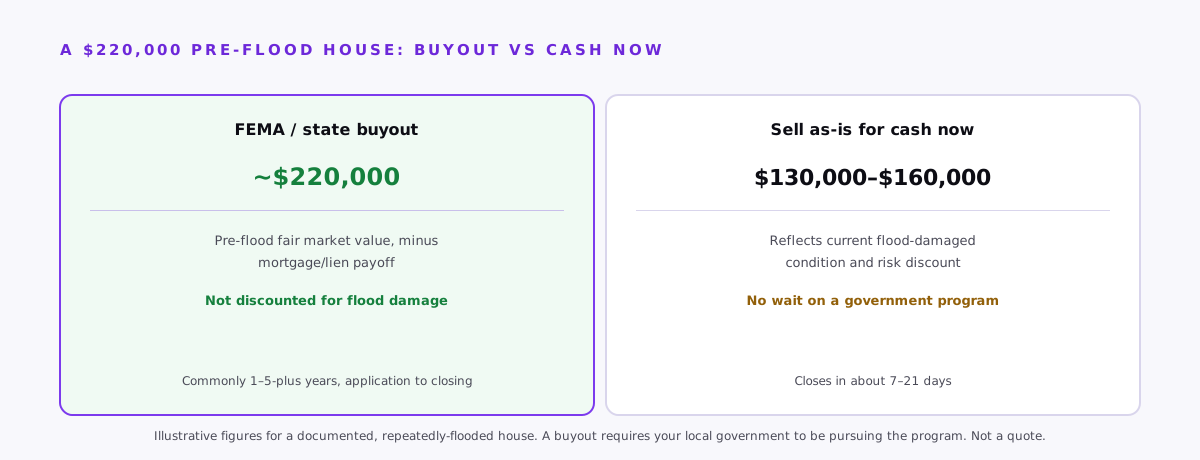
A worked comparison for a house that flooded this year, pre-flood value $220,000, now sitting with real water damage:
| Route | What you're paid for | Typical payout range | Timeline | What you give up |
|---|---|---|---|---|
| FEMA/state buyout | Pre-flood fair market value, independently appraised | Close to $220,000, minus any mortgage/lien payoff | Commonly 1-5+ years from application to closing | Time, and the house is demolished — no option to keep or relocate it |
| Cash sale now | Current as-is, flood-damaged condition | Roughly $130,000-$160,000, reflecting repair cost and risk discount a cash buyer prices in | 7-21 days | Full repaired-condition value; no buyout upside if you'd have qualified |
| List on the open market | Current condition, but financing is the obstacle | Theoretically highest if a cash buyer appears anyway — but conventional/FHA/VA financing is frequently difficult to obtain on repeat-flood properties, and private insurers often decline coverage on severe-repetitive-loss homes, which can collapse a financed deal before closing | 60-120+ days, with real risk of a financing-related fall-through | Deal certainty; retail buyers on flood-prone property are a thinner pool than people assume |
The buyout, when it actually happens, is usually the better number — paid at pre-flood value rather than a damage-discounted one. The real risk isn't the payout, it's the multi-year wait and the fact that your community has to be pursuing the program at all. A family that can't carry another flood season of repairs, insurance, and uncertainty while a buyout application works its way through a state agency has a legitimate reason to take a faster cash sale instead, even at a lower number. Our cash offer vs. listing net proceeds guide walks through that same tradeoff math outside the flood-buyout context, and if the flooding came with wind damage too, see our guide to selling a house with hurricane damage for the insurance side of that.
This is educational information, not financial advice. A licensed public adjuster or your state's emergency management office can give you a specific read on your eligibility and timeline.
If your community is actually pursuing a buyout and your household can absorb a multi-year wait, that route usually pays the better number — paid at pre-flood value. We'd tell you that directly.
Where a cash sale earns its place is when you can't carry another flood season of repairs, insurance, and uncertainty while an application works through a state agency. Send the address and we'll send a written offer within 24 hours. No cost, no obligation.
All guides · Selling a house in a flood zone · Cash offer vs listing net proceeds · Selling a house with hurricane damage
Step 1 of 5
No obligation, no fees, no repairs. We respond the same day.
You’ll talk to Trevor McAmis, Owner & Acquisitions Lead
(313) 710-6129
Takes about two minutes. Or call (313) 710-6129 — we answer.
