Every market page publishes the numbers behind its offer. See the math
Home › Guides › Selling a House in a Flood Zone: The Real Numbers
Guide
Selling a House in a Flood Zone: The Real Numbers
Selling a house in a flood zone is not the problem most sellers think it is. The house is not unsellable, and the flood map is not a verdict. What the zone actually does is quieter and more expensive: it attaches a permanent monthly cost to your house, that cost comes out of the payment a buyer can afford, and the payment a buyer can afford is the price. On a $2,400 annual premium that mechanism removes roughly $31,600 of borrowing power from every financed offer you will receive. Here is how to measure it, the one asset most sellers throw away without knowing it, and the rule that can make repairing the house impossible.
Takes about two minutes. Or call
(313) 710-6129 — we answer.
Educational only. This explains how these situations generally work. It is not legal, tax or financial advice, and the rules differ by state — talk to an attorney or CPA about your own situation before you act on any of it.
Selling a house in a flood zone: the short answer
You can sell a house in a flood zone, and most of them sell on the open market. What changes is the buyer pool and the price: a federally backed loan on a home in a Special Flood Hazard Area requires flood insurance, so the premium becomes part of what the buyer can afford.
This is educational information about how flood zones and insurance generally affect a sale, not legal, tax or insurance advice. Zone designations, premiums and local floodplain rules vary and change. Confirm your own situation with an insurance agent, your local floodplain administrator, and an attorney.
Start by finding out which zone you are actually in
The first practical step in selling a house in a flood zone is confirming which zone you are in, and a surprising number of sellers are wrong about it in both directions. Maps get restudied and republished, and a house that was outside the hazard area when it was bought can be inside one now, or the reverse.
The authoritative place to check is the FEMA Flood Map Service Center, which FEMA describes as the official public source for flood hazard information produced in support of the National Flood Insurance Program. It takes an address. It is free.
The labels matter because only some of them trigger anything. A Special Flood Hazard Area is defined by FEMA as the area that will be inundated by the flood event having a 1-percent chance of being equaled or exceeded in any given year. Those are the zones written as A, AO, AH, AE, A99, AR and the V zones including VE. Outside them, Zone X covers both moderate risk (the area between the base flood and the 0.2-percent-annual-chance flood, sometimes shown as shaded X or Zone B) and minimal risk (unshaded X, or Zone C). The full list is on FEMA's flood zones glossary.
The practical translation is short. An A or V zone is a mandatory-insurance zone for a financed buyer. An X zone is not. Everything below follows from which side of that line your house sits on.
Why the zone changes who can afford your house
The mechanism is a federal lending rule, not a lender preference. FEMA defines the mandatory purchase requirement as the rule under which people buying, building or improving property located in identified areas of special flood hazards within participating communities are required to purchase flood insurance. It comes from the Flood Disaster Protection Act of 1973, and it binds federally regulated and insured lenders.
Two consequences fall out of it that sellers feel directly.
First, the insurance has to be in place before the loan closes. It is not a thing the buyer sorts out later. If the quote comes back higher than the buyer budgeted, that is a financing problem discovered late, and late financing problems are how contracts die in week five.
Second, since 1 January 2016 regulated lenders have generally had to escrow flood premiums on loans secured by residential improved real estate, so the cost lands in the buyer's monthly payment rather than as an annual bill they can quietly skip. That is what converts a premium into lost purchasing power.
None of this applies to a buyer who is not borrowing. That is a real structural difference between the financed market and the cash market for a house in an A or V zone, and it is worth understanding before you price.
The arithmetic: what a premium is worth in purchase price
This is the calculation almost nobody puts in front of a seller, and it is the one that explains the offers you get.
A buyer qualifies on a monthly payment. Every dollar of monthly flood premium is a dollar that cannot go to principal and interest. At roughly 6.5% over 30 years, $1,000 of loan costs about $6.32 a month, so each $100 of monthly premium displaces roughly $15,800 of loan.
Annual flood premium
Per month
Borrowing power it displaces
$1,200
$100
about $15,800
$2,400
$200
about $31,600
$3,600
$300
about $47,500
$4,800
$400
about $63,300
That is not a prediction that your price drops by exactly that much — buyers are not all at the edge of what they qualify for, and rates move. It is the size of the pressure. A $4,800 premium is not a $4,800 problem. It is closer to a $63,000 problem, and it explains why two nearly identical houses on opposite sides of a zone line do not sell for nearly identical money.
It also tells you where to spend your effort: every $1 you take off the annual premium is worth roughly $13 of borrowing power to your buyer. Shopping the policy is the highest-return hour available to you before listing.
The asset most sellers throw away: your policy is transferable
If you already carry a National Flood Insurance Program policy, it is very likely an asset you can hand to your buyer, and most sellers never mention it.
FEMA's own definition of assignment is the transfer by a policyholder of a legal right or interest in a policy contract to a third party, and FEMA states that written assignment of a policy is permissible upon transfer of title without the consent of FEMA. The two exceptions are residential contents-only policies and policies issued on buildings under construction.
Why this is worth real money: an older policy can carry a materially lower premium than a fresh quote on the same building. If your assignable policy runs $1,150 and a new quote comes back at $2,900, that $1,750 a year is about $146 a month, which is roughly $23,000 of borrowing power you can hand a buyer at no cost to yourself.
Two things to do about it, both cheap. Ask your agent in writing whether your policy is assignable and what the buyer's premium would be on assignment. Then put the answer in the listing. A number in the listing removes the fear that otherwise gets priced in as a guess, and buyers guess high.
The 50 percent rule, and when repairing stops being possible
This is the flood-zone mechanic that changes the whole decision, and it catches people after a storm.
FEMA's threshold for substantial damage is damage of any origin where the cost of restoring the structure to its before-damaged condition would equal or exceed 50 percent of the market value of the structure before the damage occurred. The parallel test for substantial improvement applies the same 50 percent threshold to voluntary reconstruction, rehabilitation, addition or improvement. FEMA's substantial damage guidance states that buildings must comply with flood provisions when the cost of restoring the structure to its before-damaged condition would equal or exceed 50 percent of the market value of the structure before the damage occurred.
Communities that participate in the NFIP have to enforce this. Cross the line and the building must be brought into compliance with current floodplain rules — in practice, elevated to or above the base flood elevation, or dry floodproofed where that is permitted. That is frequently a five- or six-figure job on top of the repair you were already facing, and it is triggered by the repair, not by the flood.
The consequence for a seller is stark and it cuts both ways. A $60,000 repair on a structure valued at $110,000 does not cost $60,000; it costs $60,000 plus elevation. Whereas the same repair on a structure valued at $200,000 is under the threshold and stays an ordinary renovation. Before you commit to repairing a damaged house in an A or V zone, ask your local floodplain administrator in writing how they calculate the ratio and what your number is. They are the ones who decide, not your contractor.
The honest comparison, with the numbers both ways
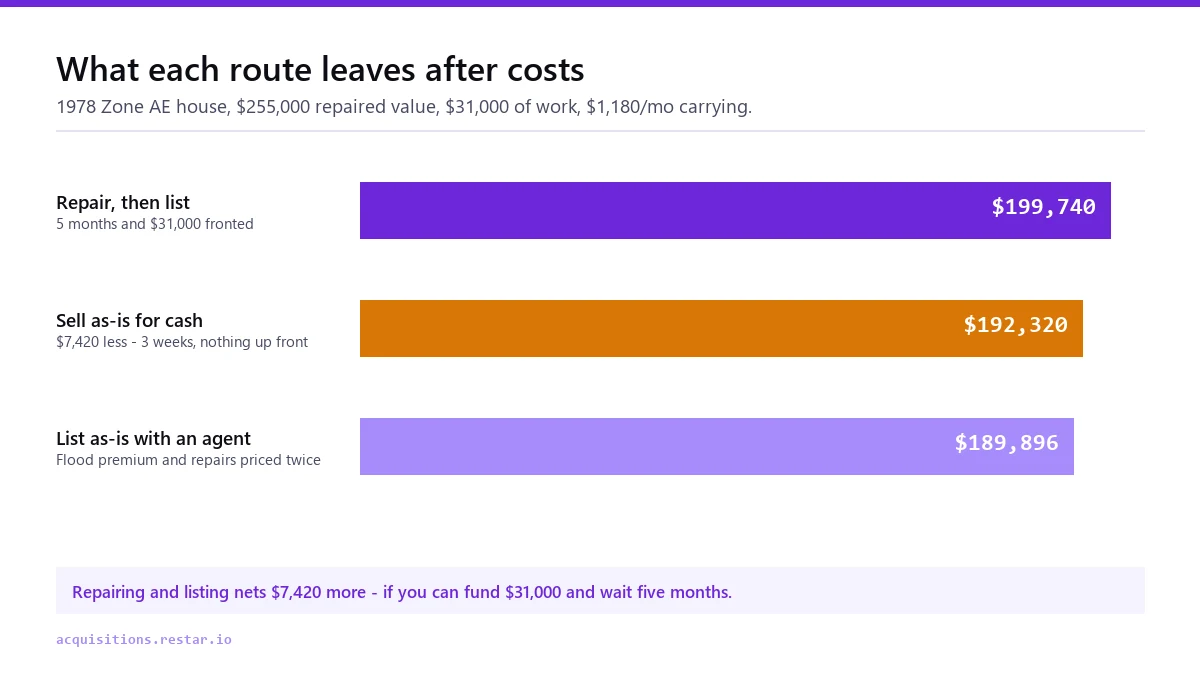
Take a 1978 slab house in a Zone AE part of southwest Florida. Repaired value $255,000. It needs $31,000 of work, mostly systems and a storm-damaged roof section, and it is under the substantial-damage threshold, so elevation is not triggered. Carrying costs are $1,180 a month once flood and wind coverage, taxes and utilities are counted.
Line
Repair, then list
List as-is
Cash as-is
Price
$255,000
$212,000
$193,500
Repairs paid up front
−$31,000
—
—
Commission at 5%
−$12,750
−$10,600
—
Seller settlement costs
−$3,060
−$2,544
—
Carrying costs
−$5,900 (5 mo)
−$4,720 (4 mo)
−$1,180 (1 mo)
Buyer concession
−$2,550
−$4,240
—
Net to you
$199,740
$189,896
$192,320
What each route leaves after costsRestar Acquisitions · worked example from this page
Repairing and listing nets the most, by $7,420 over our route. We are not going to pretend otherwise. If you can fund $31,000 without borrowing it, and you can carry the house for five months while the work is done and a financed buyer clears underwriting, you should list it with an agent. That is the better financial outcome and it is not close enough to argue about.
Notice also that listing as-is is the worst of the three here. That is typical in a mandatory-insurance zone: the same buyer who has to absorb a premium is being asked to absorb a repair scope as well, and they price both with a margin for error. As-is listings in A and V zones tend to sit, and sitting costs $1,180 a month.
When each route is actually the right one
List it after repairing when: you can fund the work without a loan, the house is under the substantial-damage threshold, your flood premium is assignable or modest, and no deadline is running against you.
List it as-is with an agent when: the repair scope is small, the zone is X rather than A or V, and you would rather trade a few months for a higher gross price.
Consider a cash sale when: the substantial-improvement rule means repairing triggers elevation you cannot fund; the house cannot be insured or financed in its current state; an insurance claim is still open, which stops most lenders funding — our guide on selling with an open insurance claim covers that case; or you are carrying a vacant property and the monthly holding cost is outrunning the difference in price.
One thing that is never optional: disclose what you know about flooding, in writing. Florida has required a written flood disclosure from residential sellers since October 2024, and our Florida selling guide covers that requirement in detail. Even where no statute compels it, a documented flood history that a buyer learned about from you is a price negotiation. One they discover afterwards is a lawsuit.
Common questions
Can you sell a house in a flood zone?
Yes. Selling a house in a flood zone happens every day, including in high-risk A and V zones. The zone does not restrict your right to sell. It restricts what a financed buyer can afford, because a federally backed loan on a home in a Special Flood Hazard Area requires flood insurance and that premium is usually escrowed into the buyer's monthly payment.
How much does a flood zone lower a home's value?
There is no fixed percentage. The useful way to size it is through the premium: at about 6.5% over 30 years, every $100 of monthly flood premium displaces roughly $15,800 of loan a buyer can carry. A $2,400 annual premium is therefore closer to a $31,600 problem than a $2,400 one.
Can I transfer my flood insurance policy to the buyer?
Usually, yes. FEMA states that written assignment of an NFIP policy is permissible upon transfer of title without FEMA's consent, with exceptions for residential contents-only policies and buildings under construction. If your existing premium is lower than a fresh quote, assigning it is free money for the buyer's affordability. Ask your agent to confirm in writing.
What is the 50 percent rule when selling a flood-damaged house?
If the cost of restoring a structure to its before-damaged condition equals or exceeds 50 percent of its market value before the damage, FEMA treats it as substantially damaged and the community must require the building to comply with current floodplain rules, typically meaning elevation. That obligation is triggered by the repair, so it can make repairing uneconomic even when the repair itself is affordable.
Do I have to tell buyers the house has flooded?
Disclosure duties vary by state, and Florida has required a specific written flood disclosure from residential sellers since October 2024. Regardless of the statute where you are, writing down what you actually know and giving it to the buyer converts a potential lawsuit into a price negotiation. Ask a local attorney what your state requires.
Is it better to repair a flood-zone house or sell it as-is?
It depends on whether you can fund the work and whether the substantial-improvement threshold is triggered. In the worked example on this page, repairing and listing nets $199,740 against $192,320 for a cash as-is sale, so repairing wins by $7,420 if you can front $31,000 and wait five months. If elevation is triggered, that comparison usually reverses.
If you send us the address we will tell you within 24 hours what we would pay for it as-is, with no repairs and no insurance contingency to fail late. We will also tell you if the arithmetic says you should repair it and list it instead — as it does in the example on this page.
Every offer on this site is underwritten by a person, not a form. If the
numbers do not work for you, say so and I will tell you what would.
Also from Restar
Want the data behind all of this?
Restar Acquisitions is the acquisitions arm of Restar — a housing-market analytics
platform tracking 180+ metrics across every U.S. market, with composite scores and 12-month
price forecasts. The numbers on this page come from the same work.