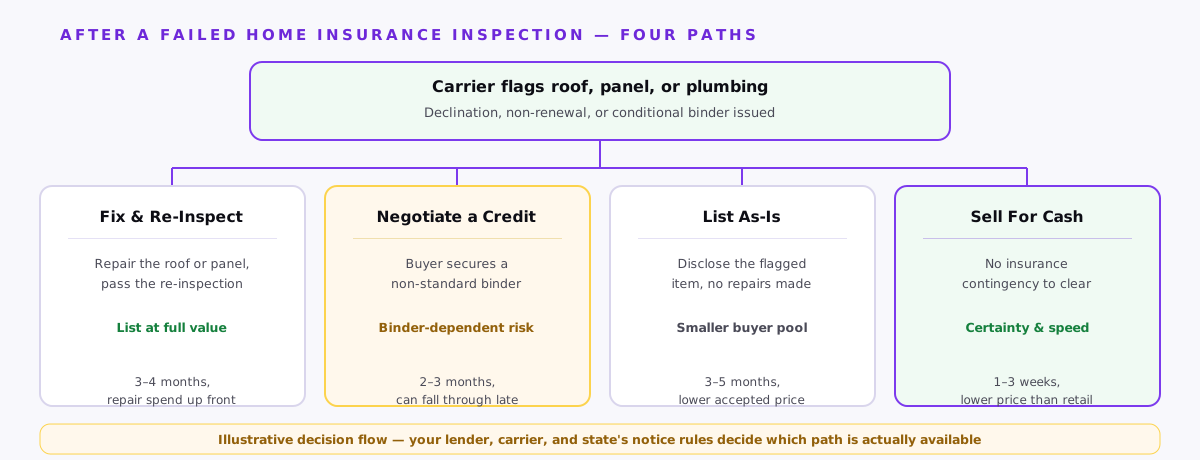
<b>A failed home insurance inspection usually means your carrier flagged an aging roof, a Federal Pacific or Zinsco electrical panel, or outdated plumbing — and is declining, non-renewing, or conditioning your policy on repairs.</b> This isn't Florida's 4-point process; carriers in Texas, Georgia, North Carolina and similar wind-exposed states are increasingly running their own version of the same underwriting check, and a buyer's lender usually won't fund a loan without proof of coverage in place. You can fix the item and re-inspect, shop a non-standard carrier, negotiate a closing credit, sell as-is to a smaller buyer pool, or sell for cash without the insurance contingency at all.

Step 1 of 5
Tell us about the property and we'll send a written cash offer within 24 hours — no repairs, no re-inspection, and no insurance contingency required on your end.
You’ll talk to Trevor McAmis, Owner & Acquisitions Lead
(313) 710-6129
Takes about two minutes. Or call (313) 710-6129 — we answer.
Educational only. This explains how these situations generally work. It is not legal, tax or financial advice, and the rules differ by state — talk to an attorney or CPA about your own situation before you act on any of it.
A carrier-ordered inspection — sometimes a drive-by, increasingly a satellite or aerial-imagery review, sometimes an on-site visit — checks roof age and visible condition, the electrical panel brand and amperage, plumbing material, and occasionally HVAC age. If something gets flagged, you typically get one of three outcomes: a declination (no new policy issued), a non-renewal (your existing policy won't renew at the next term), or a conditional binder requiring the repair within 30 to 90 days. Any of the three can stall a sale, because most mortgage lenders won't fund a loan without proof of hazard insurance in place at closing.
Roof age is the single most common trigger. According to the Insurance Information Institute, insurers generally require an inspection once a roof passes 20 years old, and some carriers decline new policies for older roofs outright, because the Insurance Institute for Business & Home Safety attributes roughly 70 to 90 percent of storm-related residential claims to roof damage. Electrical panels are the second most common flag — specifically Federal Pacific Electric (FPE) Stab-Lok and Zinsco panels, which many insurers simply won't write a policy around regardless of visible condition, because both brands have a documented history of breakers that fail to trip properly under overload. The Consumer Product Safety Commission investigated FPE breakers for two years and closed the matter in 1983 without a recall and without ruling on their safety either way — insurers have largely made their own call since.
Carriers are pulling back from older homes in wind-exposed states for the same reason they pulled back in Florida years ago: the loss math stopped working on aging systems. As more standard carriers decline or non-renew these homes, owners are increasingly pushed into the surplus-lines market — non-standard insurers who will write harder-to-place risks at a higher premium. Residential, homeowners, and other personal-property surplus-lines premium grew 20.2 percent in the first half of 2026, according to the Wholesale & Specialty Insurance Association's reporting, cited by PIA Western Alliance. That's a real, measurable shift of risk out of the standard market and into costlier non-standard policies — exactly the kind of policy a seller sometimes has to help a buyer secure to get a deal to the closing table.
States are responding differently. In September 2026, the Texas Department of Insurance clarified that insurers cannot decline or non-renew a homeowners policy based solely on the age of a house or a system like the roof, wiring, plumbing, HVAC, or siding — age alone isn't allowed to be the reason, though actual physical condition still can be. Georgia requires insurers to send a written non-renewal notice stating the specific reason, with a path to request a review from the Commissioner's office, per the Georgia Office of Insurance's Bulletin 24-EX-2. North Carolina has its own separate notice-and-reason requirements. None of this guarantees your carrier reverses course, but it does mean the notice you received should name a specific, checkable reason — not just “too old.”
Here's a worked example on a $310,000 house with a 23-year-old asphalt shingle roof and a Zinsco panel, both flagged on the carrier's inspection, with a non-renewal notice already in hand and a buyer's closing 45 days out. Replacing the roof runs roughly $7,500 to $24,000 nationally depending on size and material per 2026 cost data; call this roof $12,000. Swapping the Zinsco panel for a modern breaker panel runs $2,000 to $4,500 per 2026 electrical-contractor pricing; call it $3,200. That's $15,200 in repair spend before you even relist.
| Path | Fix, re-inspect, list | List as-is, buyer credit | Cash sale, as-is |
|---|---|---|---|
| Sale / offer price | $310,000 | $310,000 | $255,000 |
| Roof & panel repairs | −$15,200 | — | — |
| Buyer closing credit | — | −$9,000 | — |
| Agent commission (6%) | −$18,600 | −$18,600 | — |
| Closing costs | −$4,650 | −$4,650 | covered |
| Net to seller | ~$271,550 | ~$277,750 | ~$255,000 |
| Rough timeline | 3–4 months | 2–3 months, binder-dependent | 1–3 weeks |
Two things stand out. First, the credit path nets more than the full-repair path in this example, because the $9,000 credit a motivated financed buyer actually accepted was smaller than the true $15,200 repair bill — the same logic that makes fixing it yourself cost more than it looks like once you add the time and inconvenience of scheduling contractors and a re-inspection before your buyer's rate lock expires. Second, the credit path carries real execution risk: if the buyer's insurer doesn't bind before the closing deadline, that deal can still fall apart, and you're back to square one with less time on the clock. The cash path nets roughly $16,550 to $22,750 less than the other two in this example, in exchange for skipping the repair bill, the binder risk, and the calendar pressure entirely.
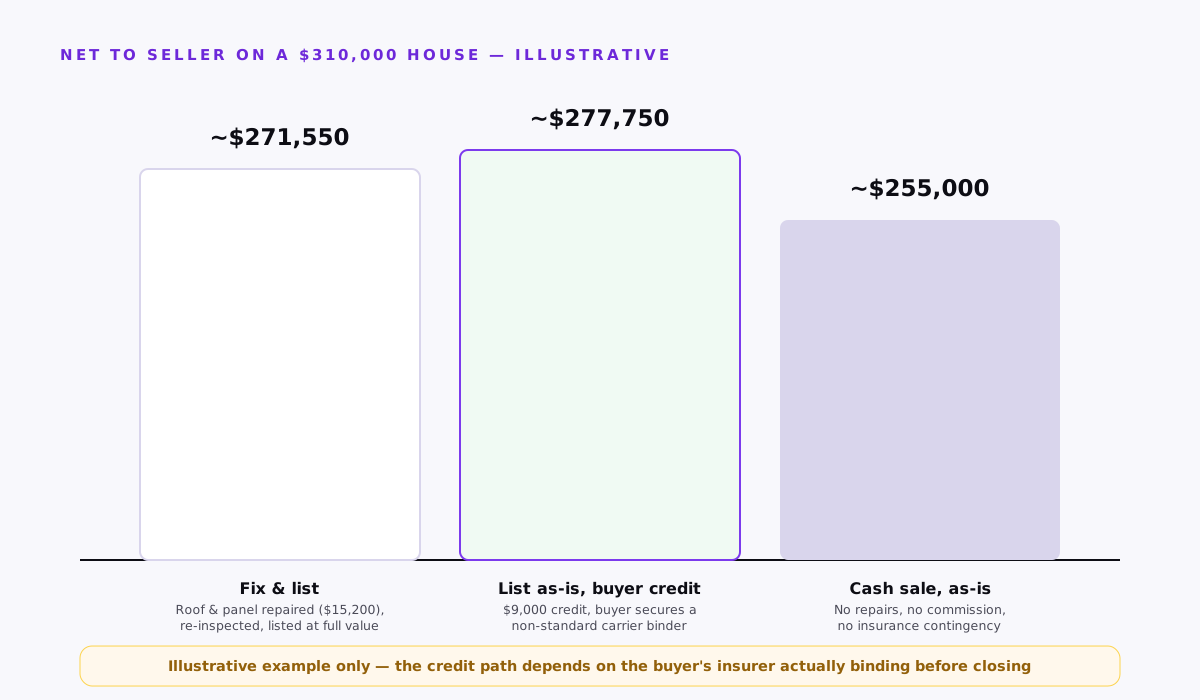
These numbers are illustrative for one hypothetical house — your roof size, panel cost, local contractor pricing, and buyer pool will change every line of this math. Get your own repair quotes and your own listing comparables before deciding.
You have more options than fixing everything or walking away from the deal. Get quotes and re-inspect if the fix is affordable and you have the weeks to spare — a roofer's or electrician's quote plus a re-inspection can clear the non-renewal and let you list at full value, often the strongest outcome on paper if your timeline allows it. Shop a non-standard or surplus-lines carrier if you'd rather not spend on repairs; it can satisfy a lender's insurance requirement at a higher premium, though the extra cost becomes someone's ongoing expense.
Negotiate a closing credit with a financed buyer instead of doing the repair yourself — often the best-netting path, but it depends on the buyer's lender and insurer actually agreeing to it before the closing deadline. List as-is and accept a smaller buyer pool by disclosing the flagged item and pricing accordingly, which opens the house to cash buyers and investors who don't need standard financing or a clean inspection, usually at a lower price than a repaired listing. Or sell for cash, which skips the insurance contingency altogether because the sale isn't conditioned on a lender's hazard-insurance requirement — the tradeoff is a lower price than the best-case financed outcome, for certainty and speed.
If plumbing material is the flagged item rather than the roof or panel, the cost and negotiation dynamics are similar but the material matters — see our guide on selling a house with galvanized or polybutylene plumbing for specifics on that system. And whichever path you're weighing, our cash offer vs. listing net proceeds guide walks through the same kind of comparison in more detail.
Usually, yes, in the specific sense that matters here: a cash sale removes the lender's hazard-insurance requirement from the transaction entirely, because there's no mortgage underwriting to satisfy. That doesn't make the roof or panel issue disappear — the buyer still owns a house with an aging roof or a flagged panel, and prices it accordingly, as shown in the table above. It just takes the insurance contingency, the binder risk, and the closing-deadline pressure off your plate.
If you're in Florida specifically, this same underwriting pressure shows up as the state's 4-point inspection process rather than an out-of-state carrier's own check — see our 4-point inspection cost guide for that version of the math. If you'd rather know your number before deciding between repairing, negotiating, or listing as-is, a written cash offer costs nothing to get and gives you a real figure to measure the other paths against.
A cash offer accounts for the flagged roof, panel, or plumbing as-is, so you're not choosing between a repair bill and a financing deadline.
You'll get a written offer within 24 hours, no repairs or commissions required, and you pick the closing date. We're a direct buyer, not an insurance agent or your attorney, and this isn't insurance or legal advice.
All guides · Cost of a 4-point inspection in Florida · Selling a house with galvanized or polybutylene plumbing · Cash offer vs. listing net proceeds
Step 1 of 5
No obligation, no fees, no repairs. We respond the same day.
You’ll talk to Trevor McAmis, Owner & Acquisitions Lead
(313) 710-6129
Takes about two minutes. Or call (313) 710-6129 — we answer.