A 4-point inspection itself typically costs $75 to $200. The real cost shows up if it fails — repairs for an aging roof, an outdated electrical panel, old plumbing, or worn-out HVAC can run from a few thousand dollars to $15,000 or more. It's an insurance underwriting requirement that Florida insurers commonly apply to older homes, not a state law or a government mandate. If your insurer, or your buyer's insurer, has flagged your house for a 4-point inspection, the letter itself can feel like the start of a bad chain reaction — inspection, then a fail notice, then a non-renewal, then a buyer's lender getting nervous about closing. It's worth separating what's actually happening from what it feels like. A 4-point inspection is an underwriting tool insurance companies use to decide whether to write or renew a policy on an older home. It isn't a code inspection, a permit requirement, or anything the state of Florida requires you to get before you can sell. This guide walks through the cost of a 4-point inspection before selling a house in Florida — what the inspection actually checks, who requires it and why, what typical fail-item repairs cost, and how an uninsurable house plays out differently depending on whether you're selling retail to a financed buyer or selling as-is for cash. Every dollar figure below is an illustrative example, not a quote for your specific house.
Step 1 of 5
Send the address and we'll show you both paths — cash and repair-and-list — net of realistic repair costs.
You’ll talk to Trevor McAmis, Owner & Acquisitions Lead
(313) 710-6129
Takes about two minutes. Or call (313) 710-6129 — we answer.
Educational only. This explains how these situations generally work. It is not legal, tax or financial advice, and the rules differ by state — talk to an attorney or CPA about your own situation before you act on any of it.
A 4-point inspection looks at exactly four systems in a home: the roof, the electrical system, the plumbing system, and the HVAC (heating, ventilation, and air conditioning) system. An inspector notes the age, condition, and remaining useful life of each system, along with any obvious safety hazards — an outdated fuse box, exposed wiring, a roof with visible wear, corroded or leaking pipes.
It's a narrower report than a full home inspection, which covers structure, appliances, windows, and dozens of other items. The 4-point exists purely to answer an insurer's question: is this specific home an acceptable underwriting risk given the age and condition of its four most expensive-to-fail systems?
No Florida statute requires a homeowner to get a 4-point inspection before selling — it's an insurance-industry practice, not a legal mandate. Insurance carriers writing or renewing homeowners policies in Florida commonly require one on homes around 25 to 30 years old or older, because those are the homes statistically more likely to have original systems nearing the end of their service life.
The requirement comes from the insurance company underwriting the policy — yours if you're keeping the house, or a buyer's if they're financing a purchase and their lender requires a policy to close.
It's easy to conflate this with Florida's wind mitigation inspection, but they're different reports serving different purposes. A wind mitigation inspection documents features that reduce hurricane and windstorm damage — roof shape, roof-to-wall connections, opening protection — and Florida law requires insurers to offer documented discounts for those features under a uniform verification form set out in Florida Statute 627.711. A 4-point inspection, by contrast, is about whether the home qualifies for coverage at all, not about a discount on it. Older homes near the coast are frequently asked for both at once, which is part of why the two get confused.
The inspection itself is the cheap part. Florida inspectors typically charge $75 to $200 for a standalone 4-point inspection, and many bundle it with a wind mitigation inspection for a combined $150 to $300, since both are commonly ordered together on older homes. Compared to what's at stake — a policy renewal or a closing — the inspection fee is a rounding error. The number that actually matters is what happens next: pass, and nothing changes; fail, and you're looking at either repair costs or a harder conversation about insurability.
A fail on any one of the four systems can trigger a non-renewal notice or a new-policy denial, and the fix is specific to whichever system failed. These are illustrative cost ranges for common Florida fail items, not a quote for your house:
Outdated electrical panel or aluminum branch wiring. A full panel replacement generally runs $2,000 to $6,000. If the fail is aluminum branch wiring throughout the house rather than just the panel, a full rewire can run $8,000 to $15,000 or more.
Aging roof. Insurers commonly flag asphalt shingle roofs once they're 15 to 20+ years old. Full replacement on a typical Florida home runs roughly $9,000 to $16,000 for asphalt shingle, $15,000 to $30,000 for metal, and $18,000 to $35,000 or more for tile.
Polybutylene or galvanized plumbing. A full repipe on an older home commonly runs $4,000 to $12,000 depending on square footage and the number of fixtures.
Aging HVAC. A full system replacement typically runs $6,000 to $12,000, depending on system size and ductwork condition.
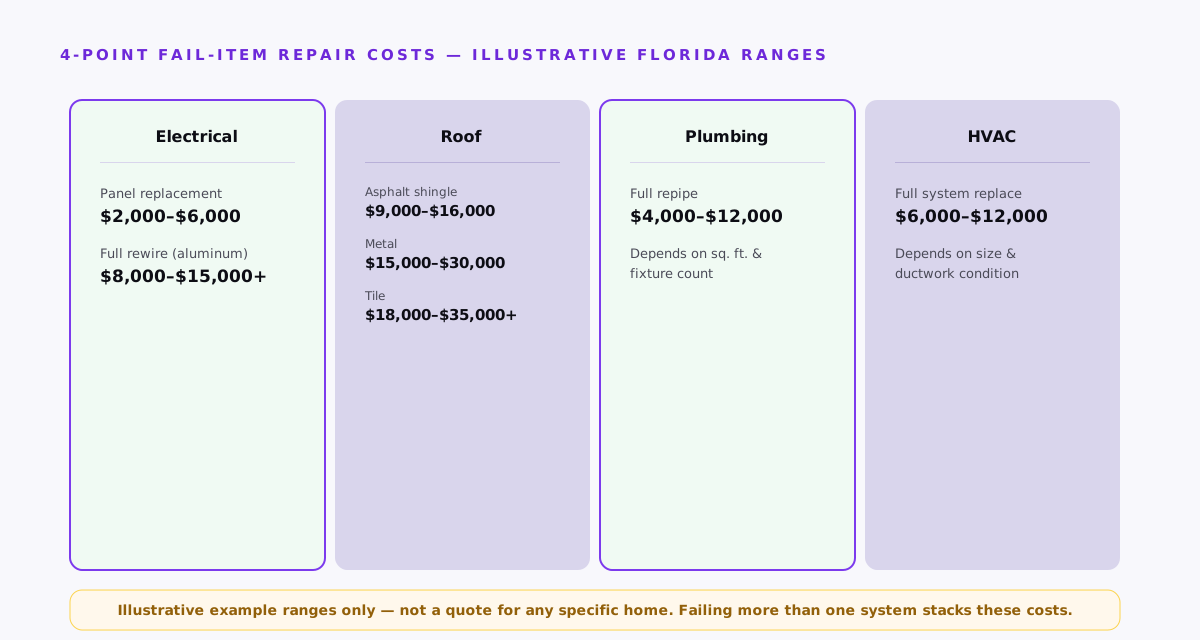
Failing on more than one system stacks these costs. A house with both a 25-year-old roof and an original electrical panel isn't unusual in Florida's older housing stock, and the repair bill to get it back to insurable can run well into five figures before you've spent anything on cosmetic updates.
Florida's homeowners insurance market has spent years under pressure from repeated hurricane losses, and carriers have pulled back or non-renewed policies on higher-risk homes more aggressively than in most other states. An older home that fails its 4-point inspection can end up non-renewed by its current carrier, difficult to place with a new one, and reliant on a higher-premium option if it can be placed at all.
The Florida Office of Insurance Regulation oversees that market and the carriers operating in it, and Citizens Property Insurance Corporation exists specifically because private carriers have declined to cover a meaningful share of Florida homes, including many older ones — Citizens was created as the state-backed insurer of last resort for homeowners who can't find coverage on the private market. For a homeowner planning to sell, that's the backdrop the buyer's insurability question gets asked against — it isn't just your problem, it's baked into the local insurance market.
This is where the 4-point inspection stops being an abstract insurance issue and starts being a closing-timeline issue. A retail buyer using a mortgage generally cannot close without a homeowners insurance policy in place, because their lender requires it as a condition of funding. If a 4-point inspection ordered during that buyer's underwriting comes back with fail items, and no carrier will bind a policy until the roof or panel is replaced, the financed deal can stall while repairs get done, or fall apart entirely if the buyer or seller won't pay for them. That risk is on top of, not instead of, the repair cost itself — see our guide on the cost of lender-required repairs before closing for how this shows up more broadly in financed sales, and our guide on selling a house with no homeowners insurance for what an uninsurable house does to a listing generally.
A cash sale works differently because there's no lender in the transaction requiring a bound insurance policy to fund at closing. As a cash buyer, Restar Acquisitions doesn't have an insurance-binding contingency the way a financed retail buyer's lender does, so a failed 4-point inspection or a non-renewal notice doesn't stall our closing the way it can stall a financed one. That doesn't mean the roof or the panel stopped needing repair — it means the cost of that repair shows up as a lower offer price instead of a repair bill you pay out of pocket before closing, which is a different tradeoff, not a free one.
These are illustrative example figures only, not a quote for any specific property. Say a Cape Coral home built in the mid-1990s fails its 4-point inspection on two items: the original asphalt shingle roof, now past insurers' age threshold, and an outdated electrical panel.
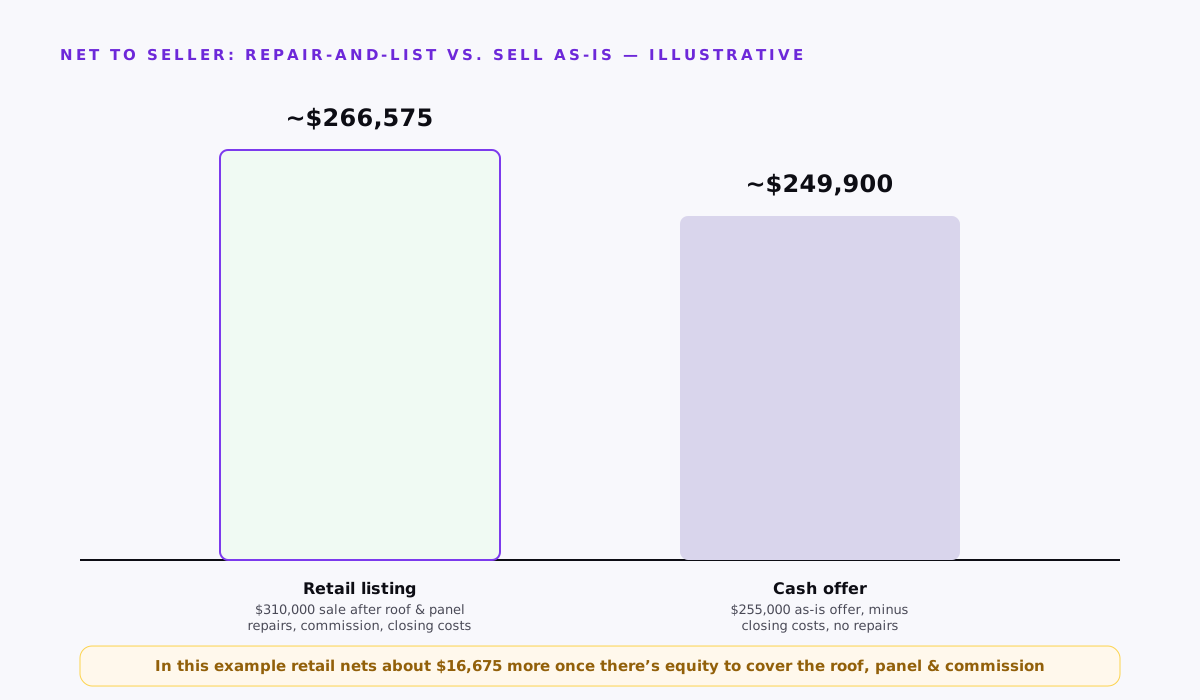
| Retail listing (after repairs) | Cash offer (as-is) | |
|---|---|---|
| Estimated sale price | $310,000 | $255,000 |
| Roof replacement | −$12,500 | $0 (sold as-is) |
| Electrical panel replacement | −$3,500 | $0 (sold as-is) |
| 4-point inspection fee | −$125 | $0 |
| Agent commissions (~6%) | −$18,600 | $0 |
| Seller closing costs (~2%) | −$6,200 | −$5,100 |
| Carrying/delay costs during repairs (est.) | −$2,500 | $0 |
| Estimated net to seller | $266,575 | $249,900 |
In this illustrative example, repairing the fail items and listing retail nets roughly $16,675 more than selling as-is for cash, because an insurable, fully repaired house commands a higher price even after commissions and repair costs come out. That's the honest tradeoff: selling as-is skips the roof job, the electrical work, and the wait for a buyer's insurance to bind — but it typically nets less than a repair-and-list path when there's enough equity to absorb the repair costs. If the repair bill is large relative to the home's value, or if the seller can't front the money for a new roof before selling, the gap narrows. Run your own numbers — see our cash offer vs. listing net proceeds breakdown for more on what actually comes out of each path.
A failed 4-point inspection doesn't automatically mean you have to sell, and selling as-is for cash isn't the only path if you do. Worth weighing:
Make the repairs and re-inspect. If you have the cash or can finance the roof or panel work, passing a follow-up 4-point inspection can restore your ability to renew or get a new policy at a normal rate.
Shop for a different carrier, or Citizens as a last resort. Not every insurer applies the same age thresholds or fail criteria. A different carrier may still write a policy your current one won't, and Citizens exists specifically for homes that can't place coverage on the private market.
Negotiate a repair credit with a retail buyer. Instead of doing the repairs yourself before listing, some sellers negotiate a closing credit so the buyer handles the repair after closing — though many lenders still require the fail items resolved before they'll fund, so this doesn't always work for a financed sale.
Sell as-is for cash. Skips the repair bill and the insurance-binding contingency, at the cost of a lower price, as the worked example above shows.
Restar Acquisitions buys houses directly, as-is, for cash, in 45 markets across Alabama, Arizona, Florida, Georgia, Indiana, Maryland, Michigan, Missouri, New York, North Carolina, Ohio, and Texas — including Cape Coral, Fort Myers, Jacksonville, Lehigh Acres, and North Fort Myers in Florida. If your home is in one of those markets, we can typically give a written offer within 24 hours of seeing it, require no repairs, and charge no commissions — you also pick the closing date. A failed 4-point inspection, a non-renewal notice, or an outdated roof or panel doesn't need to be fixed before we can make an offer.
We are not insurance agents, real estate agents, or brokers, and we do not represent you as a seller — we're a direct buyer, and our interests in the transaction are our own, not yours. As the worked example above shows, repairing the fail items and listing retail typically nets more than selling as-is for cash when there's enough equity to make the repairs worthwhile. If your numbers work out better with an agent, or with getting the roof done and shopping for a new carrier, we'll say so. A fast sale isn't the right fit for everyone.
This article is for general educational purposes only and is not insurance, legal, or financial advice. Insurance underwriting requirements, carrier policies, and repair costs vary by insurer, property, and market conditions. Talk to a licensed Florida insurance agent or a contractor for guidance specific to your home.
We'll give you a written offer within 24 hours and buy the house as-is, whether it passed, failed, or was never inspected — and if repairing and listing nets you more, we'll say so.
All guides · Selling a house with no homeowners insurance · Cash offer vs listing net proceeds · Cost of lender-required repairs before closing
Step 1 of 5
No obligation, no fees, no repairs. We respond the same day.
You’ll talk to Trevor McAmis, Owner & Acquisitions Lead
(313) 710-6129
Takes about two minutes. Or call (313) 710-6129 — we answer.
