If your house sits off a private road, a gravel lane, or a shared drive the county doesn't plow or pave, you can still sell it. The complication isn't the road itself. It's that most mortgage lenders won't fund a loan on a house without a public street or a recorded, permanent agreement guaranteeing year-round access and shared maintenance. No agreement, or a weak one, and your buyer pool narrows fast to cash.
Step 1 of 5
Send the address. We will tell you what we would pay, and whether a recorded agreement would net you more.
You’ll talk to Trevor McAmis, Owner & Acquisitions Lead
(313) 710-6129
Takes about two minutes. Your address is never shared.
Educational only. This explains how these situations generally work. It is not legal, tax or financial advice, and the rules differ by state. Talk to an attorney or CPA about your own situation before you act on any of it.
A road maintenance agreement, sometimes called an RMA or a private road association agreement, is a recorded covenant among everyone who uses a private road. It spells out who pays for grading, paving, snow removal and repairs, and it's supposed to bind future owners, not just whoever signed it originally.
Some of these are informal handshake deals between three neighbors that were never written down. Some are formal associations with bylaws, an elected board, and annual dues, functioning a lot like an HOA except the only thing it governs is the road.
The agreement matters because of what it's for, not because the road is pretty or ugly. A lender funding a 30-year mortgage wants certainty that the house will have year-round vehicle access for the life of the loan, and that no single neighbor can block the road in a dispute and leave the buyer's new house unreachable.
A financed buyer's lender needs proof of permanent, legal access to a public road, and most will not close without it. If your road is private, that proof is either a recorded easement with a maintenance agreement attached, or a state law that already assigns maintenance duty without one. Missing both, the loan file has a gap a lender's underwriter has to resolve before funding, and that resolution can take weeks you don't have mid-escrow.
Here's how each major loan backer treats it.
FHA requires what HUD's Handbook 4000.1 calls Adequate Vehicular Access: an all-weather surface that a typical passenger vehicle and emergency vehicles can use at any time of year, reaching the house from either a public street or a private street covered by a permanent, recorded easement or ownership interest. Where an HOA or recorded agreement already handles the private street's upkeep, FHA doesn't require a separate maintenance agreement on top of it.
VA used to require a standalone joint-maintenance agreement for private roads. It doesn't anymore. VA Circular 26-22-17, effective November 2022, dropped that requirement outright for VA-financed homes nationwide. A VA loan on a private-road house still needs a recorded permanent easement or right-of-way reaching a public road, just not the maintenance paperwork that used to come with it.
Fannie Mae's Selling Guide, Section B4-1.3-04, is the most specific of the three. For a community-owned or privately maintained street, it requires an adequate, legally enforceable agreement or covenant for maintenance of the street, and spells out what that agreement has to cover: each party's share of the cost, what happens if someone doesn't pay, and a term that's perpetual and binds future owners, recorded in the land records. There's one exception: if your state already assigns private-street maintenance responsibility by statute, you don't need a separate recorded agreement. Skip this requirement without the state-law exception, and the lender can still sell the loan to Fannie Mae, but has to personally indemnify Fannie Mae against any loss tied to the street's condition or access, which is exactly the kind of risk a lender's underwriter tends to decline rather than accept.
Freddie Mac's guide requires the same basic thing in substance: ingress and egress either from a public road directly, or through a recorded, perpetual easement providing safe, reliable access to one.
If your road has a formal association and you owe back dues, that debt generally has to be resolved before the sale closes clean, the same way an unpaid HOA assessment does.
It shows up in a title search, it can turn into a lien if it's been outstanding long enough under your association's own rules, and a buyer's title company will want it paid off or credited at closing rather than passed along unresolved. Check your specific agreement; some include their own lien and foreclosure remedies for nonpayment, which is worth knowing before you list.
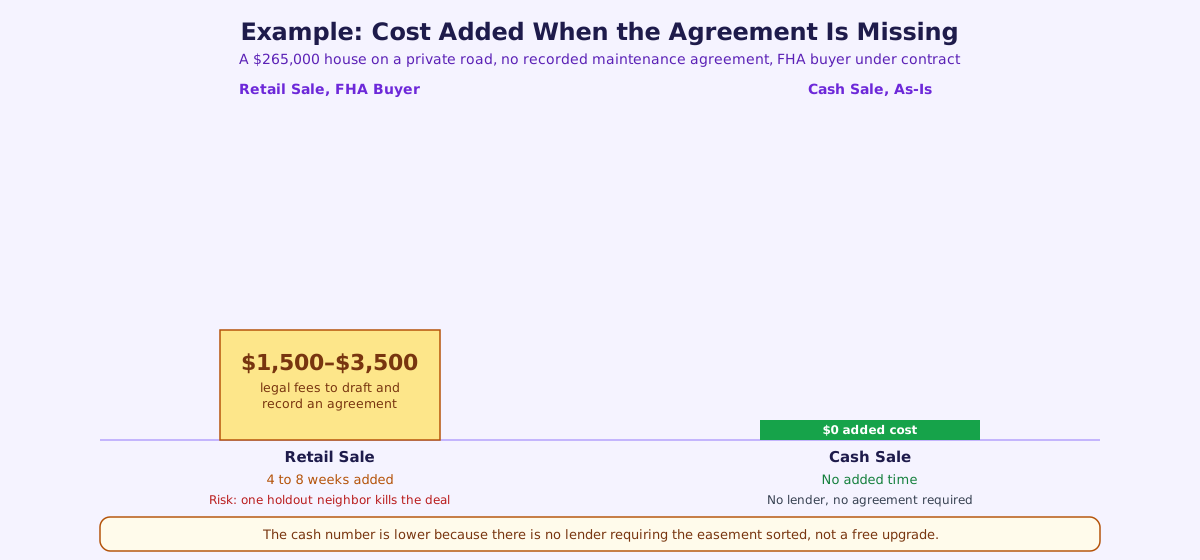
Example: a $265,000 house on a private gravel road with no recorded maintenance agreement, no HOA, and no state-law fallback in your state. A retail buyer puts the house under contract with an FHA loan, and the appraiser flags the access issue before the deal can close.
The underwriter now asks for a recorded easement and maintenance agreement before closing, and you need a real estate attorney to draft one, get every neighbor on the road to sign it, and record it, typically $1,500 to $3,500 in legal fees depending on how many neighbors are involved and how cooperative they are. That process commonly adds four to eight weeks. If even one neighbor refuses to sign, the deal can die entirely, and you're back to square one with a house that still shows "financing fell through" in its history to the next buyer.
| Retail sale, agreement missing | Cash sale, as-is | |
|---|---|---|
| Needs a recorded maintenance agreement before close | Yes, buyer's lender requires it | No |
| Needs every neighbor's signature | Yes | No |
| Typical added cost | $1,500–$3,500 legal fees | $0 |
| Typical added time | 4–8 weeks, or deal collapse if a neighbor refuses | None |
| Who bears the risk of a holdout neighbor | You, mid-contract | Not applicable |
That doesn't mean the cash number wins automatically. A cash buyer doesn't need the easement sorted because there's no lender in the transaction requiring one, and that convenience shows up as a lower offer, not a free upgrade. If your road already has a clean, recorded agreement in place, or your state assigns maintenance duty by statute, none of this applies to you, and listing with an agent at full retail price is very likely your better number. Get the real comparison before deciding either way.
Get the agreement drafted and recorded before you list, if time allows. A real estate attorney can draft a compliant maintenance agreement and get it signed by everyone on the road, then record it. It costs money and takes weeks, but it removes the financing obstacle permanently, not just for this sale.
Check if your state already handles it. A handful of states assign private-road maintenance duty by statute, which can satisfy Fannie Mae's exception without any new paperwork. A local real estate attorney can tell you in one phone call whether yours is one of them.
List as-is and disclose the access situation. Some retail buyers pay cash or use a loan program less exacting about this issue. You're accepting a smaller buyer pool, but not giving up the retail price entirely.
Sell to a cash buyer who doesn't need lender approval of the road at all. This is where we fit, if the math says it's your best option once you've looked at the real numbers above.
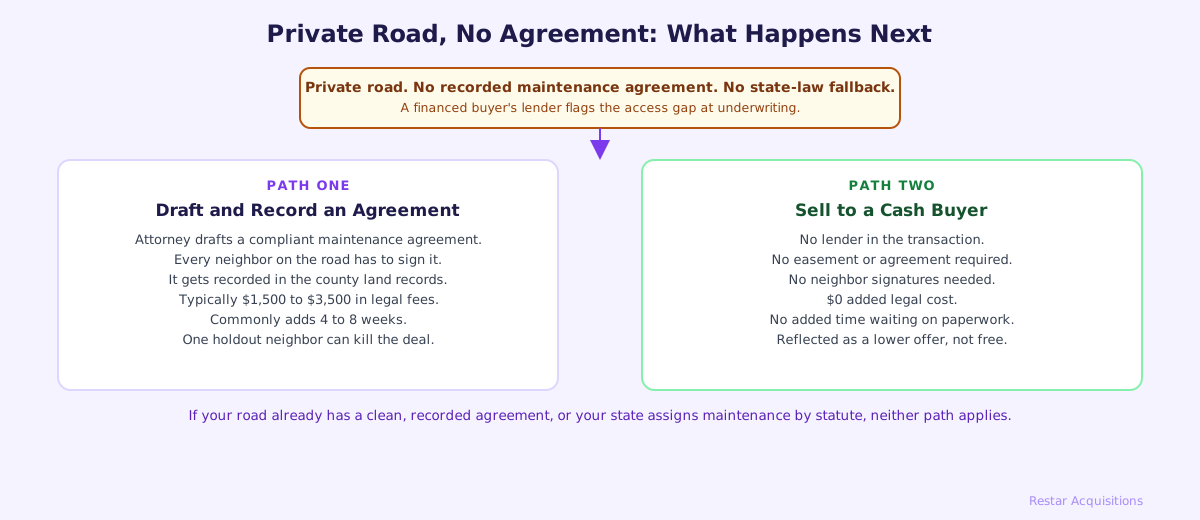
Restar Acquisitions buys houses as-is, for cash, in 69 markets across 14 states, including rural and exurban areas where private roads are common. We'll give you a written offer within 24 hours, with no repairs, no commissions, and no financing contingency to fail over a road easement. If getting an agreement drafted and recorded would net you more once you weigh the legal cost against the time, we'll tell you that too.
This issue shows up alongside other access problems we cover too, including selling a house with no legal access and selling a house with a shared driveway or access easement, if either of those sounds closer to your situation.
This article is for general educational purposes and is not legal advice. Road maintenance requirements vary by state, by lender, and by the specific loan program. Confirm your situation with a real estate attorney before relying on anything above.
If you send us the address we will tell you within 24 hours what we would pay for it as-is, with no financing contingency to fail over a road easement. We will also tell you if getting an agreement drafted and recorded would net you more, as it does for some sellers in the example on this page.
All guides · Selling a house with no legal access · Selling a house with a shared driveway · Cash offer vs listing net proceeds
Step 1 of 5
No obligation, no fees, no repairs. We respond the same day.
You’ll talk to Trevor McAmis, Owner & Acquisitions Lead
(313) 710-6129
Takes about two minutes. Your address is never shared.
