Every market page publishes the numbers behind its offer. See the math
Home › Guides › Selling a House with an Underground Oil Tank
Guide
Selling a House with an Underground Oil Tank
An underground oil tank scares off financed buyers a lot more often than it violates any law. Most states don't force you to dig one up just because it's there and unused — but lenders, title companies, and buyers react to it anyway, and if the tank has ever leaked, the cleanup bill has no ceiling. Here's what's actually required, what it actually costs, and what your real options are.
Takes about two minutes. Or call
(313) 710-6129 — we answer.
Educational only. This explains how these situations generally work. It is not legal, tax or financial advice, and the rules differ by state — talk to an attorney or CPA about your own situation before you act on any of it.
Selling a house with an underground oil tank: the short answer
Most states don't legally require you to remove an inactive underground oil tank before selling, but you generally must disclose it if you know it's there, and financed buyers' lenders frequently require proof of removal, proper closure, or a pollution liability policy before they'll approve the loan — which is often the bigger obstacle than the law itself.
This is educational information, not legal or environmental advice. Tank laws, disclosure duties, and lender overlays vary by state, county, and loan program — confirm your specific situation with a real estate attorney and a licensed tank contractor before you list.
Why this comes up so often in older housing stock
Home heating oil was standard in much of the Midwest and Northeast before natural gas lines reached most neighborhoods, and a lot of that infrastructure never got dug up — it just got abandoned in place when the house switched to gas or electric. If your house was built before the 1970s, there's a real chance an oil tank is still buried somewhere in the yard even if no one currently living there has ever used it.
This shows up constantly in exactly the kind of older housing we buy across our markets — homes from the 1920s through the 1960s in cities like Detroit, Cleveland, Baltimore, and Rochester still routinely turn up tanks that predate every current owner's paperwork.
What federal and state law actually require
Here's a fact that surprises most sellers: the EPA's underground storage tank program, at 40 CFR Part 280, specifically excludes tanks that store heating oil for use on the same property where the tank sits. A typical residential heating oil tank is federally exempt from EPA's UST regulations entirely — this isn't a program built around your basement furnace tank.
States are a different story, and this is where you actually need to check local rules. Some states (Michigan among them) require sellers to disclose known underground storage tanks on a standard property disclosure form. Others regulate tanks only once a leak is suspected or confirmed, and stay silent otherwise. We did not find a blanket statute forcing every seller to remove every inactive tank before closing in the states where we buy, but county and municipal rules can layer on top of state law and change from one jurisdiction to the next — confirm your specific city and county with a real estate attorney rather than relying on a general answer. Separately, disclosure duties for known material defects apply broadly under ordinary real estate law, tank-specific statute or not. If you know about a buried tank and say nothing, you're taking on real post-closing liability if the buyer finds it later, regardless of what a specific tank statute does or doesn't say.
Why lenders act like it's illegal even when it isn't
FHA appraisal guidance (in HUD's FHA Single Family Housing Policy Handbook updates) directs appraisers to note visible surface evidence of underground tanks — fill pipes, vent caps, ground depressions — and flag it for further review if there's evidence of leakage. The often-cited "300-foot rule" that disqualifies a property near a large tank applies to aboveground tanks holding 1,000+ gallons of flammable material, which is not what a typical 275- to 330-gallon residential heating oil tank is. That rule usually doesn't apply to your situation, but plenty of appraisers and loan officers treat any tank mention as an automatic problem out of caution, not because the rule actually says so.
In practice, most conventional, FHA, and VA lenders will still want one of three things before funding: documented proof the tank was properly removed or closed in place by a licensed contractor, soil testing showing no contamination, or a pollution/tank liability insurance policy the buyer or seller puts in place to cover any future discovery. Any one of those can stall a financed closing by weeks while it gets arranged.
What removal, testing, and remediation actually cost
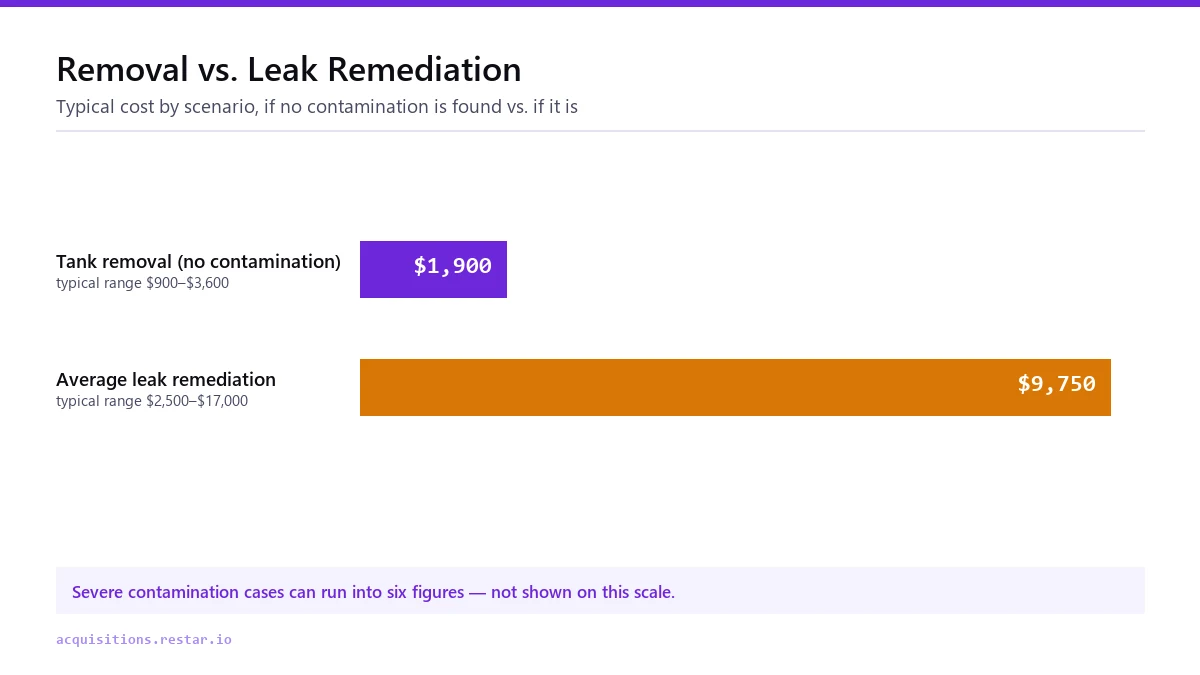
Straightforward tank removal (no contamination found)
$900 – $3,600
Soil testing / tank sweep only
$300 – $800
Remediation if a leak is confirmed
$2,500 – $17,000 (average)
Severe contamination, worst case
Can run into six figures
The cost range widens fast once a leak is confirmedRestar Acquisitions · cost ranges from industry cost data
The gap between those numbers is the entire reason sellers get nervous. A clean removal is a manageable, planned expense. A confirmed leak turns an oil tank from a line item into an open-ended liability that a home inspection alone won't catch — only soil testing will.
The honest math: removal-then-list versus selling as-is
Say a $2,600 removal (mid-range, no contamination found) is what stands between your house and a normal financed buyer. Selling on the retail market after that removal likely nets more than an as-is cash sale in absolute dollars — that's true of most repairs and disclosures. But it also means fronting $2,600 you may not have, waiting weeks for a contractor and testing before you can even list, and accepting the small but real risk that testing turns up contamination you didn't expect, at which point the bill can jump into five figures before you've sold anything.
A cash sale skips that sequence: no removal required before closing, and the buyer prices the uncertainty into the offer rather than requiring you to resolve it first. If your budget or timeline can't absorb an open-ended remediation risk, that trade is often worth more than the price gap suggests — but only you can weigh that against your actual finances. If you can afford the removal and testing comes back clean, listing after removal is very likely the better financial outcome.
Your options besides digging it up
Proper closure in place — where state or local rules allow it, a licensed contractor can fill an inactive tank with sand or foam and file closure documentation, which is often cheaper than full removal and satisfies some lenders.
Pollution/tank liability insurance — a policy covering future contamination discovery, sometimes accepted by lenders and title companies as a substitute for removal.
Seller credit at closing — crediting a financed buyer the estimated removal cost so they handle it after closing, if the buyer and their lender will accept the property with the tank still in place.
Sell to a cash buyer as-is — the buyer takes on the uncertainty directly, no lender tank policy to satisfy.
Whichever path you take, get a written closure certificate or test result for your own file — it's what protects you from a dispute after closing, tank statute or not.
Common questions
Do I legally have to remove an underground oil tank before I sell?
In most states, no — there's no blanket law forcing removal of an inactive tank. You generally do have to disclose it if you know it's there. Check your specific state and county, since local rules do vary.
Will an oil tank automatically disqualify a buyer's FHA or VA loan?
Not automatically. The rule that disqualifies properties near large tanks applies to 1,000-gallon-plus aboveground tanks holding flammable material, not typical residential heating oil tanks. In practice, though, many lenders still want proof of removal, testing, or an insurance policy before funding, which can feel like the same thing.
How do I even find out if there's a tank on my property?
A tank sweep using ground-penetrating radar or a metal detector, done by a licensed environmental or tank removal contractor, is the standard way to confirm one exists if you only suspect it from old fill pipes, vent caps, or a depression in the yard.
What happens if testing finds a leak?
You'll typically need to report it to your state environmental agency and remediate the contaminated soil, which averages $2,500 to $17,000 but can run far higher in severe cases. The <a href="https://www.epa.gov/ust">EPA's underground storage tank program</a> outlines general cleanup and reporting principles even though most residential heating oil tanks fall outside its direct jurisdiction. Get a written scope from a licensed remediation contractor before you commit to any number.
Can I just sell the house without mentioning the tank?
Not without real risk. Even in states without a tank-specific disclosure statute, failing to disclose a known material defect can expose you to a misrepresentation or fraud claim after closing. Disclose what you know.
Does a cash buyer still care if there's a leak?
Yes — a confirmed active leak is a real environmental liability regardless of who buys the house, and it affects any reasonable buyer's price. What a cash sale changes is that you're not required to resolve or fund the remediation yourself before closing.
A cash sale doesn't require you to remove the tank first
Most financed buyers' lenders will ask for proof the tank is gone, filled in place with documentation, or covered by a pollution liability policy before they'll fund the loan — that's underwriting caution, not a law you're breaking. Selling to a cash buyer means we underwrite the property ourselves and can close without waiting on a lender's tank policy. Send us the address and we'll tell you plainly what the tank does and doesn't change about your options.
If the tank has a known or suspected leak, that changes the math regardless of who buys it — get it tested before you price anything.
Every offer on this site is underwritten by a person, not a form. If the
numbers do not work for you, say so and I will tell you what would.
Also from Restar
Want the data behind all of this?
Restar Acquisitions is the acquisitions arm of Restar — a housing-market analytics
platform tracking 180+ metrics across every U.S. market, with composite scores and 12-month
price forecasts. The numbers on this page come from the same work.