If you inherited a house through a transfer-on-death (TOD) deed, also called a beneficiary deed, the title passed to you automatically the moment the owner died — no probate required. You can usually sell once you record a death certificate and an affidavit with the county, but you still need to deal with the mortgage, any creditor claims against the estate, and — if there's more than one beneficiary — getting every co-owner to agree and sign.
Step 1 of 5
Send the address and we'll tell you honestly what it's worth and how fast we can close.
You’ll talk to Trevor McAmis, Owner & Acquisitions Lead
(313) 710-6129
Takes about two minutes. Or call (313) 710-6129 — we answer.
Educational only. This explains how these situations generally work. It is not legal, tax or financial advice, and the rules differ by state — talk to an attorney or CPA about your own situation before you act on any of it.
A TOD deed is a document the owner signs and records while alive, naming a beneficiary who receives the property automatically at death. Until that moment, it has zero effect — the beneficiary has no ownership interest, no say in the property, and no right to block a sale. The owner keeps full control: they can sell the house, mortgage it, or revoke the deed entirely, with no notice to the beneficiary required.
At death, the transfer completes outside probate. The beneficiary (or their representative) typically records an affidavit or evidence of death referencing the original recorded deed with the county recorder — confirmed directly in Ohio's statute (Ohio Rev. Code §5302.22) and Arizona's (Ariz. Rev. Stat. §33-405). No judge, no personal representative, no months-long court process. That's the entire appeal of the instrument, and it's real — but it doesn't mean the house arrives free of every other complication a probate sale would have.
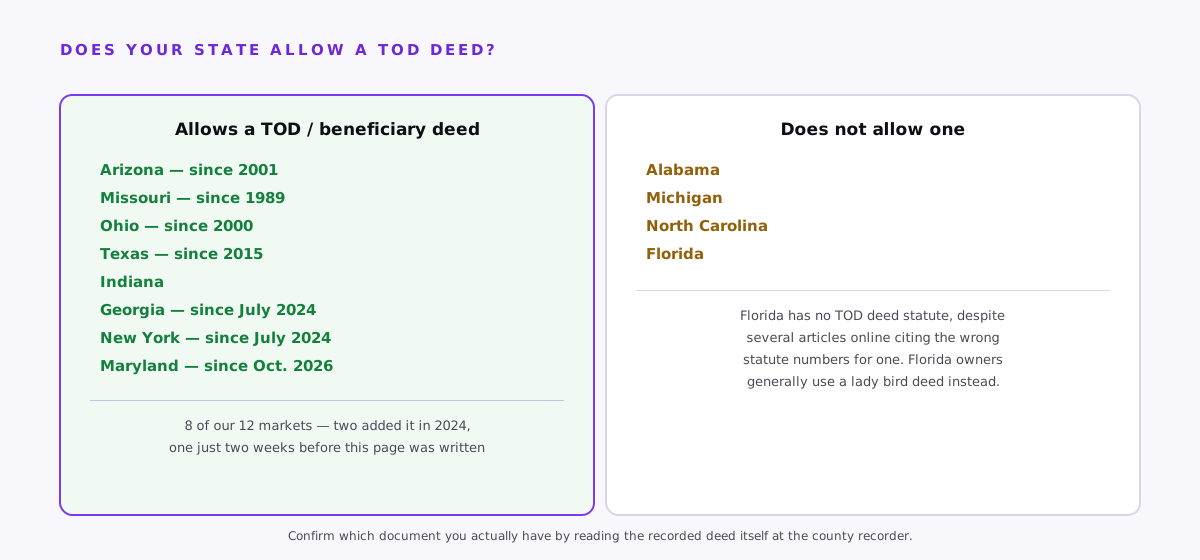
This is the first thing to check, because the answer is not uniform, and some of the most commonly repeated online claims about which states allow it are wrong. Of the markets we buy in:
Allow a TOD/beneficiary deed: Arizona (since 2001, Ariz. Rev. Stat. §33-405), Missouri (since 1989 — the first state to allow one, Mo. Rev. Stat. §461.025), Ohio (since 2000, Ohio Rev. Code §5302.22), Texas (since September 1, 2015, Est. Code Ch. 114), Indiana (Ind. Code 32-17-14), Georgia (since July 1, 2024, O.C.G.A. §§44-17-1 to 44-17-7), and New York (since July 19, 2024, N.Y. Real Prop. Law §424). Maryland just joined this list — its law (Md. Real Property Code §§14-1001–14-1014) took effect October 1, 2026, two weeks before this page was written.
Do not allow one: Alabama, Michigan, North Carolina (a 2023–24 bill to adopt one failed), and — contrary to several widely-circulated articles — Florida. We checked Florida's two most commonly cited statute numbers directly against the live Florida Statutes: one (§689.075) governs inter-vivos trusts, the other (§732.4015) governs homestead devise rules. Neither is a TOD deed statute, and Florida has not adopted one. Florida sellers who inherited through what they were told was a "transfer-on-death deed" most likely have a lady bird deed (enhanced life estate deed) instead — a different, older instrument with its own mechanics, which we cover in our life estate guide.
If you're not sure which document you actually have, the fastest way to find out is to pull the recorded deed itself from the county recorder and read its exact title and language — not to assume based on what a family member called it.
Because a TOD deed can be revoked or replaced by the owner at any time before death, with no notice ever required to the beneficiary, confirm the version you're relying on is actually the last one recorded before you plan around it. Revocation generally happens through a later recorded TOD deed, a recorded revocation instrument, or an ordinary deed transferring the property elsewhere — not through a will, and not by destroying the paper copy.
Pull the full recorded history on the property at the county recorder before you assume the deed you were shown is the final word.
Multiple named beneficiaries generally take the property as tenants in common, not as a single unit, each holding an undivided share with no automatic right to the others' portions. Texas's statute spells this out directly: concurrent beneficiaries receive "equal and undivided shares with no right of survivorship" (Tex. Est. Code §114.103(a)(3)), and Missouri and Indiana follow the same default.
That has a practical consequence that trips people up: every co-owner generally has to agree to sell and sign the closing documents. One sibling wanting to sell and another wanting to keep the house is the exact situation our heirs who can't agree to sell guide walks through — the mechanics there apply here too, TOD deed or not. Arizona is the one exception among our states: its deed can specify joint tenancy with survivorship instead, so check what your specific deed actually says before assuming the default rule applies to you.
What happens if a named beneficiary died before the original owner varies by state and sometimes by the deed's own wording. Texas applies its ordinary anti-lapse rule — if the beneficiary was a descendant of the owner or the owner's parent, that beneficiary's own children inherit the share instead of it failing. Arizona lets the owner specify in the deed itself whether a predeceased beneficiary's share lapses or passes to that beneficiary's estate. If a named beneficiary on your deed died first, get a title company or attorney to confirm who actually holds that share before you count it as settled.
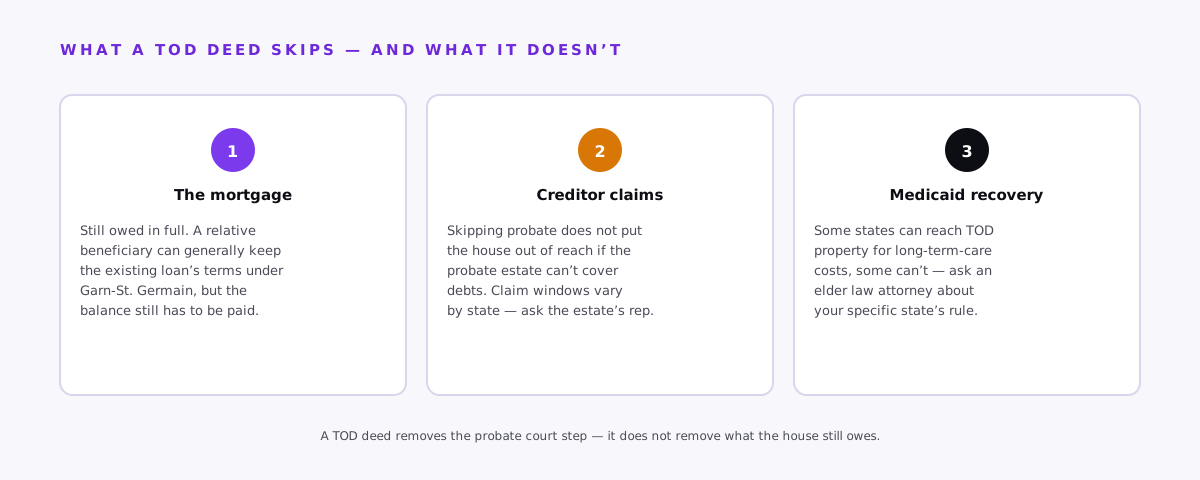
A TOD deed transfers the house, not a clean slate — it moves ownership without touching anything the deceased owner still owed. Two specific things carry over to whoever inherits, and both matter before you can actually close a sale:
The existing mortgage. The federal Garn-St. Germain Act (12 U.S.C. §1701j-3(d)(5)) blocks a lender from calling a loan due just because the borrower died and the home passed to a relative — so a TOD beneficiary who's a relative can generally keep making payments on the existing loan rather than being forced to refinance immediately. That protection is about the due-on-sale clause specifically; it doesn't erase the loan balance, which still has to be paid off or assumed before or at a sale closing.
Creditor claims. Skipping probate doesn't put the house out of reach of the deceased owner's creditors. If the probate estate doesn't have enough other assets to cover debts, creditors can generally still make a claim against TOD-transferred property — though the exact claim window varies by state and we were not able to confirm a specific number of days or months for each of our 12 states from a primary source. Before you list or close, ask the estate's personal representative (even a small or informal estate usually has one) whether any creditor claim period is still open.
Medicaid estate recovery is the sharpest version of this. Federal law lets each state choose between a "probate-only" definition of the deceased's estate or an "expanded" definition that can reach non-probate assets, including TOD-deed property, to recover Medicaid long-term-care costs. Ohio makes this concrete in its own statute: county recorders are required to give TOD beneficiaries a Medicaid estate recovery notice form before recording the deed in the first place (Ohio Rev. Code §5302.221). Whether your specific state uses the expanded definition is not something we could verify state-by-state from a primary source for this page — if the deceased owner received Medicaid long-term-care benefits, confirm your state's rule with an elder law attorney before assuming the house passed free and clear.
Because a TOD deed creates no present interest in the beneficiary — the owner retains full ownership until death — the property is included in the owner's estate for tax purposes the same way probate or trust property is. That means a TOD beneficiary generally gets the same stepped-up basis (fair market value at the date of death, under IRC §1014) that heirs get through probate. If you sell shortly after inheriting, your taxable gain is typically calculated against that stepped-up value, not against what the original owner originally paid — which is usually the difference between owing significant capital gains tax and owing very little. Confirm your specific basis calculation with a CPA; our capital gains on inherited property guide walks through the mechanics in more depth.
| Probate sale | TOD deed sale | |
|---|---|---|
| Court process before you can sell | Yes — appoint a personal representative first | No — record death affidavit instead |
| Typical added time before you can close | 1–12+ months, highly variable | Days to a few weeks for the recording step |
| Mortgage still owed | Yes | Yes |
| Creditor claims still possible | Yes | Yes, subject to state-specific claim period |
| Multiple heirs must agree to sell | Yes | Yes, if multiple TOD beneficiaries |
| Stepped-up basis for capital gains | Yes | Yes |
A TOD deed removes exactly one thing: the court process. It doesn't remove the mortgage, doesn't erase creditor exposure, doesn't make co-owners agree with each other faster, and doesn't change your tax basis. Selling a TOD-deed house to a cash buyer closes faster than listing it, the same way it would for any other inherited property — the TOD deed just means you were never going to need a probate court's permission to get there in the first place.
This article is general educational information, not legal or tax advice. Whether your state allows a TOD deed, how your specific deed is worded, whether creditor or Medicaid claims apply, and your actual tax basis all depend on your facts and your state's law. Talk to an estate attorney and a CPA before you sell.
Send us the address. We'll tell you within 24 hours what we can pay and walk you through what a TOD deed does and doesn't simplify — and if listing with an agent would net you more, we'll say so.
All guides · Selling an inherited house · When heirs can't agree to sell · Capital gains on inherited property
Step 1 of 5
No obligation, no fees, no repairs. We respond the same day.
You’ll talk to Trevor McAmis, Owner & Acquisitions Lead
(313) 710-6129
Takes about two minutes. Or call (313) 710-6129 — we answer.
