Selling a house in Pennsylvania means filling out a disclosure statement even on an as-is sale, paying a 1% state transfer tax that jumps to a combined 5% inside Pittsburgh, and facing a judicial foreclosure process if you're behind on the mortgage. Here's what the law requires and what your options look like.

Step 1 of 5
Tell us about the property and where things stand, and we'll give you a written cash offer within 24 hours, no repairs and no commissions required.
You’ll talk to Trevor McAmis, Owner & Acquisitions Lead
(313) 710-6129
Takes about two minutes. Your address is never shared.
Educational only. This explains how these situations generally work. It is not legal, tax or financial advice, and the rules differ by state. Talk to an attorney or CPA about your own situation before you act on any of it.
Yes. Pennsylvania's Real Estate Seller Disclosure Law (68 Pa.C.S. §§ 7301-7315) requires most sellers of one-to-four-unit residential property to complete and deliver a signed Property Disclosure Statement to the buyer before either side signs the agreement of sale, listing any material defect you know about. Selling as-is changes what repairs you owe the buyer. It does not excuse you from filling out this form.
The disclosure statement has to cover specific topics spelled out in the statute: the roof, basement and crawl spaces, termites and other pests, structural problems, water and sewage systems, plumbing, heating and air conditioning, electrical systems, additions or remodeling, soils and drainage, hazardous substances, homeowners associations, and any legal issues affecting title, among others (Pennsylvania Department of State, Real Estate Seller Disclosure Law). You only have to disclose what you know. The law doesn't require you to hire an inspector or investigate problems you're not aware of.
The real exemptions are narrower than most sellers assume, and "I'm selling as-is" isn't one of them. The transfers the law exempts include sales ordered by a court (probate, bankruptcy, eminent domain), transfers tied to a foreclosure or a deed in lieu of foreclosure, transfers between co-owners, transfers between spouses or close relatives, transfers as part of a divorce settlement, corporate liquidations, land that will be demolished or converted to non-residential use, unimproved land, and new construction that's never been occupied and comes with a written warranty. An ordinary sale to an outside buyer, cash or otherwise, isn't on that list.
Skipping the form doesn't unwind a completed sale, but it does expose you to a buyer's claim for actual damages if you willfully or negligently failed to disclose something you knew about, and that claim can be brought up to two years after closing.
Often yes, even though Pennsylvania abolished the old common-law doctrines of dower and curtesy decades ago and replaced them with a post-death statutory share for a surviving spouse (20 Pa.C.S. § 2105). There's no statute that flatly requires a non-owning spouse to sign a sale deed.
In practice, title insurers routinely ask for it anyway. Because marital assets or marital effort may have gone into buying or improving a house titled in just one spouse's name, title companies generally want either the non-owning spouse's signature on the deed or a signed spousal waiver before they'll insure the transaction, to close off any later claim. If the house is held as tenants by the entireties, which is common for married couples in Pennsylvania, both spouses are already owners and both already have to sign regardless. A title company or closing attorney can tell you exactly what your specific deed requires.
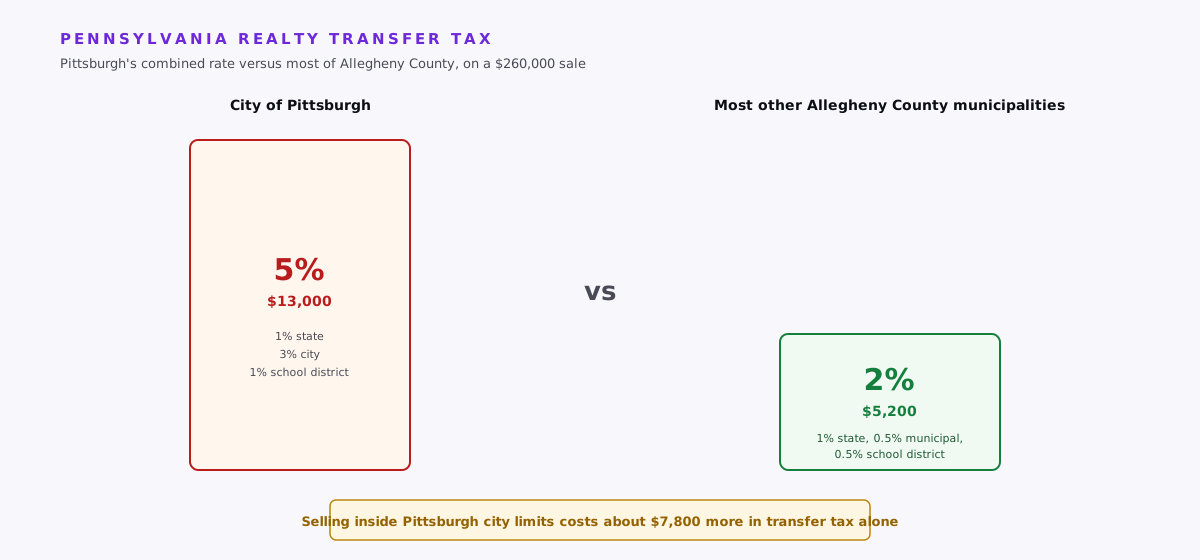
Pennsylvania charges a flat 1% state realty transfer tax on every sale, and nearly every county and municipality adds a local transfer tax on top (Pennsylvania Department of Revenue). Inside the City of Pittsburgh, the combined rate is 5%, the highest anywhere in Allegheny County and more than double what most of the county's suburbs charge.
That 5% breaks down as 1% to the state, 3% to the City of Pittsburgh, and 1% to the Pittsburgh School District. Most other municipalities in Allegheny County land around a 2% combined rate (1% state, 0.5% municipal, 0.5% school district), with a handful like McCandless, Monroeville, and Murrysville running slightly higher at 2.5% (Allegheny County Realty Transfer Taxes). On a $260,000 Pittsburgh sale, 5% works out to $13,000 total. The same sale two towns over might owe closer to $5,200.
By custom in Pennsylvania, not by law, the transfer tax is often split 50/50 between buyer and seller, and your agreement of sale can allocate it differently. See our comparison of transfer tax costs by state for how Pennsylvania's rate stacks up elsewhere.
A title company, not an attorney, handles most residential closings in the Pittsburgh area and across western Pennsylvania. Pennsylvania has no statewide law requiring a lawyer at closing. Attorney involvement is customary in Philadelphia and much of eastern Pennsylvania, but it's a regional habit, not a statewide rule.
A title company in Pittsburgh typically runs the title search, prepares the deed and settlement statement, holds funds in escrow, collects and remits the realty transfer tax, and records the deed with the Allegheny County Recorder of Deeds. You can still hire a real estate attorney for a complicated title (a messy estate, unresolved liens, a title dispute) anywhere in the state. It's optional in Pittsburgh, not required.
Pennsylvania is a judicial foreclosure state, which means your lender has to sue you in the county Court of Common Pleas and win a judgment before your house can go to a sheriff's sale. Between the required pre-filing notices and the court calendar, the full process commonly runs a year or longer from your first missed payment.
Before a lender can even file suit against an owner-occupied one- or two-family home, it generally has to send a combined Act 6 and Act 91 notice. The Act 91 notice, created by the Pennsylvania legislature in 1983 and requiring a response within 33 days of receipt, tells you about your right to foreclosure prevention counseling and the state's Homeowners' Emergency Mortgage Assistance Program, or HEMAP. You have those 33 days from the notice to meet face-to-face with a HEMAP-approved counseling agency, and the agency then has 30 days to submit your application to the Pennsylvania Housing Finance Agency. Filing on time can pause the foreclosure case while your application is reviewed (Pennsylvania Housing Finance Agency, HEMAP).
If the case isn't resolved, the lender files a foreclosure complaint, gets a judgment, and schedules a sheriff's sale, which has to be publicly advertised in advance. You can generally still sell the house, including to a cash buyer, any time before the sheriff's sale takes place, and doing so stops the foreclosure outright. Once a sheriff's sale has already happened, your options narrow fast, so the sooner you decide what you're doing, the more choices you keep.
Selling as-is in Pennsylvania means you won't make repairs or negotiate credits after a buyer's inspection turns up problems with the property's condition. It does not mean you can skip the Property Disclosure Statement, and it does not protect you if you knew about a defect and left it off the form anyway.
Those are two separate things. The disclosure law's protection for sellers (no buyer lawsuit over a defect that was properly disclosed) only covers defects you listed on the form. Leaving something off because you're selling as-is, hoping the buyer won't ask, isn't the same as disclosing it, and it isn't covered. What as-is buys you is freedom from repair negotiations and inspection-driven price cuts, not freedom from staying quiet about what you know.
A cash, as-is offer nearly always nets less than a fully-prepped retail listing, because you're trading repair costs, a commission, and months of carrying costs for speed and certainty. Here's the real math on a typical Pittsburgh house, not a best-case or worst-case guess.
Example: a Pittsburgh house worth $260,000 (close to the city's 2026 median sale price) with a $150,000 mortgage balance left on it.
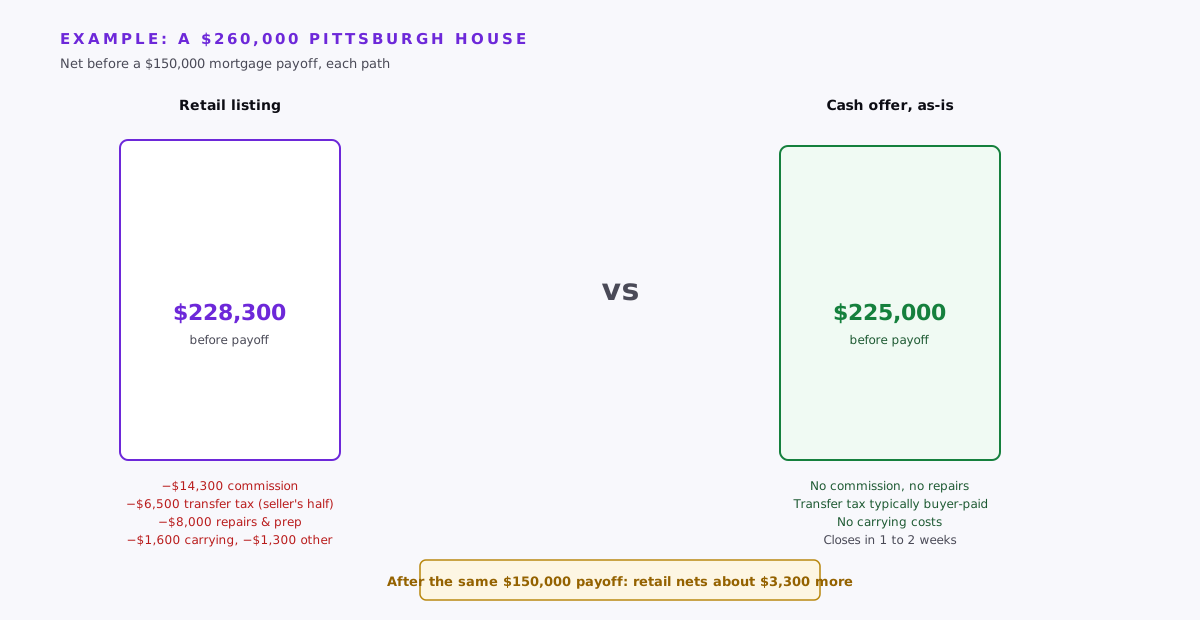
Listed with an agent at $260,000, a 5.5% commission runs $14,300. A seller's customary half of Pittsburgh's 5% transfer tax adds $6,500. Other standard seller closing costs run about $1,300. Pre-listing repairs and cleanup (paint, flooring, minor fixes an agent will tell you to make before photos) run roughly $8,000. Carrying costs for the two to three months it typically takes to go under contract and close (utilities, insurance, a partial mortgage payment) add another $1,600. After the $150,000 mortgage payoff, that leaves roughly $78,300 in the seller's pocket.
| Path | Sale price | Commission | Transfer tax (seller's half) | Other closing costs | Repairs & prep | Carrying costs | Est. net before mortgage payoff | Typical timeline |
|---|---|---|---|---|---|---|---|---|
| Retail listing | $260,000 | $14,300 | $6,500 | $1,300 | $8,000 | $1,600 | $228,300 | 2-3 months to close |
| Cash, as-is sale | $225,000 | $0 | Typically covered by buyer | $0 | $0 | $0 | $225,000 | 1-2 weeks to close |
A cash buyer like Restar offering $225,000 as-is on the same house, with no commission and no repairs, and typically covering standard closing costs on a deal like this, nets about $75,000 after the same $150,000 payoff. Run the numbers and the retail path nets roughly $3,300 more in this example, see our guide on how cash home buyers calculate offers for how that $225,000 figure gets built. But retail asks you to front $8,000 in repairs before you see a dollar, carry the house for two to three months while it's shown, and hope the sale doesn't fall apart over a buyer's financing or inspection contingency. If you can afford the repairs and the wait, that gap is real and worth taking. If you can't carry the house, don't have the repair money up front, or need this resolved now, the cash path gets you nearly the same number, faster and with far less risk.
List with an agent. If the house is in sellable condition, you can front a few thousand dollars in repairs, and you can wait two to three months, this usually nets the most money. The math above shows why.
Loan modification or forbearance. If you're behind on the mortgage and not ready to sell, talk to your lender and a HEMAP-approved counselor before a sheriff's sale gets scheduled. This can buy time or restructure the loan without selling at all.
Rent it out. If you don't need the cash right now and the numbers work as a rental, keeping the house and renting it is a legitimate option, especially for an inherited property you're not ready to part with.
Sell directly to a family member. A sale to a close relative still generally requires the disclosure process unless it falls under the law's narrow family-transfer exemption, so don't assume this skips the paperwork.
A fast cash sale. Skips repairs, showings, and financing contingencies, and closes on your timeline. Nets less than a strong retail sale, as the math above shows, but removes the time, cost, and uncertainty that come with listing.
Restar buys houses as-is in all 69 of our markets across 14 states, including Pittsburgh and the rest of Allegheny County. We give a written offer within 24 hours, there are no repairs to make and no commissions to pay, and you pick the closing date. If running the numbers shows a retail listing would net you more, we'll tell you that directly instead of pushing a sale that doesn't serve you.
All guides · We buy houses in Pittsburgh, Pennsylvania · Transfer tax costs compared by state · How cash home buyers calculate offers
Step 1 of 5
No obligation, no fees, no repairs. We respond the same day.
You’ll talk to Trevor McAmis, Owner & Acquisitions Lead
(313) 710-6129
Takes about two minutes. Your address is never shared.