Selling a house in Nevada means navigating a strict disclosure law, a community property rule that can require your spouse's signature even if they're not on the deed, a transfer tax that differs by county, and, if you're behind on payments, one of the faster non-judicial foreclosure timelines in the country.

Step 1 of 5
No commissions, no repairs, no obligation. We'll tell you if listing nets you more.
You’ll talk to Trevor McAmis, Owner & Acquisitions Lead
(313) 710-6129
Takes about two minutes. Your address is never shared.
Educational only. This explains how these situations generally work. It is not legal, tax or financial advice, and the rules differ by state. Talk to an attorney or CPA about your own situation before you act on any of it.
Yes. Nevada law (NRS 113.130) requires sellers of most residential property to complete and serve a Seller's Real Property Disclosure Form at least 10 days before the property is conveyed, and selling as-is does not remove that duty. The form covers the condition of the property, not the price or repair terms, so an as-is sale still has to tell the buyer what's wrong with the house.
The form asks about known defects: structural issues, roof condition, plumbing and electrical problems, past flooding, pest damage, and other material facts about the property. A handful of transactions are exempt under NRS 113.130, including sales between relatives, certain foreclosure and fiduciary transfers, and new construction sold by the builder. Most ordinary resale transactions are not exempt, even when the buyer is a cash investor.
The consequences for skipping it are real. Under NRS 113.150, if a seller or seller's agent fails to serve the disclosure form on time, the buyer can rescind the purchase agreement at any time before closing, with no penalty. If a seller conveys the property without disclosing a defect they knew about, Nevada law allows the buyer to recover treble (three times) the cost to repair or replace that defect, plus attorney's fees, and the claim period runs one year from when the buyer discovers the problem or two years from the closing date, whichever is later. A buyer can only waive the disclosure requirement through a signed, notarized document, not a verbal agreement. An attorney or your escrow officer can confirm exactly what has to go on your specific form before you sign anything.
Often, yes. Nevada is a community property state, and NRS 123.230 says neither spouse may sell or convey community real property unless both spouses join in signing the deed, and both acknowledge it, regardless of whose name appears on the current title.
If the house was purchased during the marriage, it's generally presumed to be community property under Nevada law, even if only one spouse's name ended up on the deed. A premarital agreement, a postmarital agreement, or a divorce decree can change that presumption, and property owned before the marriage, or received by one spouse alone as a gift or inheritance, is usually separate property instead. Title and escrow companies run this check as a matter of course, and a missing spousal signature is one of the more common last-minute holdups in a Nevada closing. If you're not sure whether your property is community or separate, that's worth confirming before you sign a purchase agreement, not after.
Nevada charges a real property transfer tax every time a deed changes hands, under NRS 375.020 and NRS 375.023. As of 2026, the combined rate in Clark County (where Las Vegas sits) is $2.55 per $500 of value, about 0.51%. In Nevada's smaller counties, the combined rate is $1.95 per $500, about 0.39%.
Here's how that breaks down. NRS 375.020 sets a base rate of $1.25 per $500 of value in any county with a population of 700,000 or more, which currently applies only to Clark County, and $0.65 per $500 everywhere else. NRS 375.023 then adds a flat statewide tax of $1.30 per $500 on top of that base rate. Add the two together and you get $2.55 per $500 in Clark County and $1.95 per $500 in the rest of the state.
State law makes the buyer and seller jointly liable for the tax, but the purchase contract decides who pays it, and local custom in Clark County has the seller covering it. On a $350,000 Las Vegas house, that's 700 units of $500 multiplied by $2.55, or $1,785. That's one line item. Commission, repairs, concessions, and holding costs during a listing usually add up to far more than transfer tax does, which is the subject of the cash-versus-retail math below. For how this compares to other states, see our state transfer tax comparison guide.
When you're selling a house in Nevada, a title or escrow company closes almost every residential sale, not a lawyer. The state doesn't require an attorney to be involved in the transaction, unlike parts of the Northeast and mid-Atlantic where attorneys run closings.
In practice, your escrow officer manages the purchase contract, orders the title search and title insurance, holds the earnest money deposit, prepares the closing documents, coordinates recording with the county recorder, and disburses funds once everything is signed. You can still hire a real estate attorney to review your contract or deed, and it's worth doing if the sale involves probate, a contested divorce, a title defect, or anything else out of the ordinary. For a standard sale, it isn't required, and most Nevada sellers never meet a lawyer during the process.
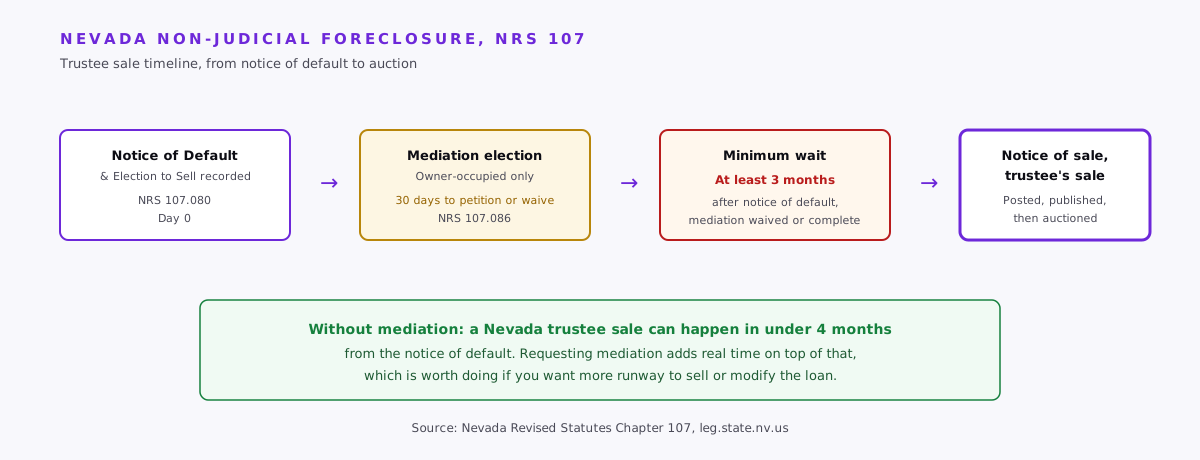
Most Nevada foreclosures are non-judicial trustee sales handled under NRS 107, not court cases. Once a lender records a notice of default, state law requires at least a three month wait before a notice of sale can go out, and if the home is owner-occupied, the lender has to offer the state's Foreclosure Mediation Program first.
Here's the sequence. The lender records and mails a Notice of Default and Election to Sell once the borrower has been behind long enough to trigger it (NRS 107.080). For owner-occupied homes, NRS 107.086 requires that notice to include information about mediation, and the borrower has 30 days from being served to either petition the district court for mediation, which costs a $25 filing fee plus a share of mediation costs, or waive it. If mediation is waived, or completed without a resolution, the lender still has to wait at least three months after recording the notice of default before scheduling a trustee's sale, then post and publish a notice of sale before the auction can happen. The mediation program itself is currently administered through Home Means Nevada, Inc. under NRS 107.086. Without mediation, a Nevada trustee sale can realistically happen in under four months from the notice of default. Requesting mediation adds real time on top of that, and it's worth doing if you want more runway to sell or work out a modification.
Nevada law technically allows judicial foreclosure too, but lenders almost always use the faster non-judicial trustee sale process instead.
Selling as-is means you're not agreeing to make repairs, and the buyer is accepting the property in its current condition. It does not waive Nevada's disclosure law, and it does not let you leave out a defect you already know about.
What as-is buys you is speed and fewer points of failure. It removes the back-and-forth over repair requests, and it removes the risk that a lender-ordered appraisal or inspection kills the deal when a buyer is financing the purchase. It doesn't change a single word of what has to go on your NRS 113 disclosure form, and it doesn't protect you from the treble-damages remedy under NRS 113.150 if you knew about a problem and didn't say so. As-is is a condition of sale, not a stand-in for telling the buyer what's wrong with the house.
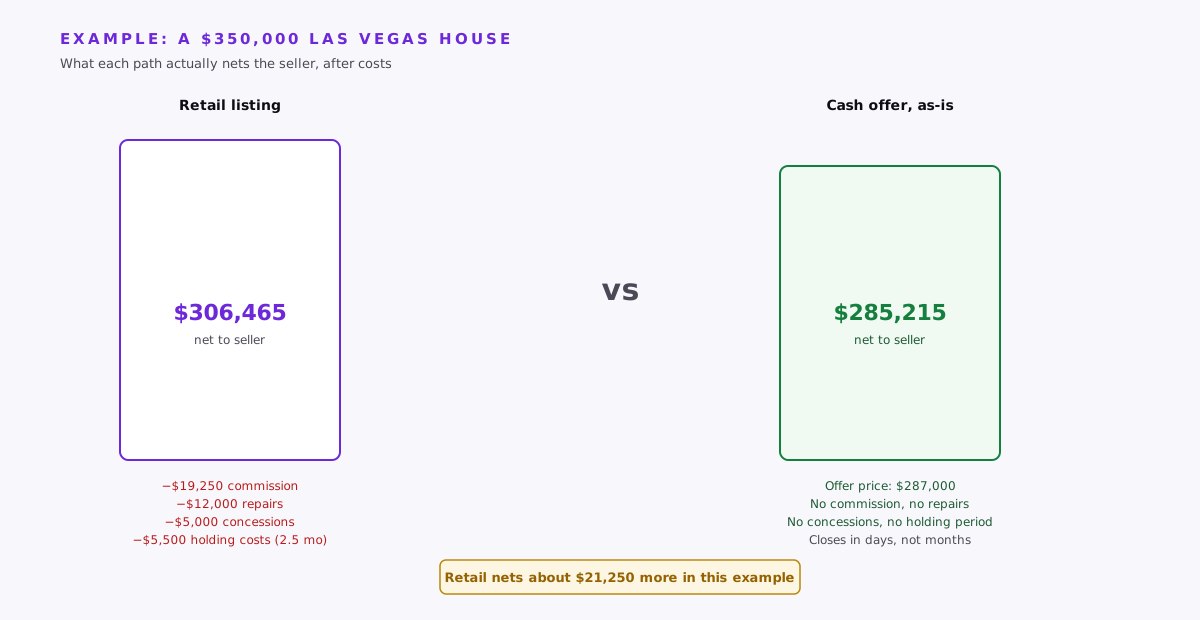
A cash, as-is offer almost always nets less money than a fully repaired retail listing, because you're trading commissions, repair costs, and weeks of holding costs for speed and certainty. Which path puts more in your pocket depends on your specific house and timeline, not a generic rule.
Example: a $350,000 house in Las Vegas.
| Cost item | Retail listing | Cash offer |
|---|---|---|
| Sale price | $350,000 | $287,000 |
| Agent commissions (5.5%) | −$19,250 | $0 |
| Repairs to pass inspection/appraisal | −$12,000 | $0 |
| Buyer concessions at closing | −$5,000 | $0 |
| Transfer tax (Clark County, seller-customary) | −$1,785 | −$1,785 |
| Holding costs during listing (2.5 months) | −$5,500 | $0 |
| Net to seller | $306,465 | $285,215 |
In this example, the retail listing nets about $21,250 more than the cash offer. That gap is the real cost of commissions, repairs, concessions, and a couple of months of holding costs, and it's the reason a cash sale isn't automatically the better deal. The gap narrows, and can reverse, when the house needs more repair work than this example assumes, when you're carrying a mortgage payment, taxes, and insurance on a vacant property for longer than 2.5 months, or when a financed buyer's deal falls through partway through escrow and you have to start over. See how we calculate a cash offer for the specific factors that move that number up or down on an actual house.
A cash sale isn't the only option. Depending on your situation, listing with an agent, working out a loan modification or forbearance, renting the property out, or selling directly to a family member can all make more sense.
Listing with a licensed agent is the better call when the house is in decent shape, you can wait 60 to 90-plus days for a sale to close, and you want to try for the highest achievable price, accepting the commission and repair costs that come with it. If you're behind on your mortgage, contact your loan servicer about a modification or forbearance before a notice of default is even recorded, and if one has already been filed on an owner-occupied home, you still have the right to request Nevada's Foreclosure Mediation Program within 30 days of being served. Renting the property out can make sense if you don't need the cash right away and the math on a tenant works better than a sale, though it comes with its own landlord obligations under Nevada law. Selling directly to a relative is allowed and is exempt from the NRS 113 disclosure form requirement, though the community property and transfer tax rules still apply the same way.
If the house is in good condition, you have equity to protect, and you don't need to close in the next few weeks, listing with an agent will usually put more money in your pocket. A cash sale is the better fit when speed, certainty, or the condition of the house matters more than maximizing the sale price.
We buy houses across Nevada, including Las Vegas, in as-is condition. You'll get a written offer within 24 hours, there are no commissions and no repair list, and you pick the closing date. If listing with an agent would net you more money, we'll tell you that too.
All guides · See how we buy houses in Las Vegas · How we calculate a cash offer · Compare transfer tax costs by state
Step 1 of 5
No obligation, no fees, no repairs. We respond the same day.
You’ll talk to Trevor McAmis, Owner & Acquisitions Lead
(313) 710-6129
Takes about two minutes. Your address is never shared.
