You found out your house sits in a historic district — from a title search, an old plaque, or a buyer's question — and now you're not sure what that actually restricts. Most historic-district sales go through like any other. What changes is what a buyer can do with the house afterward, which affects how they value it and finance any work it needs. Here's the real distinction, what a review process involves, and the honest math on fixing it up first versus selling as-is.

Step 1 of 5
Tell us about your property. We'll give you a straight read on whether fixing it up first or selling as-is makes more sense for your timeline.
You’ll talk to Trevor McAmis, Owner & Acquisitions Lead
(313) 710-6129
Takes about two minutes. Or call (313) 710-6129 — we answer.
Educational only. This explains how these situations generally work. It is not legal, tax or financial advice, and the rules differ by state — talk to an attorney or CPA about your own situation before you act on any of it.
Yes, you can sell a house in a historic district, and most sales go through like any other. What changes is what a buyer can do with the house afterward: a local historic district designation — not just a National Register listing — can require government approval before exterior changes or demolition, which affects how buyers value the property and finance repairs.
This is general educational information, not legal advice. Historic district rules are set locally — confirm what applies to your specific property with your city or county preservation office and a real estate attorney before relying on anything here.
Many sellers find out their house is “historic” from a title search or an old plaque and assume it's heavily restricted. Usually it isn't. The National Park Service is explicit about this: under federal law, listing a property in the National Register of Historic Places “places no restrictions on what a non-federal owner may do with their property up to and including destruction,” unless the project involves federal funding, licensing, or approval (National Park Service, National Register FAQ).
Nationally, the National Register — created in 1966 — now covers more than 1.5 million properties, most of them contributing structures within historic districts rather than individually listed landmarks on their own. Being one of those 1.5 million properties, by itself, usually changes nothing about your ability to sell.
What does restrict what you can do is a local historic district designation — a city or county ordinance that creates a Historic Preservation Commission or Architectural Review Board with real approval power over a defined district. That's the designation to check for, and it's separate from (though sometimes overlapping with) National Register status.
Properties inside a local historic district typically need a Certificate of Appropriateness (COA) before any exterior change — paint color, roofing, windows, additions, fences. Seattle's Historic Preservation program publishes a representative version of this process: a four-step review (application, staff review, board or committee hearing, decision), with staff typically responding within 28 days, a board hearing within 30 days of a complete application, and a final decision within 45 days — a process the city describes as taking roughly 117 days or less end to end (City of Seattle, Department of Neighborhoods).
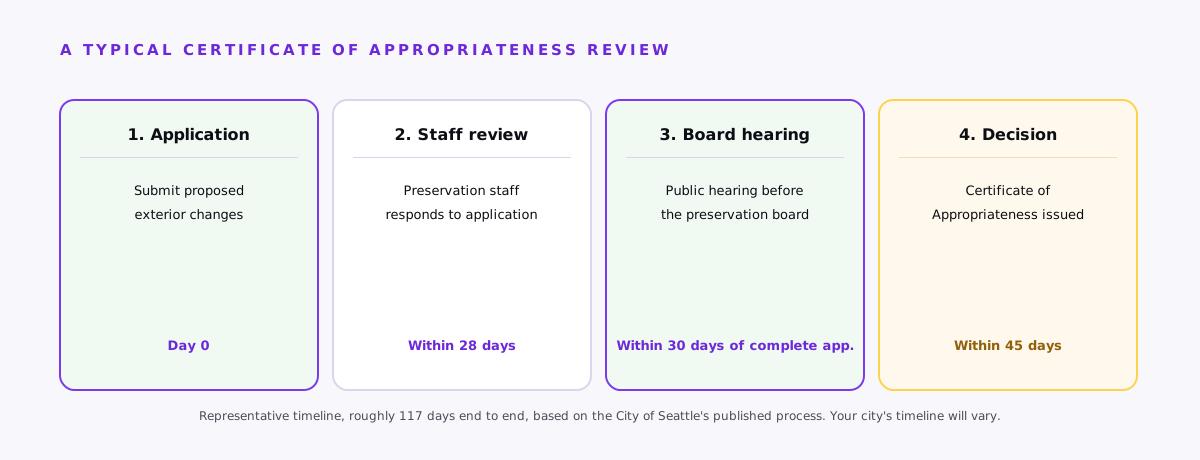
Timelines vary by city, but the shape — an application, a public hearing, and a multi-week-to-multi-month wait — is typical of how these boards work nationally.
Many local historic districts also impose a demolition delay — a waiting period before a demolition permit can be issued, even for a private owner, meant to give preservationists time to intervene. Dallas's historic overlay districts, for example, impose a 45-day demolition delay; the city's own materials note the delay itself “does not prevent an owner from modifying, selling, transferring, or deeding a property” — it only slows down demolition specifically (City of Dallas, Sustainable Development & Construction). Other cities' delay periods run considerably longer, commonly anywhere from 30 days to a year, so check your specific city or county ordinance rather than assuming a number.
A buyer financing renovation work with a federally-insured loan, like an FHA 203(k), can run into an additional review step on a property connected to a historic district or the National Register, since federally-insured projects are sometimes subject to historic-preservation review requirements. Rules here are technical and project-specific — a buyer's lender and loan officer are the right people to confirm whether it applies to a given purchase — but it's a real potential source of delay on financed renovation purchases that a cash sale doesn't carry. On insurance, the National Trust for Historic Preservation recommends historic homeowners carry “guaranteed replacement cost” coverage rather than standard replacement-cost coverage, specifically because restoring period materials and craftsmanship can cost meaningfully more than a standard rebuild (National Trust for Historic Preservation).
The federal Rehabilitation Tax Credit (a 20% credit under IRC Section 47) is often cited as a reason to love historic status — but the National Park Service is direct about the limit: “The credit cannot be used to rehabilitate your private residence” — it's available only to income-producing property, like a rental or commercial building (National Park Service, Technical Preservation Services). If you live in the house yourself, the federal 20% credit isn't available to you.
Some states fill that gap for owner-occupants. Maryland's Homeowner Tax Credit, for example, offers a 20% credit (capped at $50,000 over 24 months, minimum $5,000 spent) specifically for owner-occupied historic properties — including National Register-listed homes, homes that contribute to a historic district, and locally designated landmarks (Maryland Historical Trust). Rules differ meaningfully by state, so don't assume your state's program works the same way Maryland's does.
Historic district designation and the restrictions that come with it are something a seller should disclose. South Carolina's standard Residential Property Condition Disclosure Statement names it directly, asking whether the property has a “designation as a historic building, landmark, site or location within a local historic or other restrictive district, which may limit changes, improvements or demolition of the property” (South Carolina REALTORS). Where a state's form doesn't name it specifically, it typically still falls under general “government restrictions on use” disclosure language most standard forms include.
Take a $220,000 house in a local historic district needing new windows — a common point of friction, since district rules frequently require historically appropriate materials rather than standard vinyl replacements.
| Replace windows, then list retail | List retail as-is | Sell as-is for cash | |
|---|---|---|---|
| Sale price / typical offer | $220,000 | $220,000 (if buyer accepts) | 75–82% of value |
| Compliant window replacement | −$8,000–$15,000 (custom units start around $1,000 each; HomeAdvisor notes historic-appropriate replacements can run double to triple a standard job) | $0 | Buyer absorbs it |
| COA review delay | 1–4 months before work can start | None, but buyer discovers it during inspection | None |
| Closing costs & commission (~9%) | −$19,800 | −$19,800 | $0 |
| Net | ~$185,200–$192,200 | ~$200,200 (if buyer accepts as-is) | ~$165,000–$180,400 |
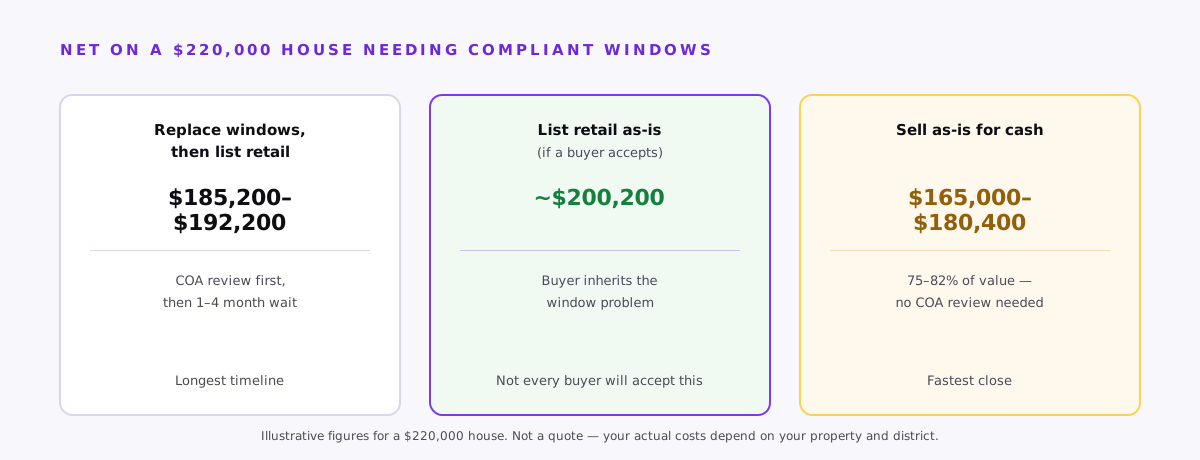
The real cost of historic status usually isn't the designation itself — it's the approval process and the materials requirement whenever something actually needs fixing. A buyer using a loan will often want that review and those materials sorted out before closing; a cash buyer typically won't.
Most historic-district sales close without drama — the designation mainly matters when exterior work is involved, either because you're doing it now or because a buyer's lender wants it resolved before closing. If your house needs work that would trigger a Certificate of Appropriateness review, that review and the materials cost are the real variables, not the “historic” label itself. Send us the address and we'll tell you honestly whether your specific situation is better served by fixing it up first or selling as-is.
A Certificate of Appropriateness review and historic-grade materials can add months and real cost if your house needs exterior work. If you'd rather skip that process entirely, we can buy the house as-is and take on the approval process ourselves.
Send us the property here and we'll walk you through both options honestly.
All guides · Selling a house with a deed restriction · Cost of getting a house market-ready · Should I repair before selling?
Step 1 of 5
No obligation, no fees, no repairs. We respond the same day.
You’ll talk to Trevor McAmis, Owner & Acquisitions Lead
(313) 710-6129
Takes about two minutes. Or call (313) 710-6129 — we answer.
