<b>If your house sits in a high wildfire-risk insurance zone, the real obstacle usually isn’t a fire — it’s the insurance.</b> Carriers are non-renewing or declining new policies based on wildfire-risk scores alone, pushing homeowners into a state FAIR Plan or surplus-lines policy that costs more and covers less. That cost and coverage gap is what scares off financed buyers, because their lender won’t close without proof of insurance — while a cash sale sidesteps the problem entirely.
Step 1 of 5
Tell us about the property and we'll send a written cash offer within 24 hours, no lender or insurer approval required to close, no repairs, no commissions.
You’ll talk to Trevor McAmis, Owner & Acquisitions Lead
(313) 710-6129
Takes about two minutes. Or call (313) 710-6129 — we answer.
Educational only. This explains how these situations generally work. It is not legal, tax or financial advice, and the rules differ by state — talk to an attorney or CPA about your own situation before you act on any of it.
A high wildfire-risk insurance zone is an area where catastrophe-modeling scores — not an actual fire history — are driving insurer decisions. Modeling firms like Verisk and First Street combine vegetation type, slope, prevailing wind patterns, structure density, and distance to fire department response into a property-level score. Insurers license these models and feed them into underwriting, so two houses a mile apart can get very different renewal outcomes depending on terrain and fuel load alone.
This is different from a house that has already burned or taken smoke and ash damage — that's a property-condition problem with its own repair and disclosure issues. A high wildfire-risk insurance zone is a forward-looking underwriting problem: the insurer isn't reacting to damage, it's pricing (or refusing to price) the chance of future damage. That distinction matters for a seller, because there's no repair that makes a risk score disappear the way a new roof fixes a leak.
The U.S. Forest Service's own Wildfire Risk to Communities project — built under congressional direction and covering Arizona, Texas, and the rest of the country — is a useful starting point for seeing how your area's risk is generally characterized, separate from whatever score your specific insurer is using internally.
Insurers price home insurance to cover the catastrophe losses they expect to pay, and wildfire losses nationally have grown large and volatile enough that several carriers have pulled back from writing new business — or renewing existing business — in zones their models flag as high risk. When that happens to a specific policy, it shows up as one of two things: a non-renewal notice at your next renewal date, or a decline if you try to shop for a new policy after a non-renewal.
Both Arizona and Texas regulate how much notice an insurer has to give before a non-renewal, but neither state currently caps the premium an insurer can charge once it does agree to write the policy, and neither blocks a non-renewal outright just because wildfire risk is the stated reason.
The mechanics differ enough between the two states that it's worth treating them separately rather than assuming one state's rules apply to the other. Arizona currently has no state insurer of last resort for wildfire risk, while Texas does. Notice periods, what a fallback policy covers, and how non-renewals cluster geographically are also different in each state, so a fact that's true for one can be flatly wrong for the other.
Arizona. Arizona does not currently have a state FAIR Plan. Homeowners who lose standard-market coverage in a wildfire-risk zone — most relevant around the wildland-urban interface ringing parts of the Phoenix metro and the state's forested high country — are routed into the surplus-lines market or whatever specialty carriers remain willing to quote, rather than into a state-run insurer of last resort. Arizona's Resiliency and Mitigation Council, convened by the state's Department of Insurance and Financial Institutions, issued a December 2025 report that favored mitigation incentives over creating a FAIR Plan, and the department has since ordered insurers to start reporting policy-level renewal and termination data for wildfire-risk areas. Arizona law requires an insurer to give written notice of a non-renewal before the policy ends, stating the specific reason. A University of Arizona Cooperative Extension analysis of statewide data found Arizona's overall non-renewal rate was about 0.8% in 2023 — lower than Florida's 2.99% or California's 1.72% — but certain counties ran far higher, with Navajo County peaking near 4.8% in 2022, and the data showed non-renewals climbing one to two years after a major local wildfire season. Maricopa County, because of its sheer population, accounts for roughly 55% of the statewide non-renewal volume even though its rate is lower than the rural counties.
Texas. Texas does have a state insurer of last resort: the Texas FAIR Plan Association, created by the state legislature and regulated by the Texas Department of Insurance. To qualify, you generally need to have been declined by at least two licensed carriers; the FAIR Plan then writes a limited, named-perils policy, caps dwelling coverage at $1 million, and — per its own policy terms — non-renews every other renewal cycle, requiring you to reapply to the voluntary market. On the notice side, Texas Department of Insurance guidance confirms an insurer must give at least 10 days' notice before canceling a policy outright, and 60 days' notice before non-renewing a policy bought or renewed in 2024 or later (30 days for older policies). Wildfire exposure in Texas is concentrated in the Hill Country west of Austin and San Antonio and in parts of West Texas, where rapid building into the wildland-urban interface has put more homes against fire-adapted brush and grassland. The Insurance Information Institute reported 244,617 Texas homes at risk for extreme wildfire — third-most of any state behind California and Colorado — and put Texas sixth-worst nationally for home insurance affordability, with homeowners there paying an average of 3.13% of median household income on premiums.
If you're outside these two markets and reading this because your state has similar dynamics, the same general shape — carrier non-renewal, a costlier fallback policy, a shrinking buyer pool — shows up in other wildfire-exposed states too, though the specific rules vary by state. Don't assume a rule confirmed for Arizona or Texas applies somewhere else without checking that state's own department of insurance.
Say your house would list for roughly $400,000 in a normal insurance market. Here's how three paths actually compare once a wildfire-risk insurance problem enters the picture: a retail listing marketed to financed buyers, a retail listing targeted at a cash-capable buyer pool, and a direct cash offer that sidesteps lender and insurer approval altogether. Each trades money against certainty differently.
A retail listing marketed to the full buyer pool, including financed buyers, typically costs about 5-6% in agent commissions (roughly $20,000–$24,000 on that price) plus your normal closing costs. The problem isn't the commission — it's that a financed buyer's lender requires proof of insurability before closing, and if your property only qualifies for a FAIR Plan or surplus-lines policy, that buyer's loan approval can stall or collapse late in the process when the lender sees the quote. That shows up as longer time on market, more price reductions, and more deals that fall through at the financing or insurance contingency, sometimes after weeks of being under contract.
A cash offer doesn't depend on a buyer's lender or a buyer's insurance approval, because there's no mortgage and no lender-required policy standing between contract and closing. The tradeoff is price: a cash offer is calculated against the property as it sits, including the insurance friction baked into the smaller pool of buyers who can actually close without a lender's sign-off, so it's typically below what a successful financed retail sale would net if everything went smoothly.
| Path | Who has to say yes | Typical cost before you net | Typical timeline |
|---|---|---|---|
| Retail listing, financed buyer | Buyer, buyer's lender, and buyer's insurer | ~5–6% commission + holding costs during a longer marketing period | Often extended by financing/insurance fall-throughs; re-listing is common |
| Retail listing, cash-capable buyer only | Just the buyer | Commission if you use an agent; smaller pool can mean price concessions | Varies with how thin the local cash-buyer pool is |
| Direct cash offer | Just you | No commissions, no repairs, no lender or insurer approval needed | Typically 1–3 weeks to close |
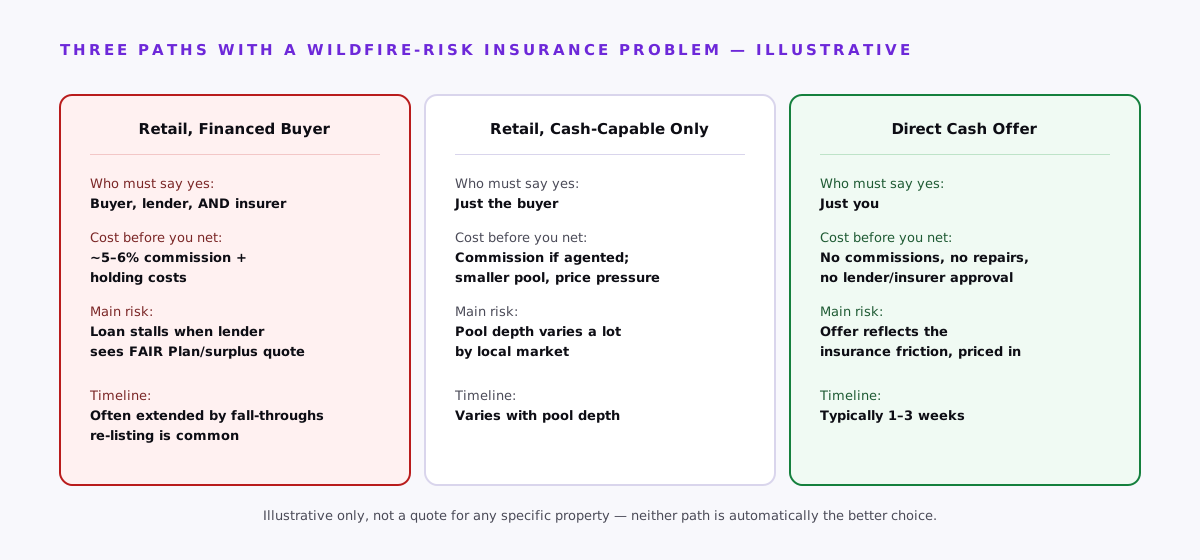
Neither path is automatically “right.” If your property can still qualify for a standard-market policy with some mitigation work, or you can afford to wait out a thinner buyer pool, a retail listing may net more. If the insurance problem is actively costing you showings and contract fall-throughs, the certainty of a cash sale is worth pricing out before you commit another listing cycle to the retail market.
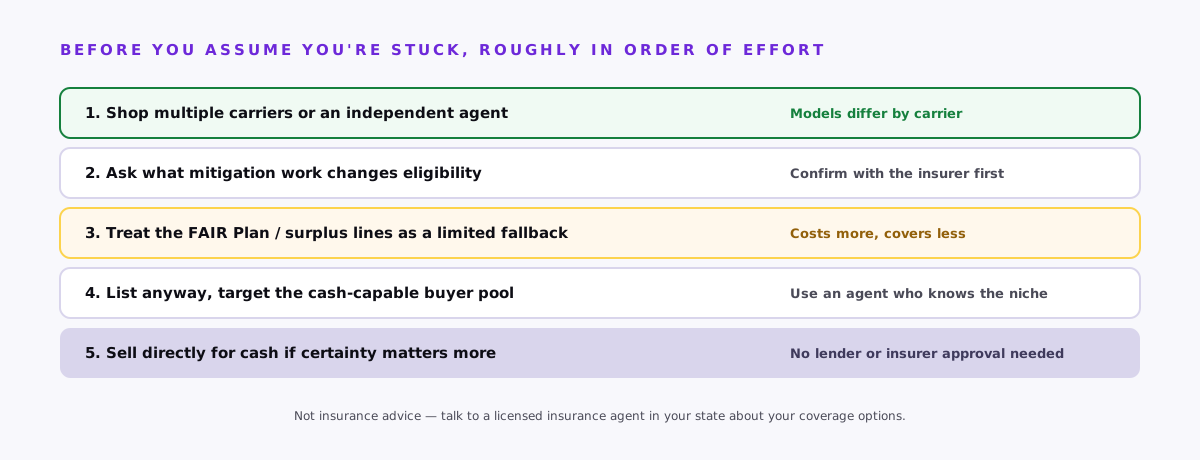
A non-renewal letter or a high quote isn't necessarily the final word. Before you assume the FAIR Plan, a surplus-lines policy, or a cash sale is your only path forward, it's worth working through a short list of options roughly in order of effort, since some of them can restore standard-market eligibility outright.
Shop multiple carriers, or use an independent agent, before assuming the FAIR Plan is your only option. One carrier's model may score your parcel very differently from another's, and an independent agent who places hard-to-insure properties regularly may know which carriers are still writing in your specific area.
Ask what mitigation work would change your eligibility. Defensible space (clearing vegetation near the structure), a Class A fire-rated roof, ember-resistant vents, and fire-resistant landscaping can sometimes move a property back into standard-market eligibility, or at least improve the quote. Ask your current insurer or a prospective one, specifically, what would change their answer — generic mitigation claims with no insurer sign-off won't move a quote.
Treat the state FAIR Plan or a surplus-lines policy as a real but limited fallback. It will very likely cost more and cover less than a standard policy, and in Texas it also sunsets every other renewal, forcing you back into the voluntary market. It's a bridge, not a permanent fix. If you end up without any coverage at all while you sort this out, see our guide on selling a house with no homeowners insurance.
List anyway, but target the cash-capable buyer pool and an agent who already works hard-to-insure properties. An agent experienced with wildfire-zone listings will know how to market around the insurance issue rather than get blindsided by it at underwriting.
Sell directly for cash if certainty matters more than maximizing price. This removes the lender and insurer approval step from the transaction entirely.
None of this is insurance advice — for your specific coverage options, non-renewal notice, or FAIR Plan eligibility, talk to a licensed insurance agent in your state. We're a direct home buyer, not an insurance agent, broker, or carrier.
A cash offer accounts for the wildfire-risk insurance problem as-is, so you're not stuck marketing to a buyer pool that could fall through at the last minute when a lender sees the FAIR Plan or surplus-lines quote.
You'll get a written offer within 24 hours, no repairs or commissions required, and you pick the closing date. We're a direct buyer, not an insurance agent, broker, or carrier, and this isn't insurance advice.
All guides · Selling a house with no homeowners insurance · Selling a house with fire damage · We buy houses in Phoenix, Arizona
Step 1 of 5
No obligation, no fees, no repairs. We respond the same day.
You’ll talk to Trevor McAmis, Owner & Acquisitions Lead
(313) 710-6129
Takes about two minutes. Or call (313) 710-6129 — we answer.