Every market page publishes the numbers behind its offer. See the math
Home › Guides › Selling a House With No Homeowners Insurance
Guide
Selling a House With No Homeowners Insurance
Your insurer just sent a non-renewal or cancellation letter, and now you're wondering whether you can still sell. Selling a house with no homeowners insurance is possible, but it changes the sale: most mortgage lenders won't let a financed buyer close without proof of coverage, so an uninsurable house often needs repairs, a surplus-lines policy, a disclosed as-is listing, or a cash buyer to actually close. If you're reading this because a letter arrived saying your policy won't be renewed, you are not alone, and you are not out of options. This guide walks through why insurers pull coverage, what it actually means for a sale, what a real cash-versus-retail comparison looks like with the numbers laid out, and the alternatives worth considering before you decide anything.
Takes about two minutes. Or call
(313) 710-6129 — we answer.
Educational only. This explains how these situations generally work. It is not legal, tax or financial advice, and the rules differ by state — talk to an attorney or CPA about your own situation before you act on any of it.
Selling a House With No Homeowners Insurance: What's Really Going On
Selling a house with no homeowners insurance is legal in every state — there's no law that says a home must be insured to change hands. The complication isn't the sale itself; it's financing. A buyer paying cash can close on an uninsured house today. A buyer using a mortgage almost always can't, because their lender requires proof of an active insurance policy before funding the loan.
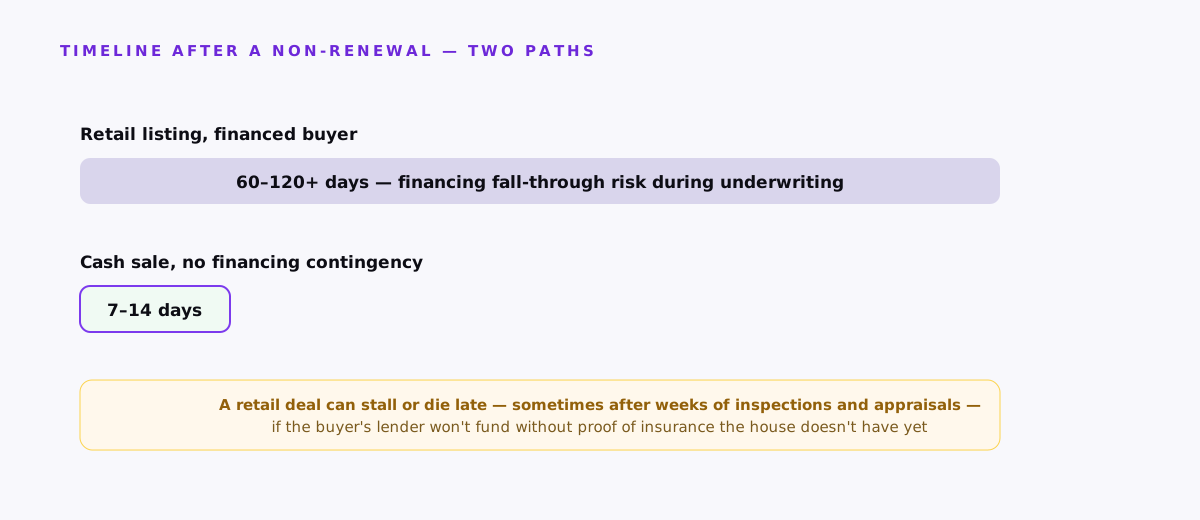
That distinction drives almost everything else in this guide. If you're selling to an investor or a cash buyer, non-renewal is mostly a paperwork issue. If you're hoping to sell retail to a family using a 30-year mortgage, it can stall or kill the deal at the closing table — sometimes after weeks of inspections, appraisals, and paperwork have already happened.
Why Do Insurers Cancel or Non-Renew Homeowners Policies?
Insurers non-renew or decline to renew homeowners policies for a short list of predictable reasons: an aging roof past the carrier's acceptable age, a history of prior claims on the property, heavy wind/hail/hurricane or wildfire exposure in the area, outdated electrical or plumbing systems that fail an inspection, or the insurer deciding to pull out of a state or region entirely. None of these are usually about anything the homeowner did wrong — they're underwriting decisions.
Roof age is the single most common trigger, especially in wind- and hail-prone states. Many carriers won't write or renew a policy on a roof older than 15–20 years without an inspection showing it's still sound. A failed four-point inspection (roof, electrical, plumbing, HVAC) or a failed wind-mitigation inspection can trigger the same result, even on a home that otherwise looks fine.
Can I Sell a House Without Homeowners Insurance?
Yes, you can sell a house without homeowners insurance, but who can buy it depends on financing. A cash buyer doesn't need your policy to close because there's no lender requiring one. A financed buyer's lender generally requires the buyer to have their own active homeowners policy in place at closing — and some insurers won't write a new policy on a home with unresolved insurability issues until they're fixed.
That means a retail sale to a financed buyer often has a hidden precondition: somebody has to make the house insurable again before the buyer's lender will fund. Sometimes that's the seller doing repairs before listing. Sometimes it's the buyer agreeing to do them post-closing, which most conventional lenders won't allow if the issue is severe enough to affect insurability. Either way, it adds time, cost, and risk that a cash sale doesn't have.
Does My Buyer Need Insurance to Close With a Mortgage?
In nearly every conventional, FHA, or VA mortgage transaction, yes — the buyer's lender requires proof of an active homeowners insurance policy before the loan can fund and the sale can close. This is standard practice across virtually all U.S. mortgage lenders, not just a policy at one bank, because the lender has a financial interest in the collateral and needs it protected against loss.
The Consumer Financial Protection Bureau explains that "when you have a mortgage, your lender wants to make sure your property is protected by insurance. That's why lenders generally require proof that you have homeowner's insurance." If your buyer can't get that proof because carriers are declining to write a policy on your house in its current condition, the loan doesn't fund, and the closing doesn't happen — no matter how good the offer looked at contract signing. This is why insurance non-renewals sometimes surface deals that were already under contract and blow them up during underwriting, not before.
Cash Offer vs. Retail Listing: What the Math Actually Looks Like
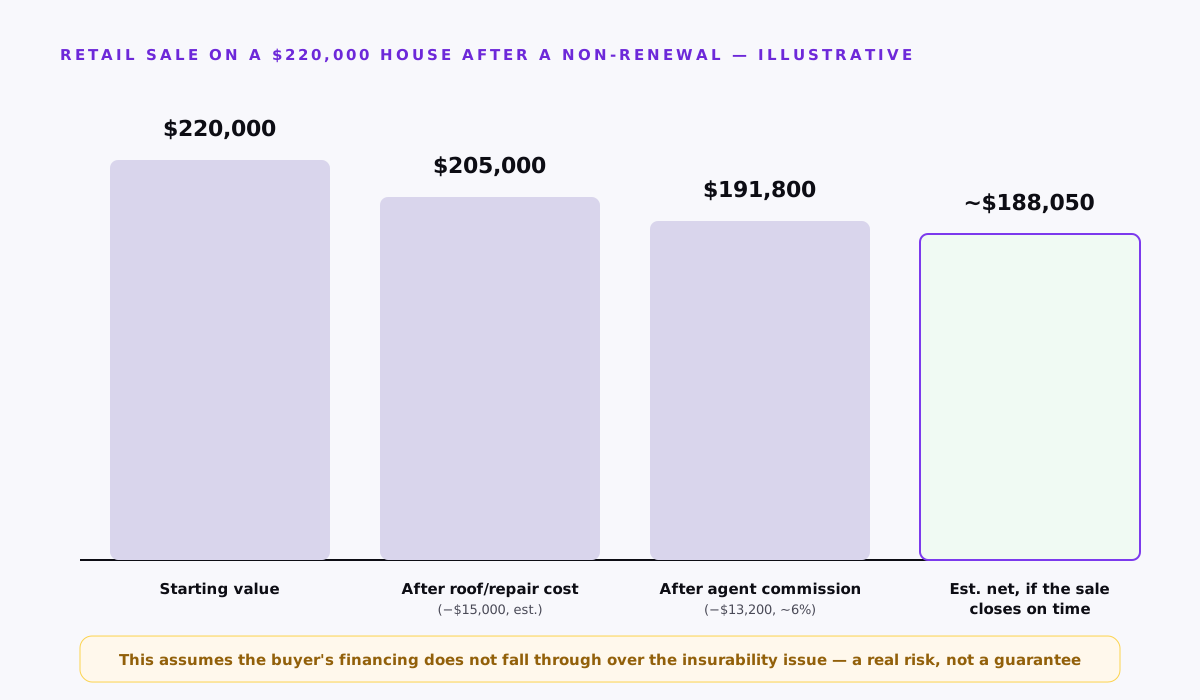
Here's a side-by-side using a $220,000 example house that just received a non-renewal notice over an aging roof. These are illustrative example numbers only — not a quote for your property or a promise of what any buyer, including Restar, would offer.
What a $220,000 retail sale nets after repairs and commissionRestar Acquisitions · worked example from this page
Real — buyer's loan can be denied at closing if insurability isn't resolved
None — no lender, no insurance contingency
Typical timeline to closed sale
60–120+ days, longer if the deal falls through and re-lists
As little as 7–14 days
Example net proceeds
Roughly $184,300–$191,800 before any re-negotiation if the deal stalls
Example range only, varies by condition and market — commonly well below retail net, since the buyer is pricing in the repair, risk, and speed
A retail deal can stall late in underwriting over insurabilityRestar Acquisitions · timeline for the same example
The honest takeaway: a cash, as-is sale nets less than a clean retail sale, because you're not paying for the roof and you're not waiting three-plus months for a buyer. But a retail sale on a currently uninsurable house isn't a guaranteed clean sale — it's a bet that you can either fix the insurability issue fast enough or find a buyer who can close without a mortgage. If that bet doesn't pay off, you can end up back at square one after paying for a roof, an agent, and months of holding costs, with the price cut anyway during re-negotiation. Run your own numbers with an agent and a contractor quote before deciding — this table is a starting framework, not a substitute for local pricing.
You have more than one path here, and the right one depends on your timeline, your cash on hand, and how much risk you're willing to carry.
Fix the insurability issue before listing. If the problem is a roof, get two or three contractor quotes and a timeline. A new roof or the repairs needed to pass a four-point or wind-mitigation inspection can be expensive, but it reopens the buyer pool to anyone using standard financing and usually gets you closer to full retail value.
Get a quote from a FAIR plan or surplus-lines carrier. Every state has some form of insurer of last resort for property owners who can't find coverage in the standard market — often called a FAIR plan. The National Association of Insurance Commissioners describes these as "state-mandated property insurance plans that provide coverage to individuals and businesses who are unable to obtain insurance in the regular market." Coverage through these plans and surplus-lines carriers tends to cost more and cover less than a standard policy, but it can be enough to satisfy a lender and get a financed buyer to closing.
List as-is and disclose the situation. Some buyers — particularly other investors, contractors, or cash buyers — will purchase a home with a known insurability issue at the right price, as long as it's disclosed upfront. This keeps your buyer pool smaller than a fully insurable retail listing, but it avoids the cost of repairs.
Sell to a cash buyer with no financing or insurance contingency. Because there's no lender requiring proof of insurance, a cash sale sidesteps the entire issue. This is typically the fastest, most certain path, and it's the trade-off shown in the table above: speed and certainty in exchange for a lower net number than a repaired, financed retail sale.
Which Option Makes Sense for Your Situation?
If you have the cash and time to fix the roof or the failed inspection item, and your local market supports a normal listing timeline, repairing first and listing retail usually nets more money. If you're short on time, cash-strapped for repairs, dealing with an estate or inherited property, or you just want the situation resolved without gambling on a buyer's financing falling through, a cash sale or an as-is disclosed listing is worth serious consideration.
Restar Acquisitions buys houses as-is for cash in 31 markets across Alabama, Arizona, Florida, Georgia, Indiana, Maryland, Michigan, North Carolina, New York, Ohio, and Texas, including several of the coastal and wind-exposed Florida markets where non-renewals are most common right now. We provide a written offer within 24 hours, there are no repairs or commissions, and you choose the closing date. We're a direct buyer, not a real estate agent or broker, and we don't represent you in the transaction — that's a role worth having on your side if you decide to list instead. If you want a no-obligation comparison of what a cash sale would look like for your specific house, you can see how we work in Florida as an example of our process. There's no pressure and no deadline attached to getting a number — take the time you need to compare it against a retail listing.
This article is for general education only and isn't legal, insurance, or tax advice. Insurance rules, non-renewal notice periods, and FAIR plan availability vary by state and change over time. Talk to a licensed insurance agent, your state Department of Insurance, or an attorney about your specific policy and situation before making a decision.
Common questions
Can I sell my house if my homeowners insurance was cancelled?
Yes. Cancellation or non-renewal doesn't prevent a sale — it primarily affects whether a buyer using mortgage financing can close, since most lenders require the buyer to have an active policy in place. A cash buyer can close without that requirement.
Will a title company or closing attorney require insurance to close?
For a cash sale, generally no — there's no lender requiring it. For a financed sale, the buyer's lender typically requires proof of the buyer's own insurance policy before funding, which the closing agent will confirm is in place before disbursing funds.
How long does an insurer have to give notice before non-renewing my policy?
Notice periods vary by state and are set by each state's insurance regulator, commonly somewhere in the range of 30 to 120 days depending on the state and the reason for non-renewal. Florida, for example, publishes its own non-renewal and cancellation rules through the <a href="https://www.myfloridacfo.com/division/consumers/understanding-insurance/faq/home">Florida Department of Financial Services, Division of Consumer Services</a>. Check your policy's non-renewal letter and your own state's Department of Insurance for the exact requirement that applies to you.
What is a FAIR plan and how do I get a quote?
A FAIR plan is a state-backed insurance program that provides coverage to property owners who can't get a standard policy in the private market. Coverage and cost vary by state; a licensed local insurance agent can tell you whether your state has one and get you a quote, along with quotes from surplus-lines carriers that also serve harder-to-insure properties.
Will I get full market value if I sell for cash instead of listing?
No, and any buyer who tells you otherwise isn't being straight with you. A cash, as-is sale with no financing contingency typically nets less than a fully repaired retail listing, because the buyer is pricing in the repair costs, risk, and speed. The comparison table above shows the trade-off in real numbers so you can weigh it for your situation.
Should I make repairs first or sell as-is?
It depends on your cash on hand, timeline, and risk tolerance. If you can afford the repair and have time for a normal listing period, repairing first usually nets more. If you need certainty and speed, or can't front the repair cost, selling as-is — whether disclosed on the open market or directly to a cash buyer — avoids that gamble.
Want to compare a cash offer against your actual numbers?
We'll give you a written offer within 24 hours with no repairs and no commissions — and if fixing the insurability issue and listing retail nets you more, we'll tell you that instead.
Every offer on this site is underwritten by a person, not a form. If the
numbers do not work for you, say so and I will tell you what would.
Also from Restar
Want the data behind all of this?
Restar Acquisitions is the acquisitions arm of Restar — a housing-market analytics
platform tracking 180+ metrics across every U.S. market, with composite scores and 12-month
price forecasts. The numbers on this page come from the same work.