<b>A tenant's bankruptcy filing does not stop you from selling the property you own — it only protects the tenant's right to stay for a while longer.</b> The automatic stay freezes eviction and collection actions against the tenant, not your sale, and a federal deadline (as short as 60 days in a Chapter 7 case) eventually forces the question of whether the lease survives. Here's what actually happens, and what it means for listing retail versus selling to a cash buyer now.
Step 1 of 5
Tell us about the property and we'll send a written cash offer within 24 hours — as-is, with the tenant in place if needed. No repairs, no commissions, you pick the closing date.
You’ll talk to Trevor McAmis, Owner & Acquisitions Lead
(313) 710-6129
Takes about two minutes. Or call (313) 710-6129 — we answer.
Educational only. This explains how these situations generally work. It is not legal, tax or financial advice, and the rules differ by state — talk to an attorney or CPA about your own situation before you act on any of it.
When a tenant files Chapter 7 or Chapter 13, the single biggest misconception landlords run into is that the filing freezes the property itself. It doesn't. The property you own is not part of the tenant's bankruptcy estate — only the tenant's own assets and interests are, including their leasehold interest in the unit they're renting from you.
That distinction matters because it means you remain free to list, market, and close a sale of the house while your tenant's case is open. What the filing does change is the lease sitting on top of your ownership: whether that lease survives the sale, gets rejected, or ends up in limbo depends on a federal timeline, not on your decision to sell.
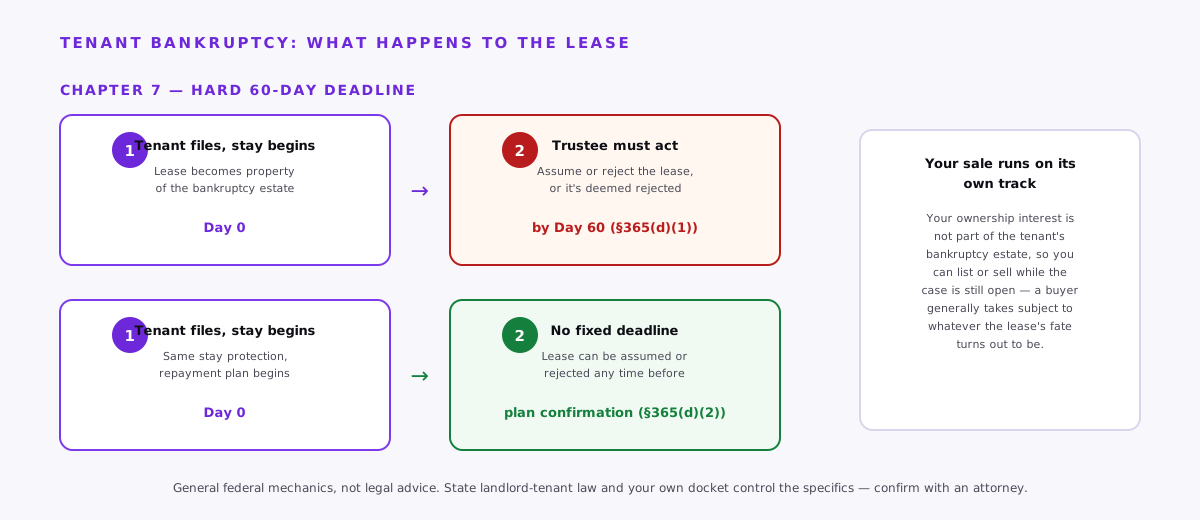
No — not on its face. The automatic stay under 11 U.S.C. §362(a) halts acts to obtain possession of “property of the estate” and judicial proceedings against the debtor. A tenant's lease is property of their bankruptcy estate under 11 U.S.C. §541, so the stay protects their right to stay in the unit from eviction or collection actions during the case.
Your fee ownership of the house is a separate interest that never entered the tenant's estate, so the stay's purpose — protecting the debtor's property from creditors — doesn't reach your decision to sell what you own. Two statutory carve-outs, §362(b)(22) and (b)(23), also let an eviction already backed by a pre-filing judgment, or one tied to property endangerment, move forward despite the stay. None of this is a substitute for your own attorney's read of your specific case; it's the general mechanics, not advice for your situation.
This is where the chapter matters. In a Chapter 7 liquidation, 11 U.S.C. §365(d)(1) gives the trustee 60 days from the order for relief to assume or reject the lease — if the trustee does nothing, the lease is deemed rejected by default and the tenant is expected to surrender the unit. That 60-day clock is the closest thing to a hard deadline in this whole process.
In a Chapter 13 repayment-plan case, §365(d)(2) is far looser: the lease can be assumed or rejected at any point before the plan is confirmed, which can be months into the case. There's no equivalent short fuse, which means a Chapter 13 tenant's lease status can stay genuinely unresolved for longer than a Chapter 7 tenant's would. One wrinkle worth flagging honestly: the statute governing a Chapter 13 debtor's own powers, 11 U.S.C. §1303, doesn't explicitly cross-reference §365, so whether the tenant personally or the trustee holds the assume-or-reject decision in a given Chapter 13 case is a point worth confirming with the court docket or an attorney rather than assuming.
Bankruptcy filings aren't rare: nationwide Chapter 7 filings rose 15% to 344,825 and Chapter 13 filings rose 4% to 203,118 in fiscal year 2025, according to the U.S. Courts' own Judicial Business 2025 report — this is a situation landlords run into with some regularity, not a freak occurrence.
Generally, yes — a buyer typically takes a tenant-occupied property subject to whatever lease is already in place, regardless of who owns it, under ordinary landlord-tenant law. That principle is governed by state law rather than federal bankruptcy law, and the specifics (notice requirements, what happens at lease end, security deposit transfer) vary enough by state that this is a point to confirm against your own state's landlord-tenant statute rather than treat as settled everywhere.
In practice, this means the bankruptcy case and the sale run on two separate tracks that eventually intersect: your sale can close on its own timeline, but whoever buys the house inherits the lease (and whatever the bankruptcy court ultimately decides about it) exactly as it stood at closing. A title company or a buyer's lender may ask more questions once an open bankruptcy case shows up in a title search — expect some extra documentation requests, though exactly how a given lender handles it varies and isn't something we found a single standardized federal rule for.
Say you own a $165,000 rental, tenant paying $1,350 a month, with an open Chapter 13 case on the title. Listing retail means marketing a tenant-occupied property with a bankruptcy filing attached to it — a combination that tends to narrow your buyer pool to investors and slow down financed buyers' underwriting. A realistic run: list at $165,000, roughly 90 days to close, 6% commission ($9,900), $4,000 in make-ready repairs, 2% closing costs ($3,300), and about $2,700 in holding costs over those three months. That nets roughly $145,100 after about three months, with real risk the timeline stretches further if a buyer's financing falls through over the title complication.
A cash sale skips the financing contingency entirely. A typical as-is, occupied-property cash offer on the same house might land around $142,000, with no commission, no repair spend, and modest closing costs (around $800). That nets roughly $141,200 in 2–3 weeks, with no financing-fallthrough risk tied to the open bankruptcy case.
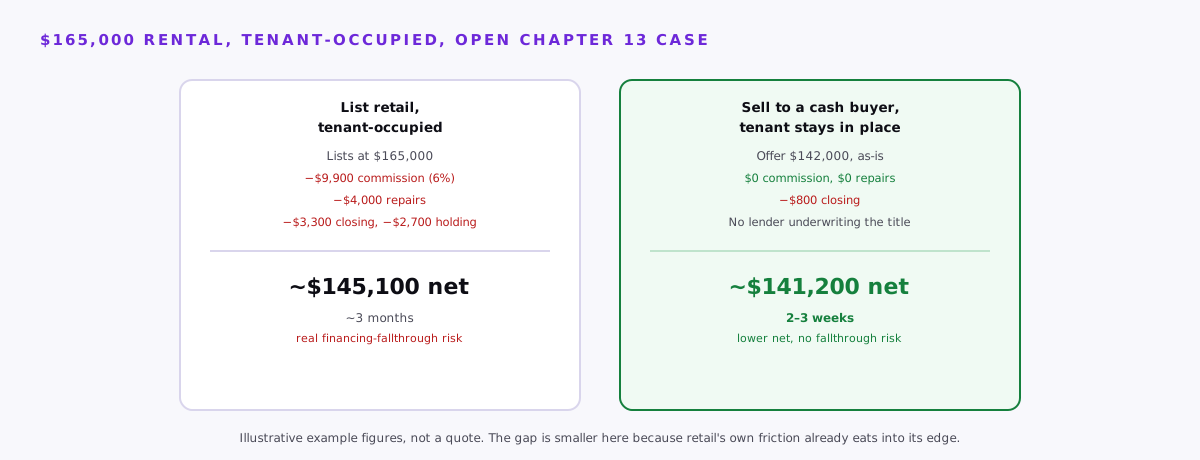
The gap here is only about $3,900 — smaller than on many properties — because the retail path's own friction (slower sale, real fallthrough risk, repair and holding costs) already eats into what looks like a bigger number on paper. That's the actual tradeoff: roughly $3,900 more, in exchange for three extra months and a real chance the deal stalls if a buyer's lender gets uncomfortable with the title.
You don't have to choose between listing immediately and selling for cash immediately. Waiting out the lease-resolution deadline (60 days in a Chapter 7 case) can hand you a cleaner, vacant-or-resolved property before you ever list, at the cost of lost rent or holding time while you wait. Negotiating directly with the tenant for a voluntary move-out, sometimes with a cash-for-keys arrangement, can resolve the occupancy question faster than letting the bankruptcy timeline run on its own.
Selling to an investor buyer who specifically wants a tenant-occupied property in place sidesteps the vacancy question altogether and can be a better fit than either a retail listing or a vacant-property cash sale, depending on the lease terms. And talking to a landlord-tenant or bankruptcy attorney before you take any action — noticing the tenant, listing the property, or signing a purchase agreement — is worth the consultation fee given how much of this turns on your specific state's law and your tenant's specific chapter and docket. This article is educational only; it isn't legal advice for your situation, and a licensed attorney in your state is the right person to confirm how these rules apply to your case.
A cash sale doesn't require a buyer's lender to get comfortable with an open bankruptcy case on the title search, and it can close in 1–3 weeks.
You'll get a written offer within 24 hours, no repairs or commissions required, and you pick the closing date. We're a direct buyer, not your attorney, and this isn't legal advice.
All guides · Tired landlord situation guide · Selling a rental property with tenants · Selling a rental after a tenant abandons it
Step 1 of 5
No obligation, no fees, no repairs. We respond the same day.
You’ll talk to Trevor McAmis, Owner & Acquisitions Lead
(313) 710-6129
Takes about two minutes. Or call (313) 710-6129 — we answer.