No medical provider can place a lien on your house just because you owe money. They have to sue you, win a money judgment in court, and then record that judgment against your property in the county where it sits. From there, state homestead law decides whether the lien attaches, and it varies enormously. Texas and Florida block an ordinary medical debt judgment from attaching to a qualifying homestead almost entirely. Maryland now blocks medical debt liens on a primary residence by name. Most other states shield only a capped dollar amount of equity, with the lien still attaching above that cap. This guide walks through the real mechanic, a state-by-state homestead comparison for all 14 states Restar Acquisitions buys in, the current status of the federal rule on medical debt and credit reports, the real alternatives to losing sleep over a hospital bill, and a worked example showing what a judgment lien does to your net proceeds.

Step 1 of 5
Send the address and we will show you both paths, cash and listing, net of the actual lien payoff.
You’ll talk to Trevor McAmis, Owner & Acquisitions Lead
(313) 710-6129
Takes about two minutes. Your address is never shared.
Educational only. This explains how these situations generally work. It is not legal, tax or financial advice, and the rules differ by state. Talk to an attorney or CPA about your own situation before you act on any of it.
A big unpaid hospital bill is scary enough on its own. Add the fear that it could somehow take your house, and a lot of people stop opening the mail. So can medical debt put a lien on your house? Not directly, and not automatically. A hospital or collector has to sue you first, win a money judgment in court, and then record that judgment against your specific property.
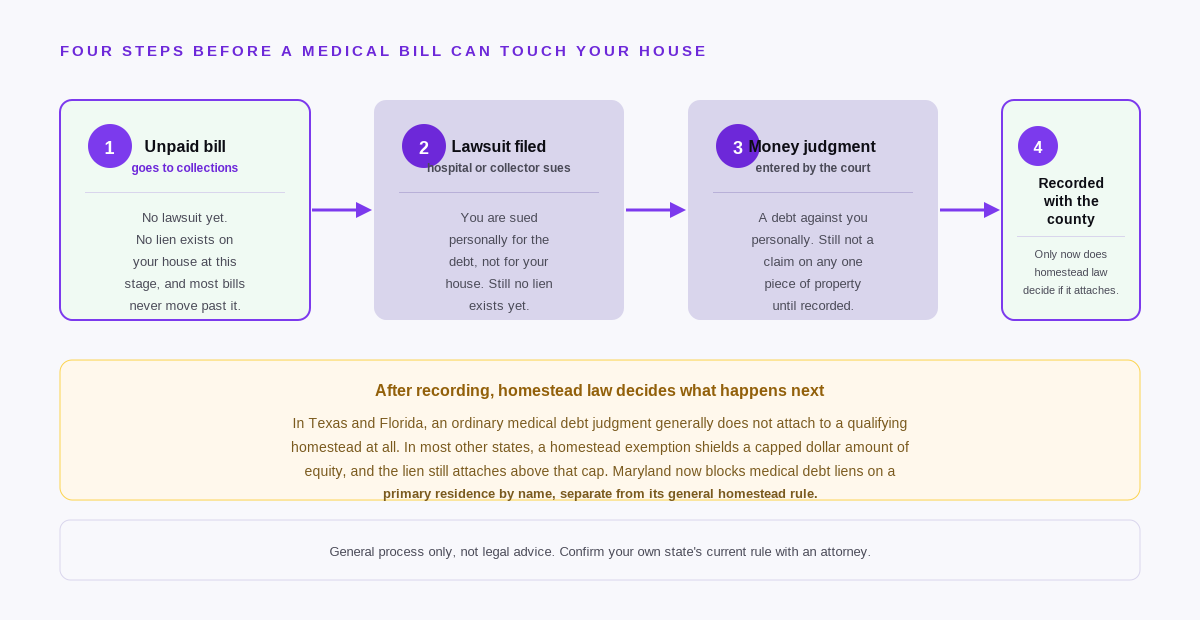
First, the hospital or a collection agency it sold the debt to has to sue you in court. This alone is less common than people assume. Many unpaid medical bills just sit as collection accounts and never become a lawsuit, especially smaller balances.
Second, if they sue and you do not show up or you lose, the court enters a money judgment against you personally. At this point the judgment is a debt against you, not a claim on any particular piece of property. Cornell Law School's Legal Information Institute describes a judgment lien as a claim that attaches to a debtor's real property once the creditor takes the additional step of filing a certified abstract of that judgment with the county (see Cornell LII's definition of a judgment lien).
Third, the creditor has to record (sometimes called docketing) that judgment with the county where your house is located. Until that filing happens, there is no lien on your specific house, just a court record against you. Once it is recorded, whether it legally attaches, and to how much of your equity, depends entirely on your state's homestead exemption.
So the answer to “can medical debt put a lien on your house” is: not on its own, and not without you getting sued first and a judgment being entered and recorded. If you have gotten scary collection letters but have not been sued, there is no lien yet.
Once a judgment is recorded, homestead exemption law decides what happens next, and it varies more than most people expect. Two basic patterns show up across Restar's 14 states.
Full or near-total block. In Texas and Florida, an ordinary money judgment, including one for medical debt, generally does not attach to a qualifying primary residence at all. Texas Property Code Section 52.0012 provides a procedure for releasing a judgment lien that was mistakenly recorded against a homestead, built on the underlying rule that such a lien does not validly attach to homestead property in the first place. Florida's protection is written directly into its constitution: homestead property is “exempt from forced sale under process of any court, and no judgment, decree or execution shall be a lien thereon,” with narrow carve-outs for property taxes, a purchase-money mortgage, and contractors' liens for work done on the home (Florida Constitution, Article X, Section 4).
Capped dollar protection. In most other states, a homestead exemption shields a specific dollar amount of your home equity from an ordinary judgment creditor, medical debt included, but the lien can still attach to equity above that cap. The cap itself ranges from a few thousand dollars to several hundred thousand, depending on the state.
Neither pattern protects you from everything. Property tax liens, a mortgage you signed, a mechanic's lien for work done on the house, and child support generally are not blocked by homestead law anywhere. And whether your specific property qualifies as your “homestead” under your state's definition is its own fact question. That is a conversation for a real estate or consumer-debt attorney, not a blog post, especially if a judgment has already been recorded against you and you are not sure it is valid.
Dollar figures below reflect the most current published amounts found at the time this was written. Several of these are scheduled to change on a set future date (noted where that is the case), and legislatures amend these numbers more often than people check. Confirm the current figure for your state before relying on it.
| State | Protection against an ordinary medical-debt judgment | Statute |
|---|---|---|
| Texas | Homestead generally blocked from judgment liens entirely (acreage-limited) | Tex. Const. art. XVI; Tex. Prop. Code §52.0012 |
| Florida | Homestead exempt from forced sale and judgment liens, unlimited value (acreage-limited) | Fla. Const. art. X, §4 |
| Nevada | Up to $605,000 of home equity shielded, declaration must be recorded | Nev. Rev. Stat. §115.010 |
| Arizona | Up to $400,000 of equity, inflation-adjusted since 2024 | Ariz. Rev. Stat. §33-1101 |
| Ohio | Up to $182,625, adjusted every three years | Ohio Rev. Code §2329.66(A)(1) |
| New York | $102,400 to $204,825 depending on county | N.Y. C.P.L.R. §5206 |
| North Carolina | $35,000 per debtor, $70,000 joint, $60,000 at 65+ in some cases | N.C. Gen. Stat. §1C-1601(a)(1) |
| Georgia | $21,500 against an ordinary judgment creditor | Ga. Code §44-13-1 |
| Indiana | $22,750, or $45,500 combined for spouses as tenants by the entirety | Ind. Code §34-55-10-2 |
| Alabama | $18,800 (rising to $20,475 on April 1, 2027) | Ala. Code §§6-10-2, 6-10-12 |
| Missouri | $15,000 (rising to $40,000 on January 1, 2027) | Mo. Rev. Stat. §513.475 |
| Maryland | $31,575, bankruptcy only; outside bankruptcy the general exemption does not shield much (see Maryland's medical-debt-specific law below) | Md. Code, Cts. & Jud. Proc. §11-504(f) |
| Michigan | $3,500 against an ordinary state-court judgment; a much larger bankruptcy-only figure exists separately | Mich. Comp. Laws §600.6023(1)(g) |
| Pennsylvania | None. No homestead exemption; only a $300 general exemption and tenancy-by-the-entirety protection for jointly owned property | 42 Pa. Cons. Stat. §8123 |
A couple of things worth flagging about this table. These figures come from current legal-industry compilations and state statute summaries, not from reading every state's live statute text directly, and dollar caps get amended on a schedule lawmakers do not always publicize well in advance. If your state's number here looks close to a threshold that matters to you, pull the actual current statute or call a local attorney before deciding anything financial based on it. Pennsylvania's lack of a homestead exemption is a genuine, significant outlier worth sitting with if you are a Pennsylvania homeowner facing a judgment.
Beyond the general homestead rules above, some states have passed laws in the last year or two that target medical debt liens by name, separate from ordinary homestead exemptions.
Maryland is the clearest example in Restar's footprint. Maryland House Bill 428, signed in May 2025 and effective October 1, 2025, prohibits using a money judgment for medical debt to place a lien on a debtor's primary residence at all, and requires a debt collector suing over medical debt to flag the complaint as medical debt and include the debtor's residential address. If a lien is improperly placed anyway, the law requires a court to remove it. This is a stronger, more specific protection than Maryland's general homestead exemption above, which (outside bankruptcy) does not shield much.
Nevada has also enacted broader medical-debt protections beyond its large homestead cap, including limits on home liens tied specifically to medical debt. Pennsylvania has a bill (Senate Bill 371) that would prohibit medical creditors from placing a lien on a patient's home, but as of this writing it remains in committee and is not current law. If you are in Pennsylvania, do not rely on a bill that has not passed.
None of the other states in Restar's footprint currently have a medical-debt-specific lien law beyond their general homestead rules, as far as could be confirmed. Check your own state's current session if this matters to you; state legislatures have been moving on this topic faster than most people realize.
Not right now, and this one has a messy recent history worth knowing. The CFPB finalized a rule in January 2025 that would have banned medical debt from appearing on consumer credit reports nationwide and stopped lenders from using it in lending decisions. A federal court in the Eastern District of Texas vacated that rule in July 2025, after the CFPB itself joined a motion asking the court to do so, on the grounds that the rule exceeded the bureau's authority. As of this writing, there is no federal rule keeping medical debt off your credit report (see the CFPB's own page on medical debt and credit reports).
Separately, the major credit bureaus still maintain their own voluntary policies: paid medical collections are generally removed from reports, medical collection balances under $500 are generally excluded, and there is typically a one-year grace period before an unpaid medical bill can even show up as a collection. Those are bureau policies, not law, and they can change without the kind of public notice a federal rule would require. Several states have passed their own laws banning medical debt from credit reports, but the CFPB separately published an interpretive rule in late October 2025 arguing that federal law broadly preempts those state credit-reporting bans. That dispute is unsettled. If this affects you directly, check your state's current status rather than assuming either way.
A lien, or even a lawsuit, is not the end of the line. A few real options, roughly in the order most people should consider them.
Apply for the hospital's financial assistance program. Nonprofit hospitals (which is most hospitals) are required under IRS Section 501(r), enacted as part of the Affordable Care Act, to maintain a written financial assistance policy and to limit charges for qualifying patients to what is generally billed to insured patients. This exists specifically for people who cannot pay, and a lot of eligible patients never apply because they do not know it is there.
Negotiate a settlement directly. Medical debt gets settled for a fraction of face value more often than almost any other kind of consumer debt, especially once it is with a collector rather than the original hospital billing department. A lump-sum settlement, even at 30 to 50 cents on the dollar, often beats letting a case go to judgment.
Ask about a payment plan. Most hospitals will set one up, and a reasonable payment plan in progress makes a lawsuit less likely in the first place.
Get a lien checked or disputed by an attorney, if one has already been recorded. This is the single most important moment to involve a consumer-debt attorney in this whole process. An attorney can confirm whether a judgment attached to your house given your state's homestead rules, whether the underlying judgment was entered properly (default judgments on old or disputed medical debt are not rare), and whether it can be challenged or removed rather than paid.
Sell the house, if that's the right call. This makes sense when there is real equity exposed above your state's exemption and paying the lien off at a sale is simpler than fighting it, or when you just want to be done carrying the stress regardless of the legal exposure. It is one option among several, not the first move.
If you have read our guide on selling a house with a judgment lien, you will recognize some of the mechanics here, they are the same underlying process. That guide covers judgment liens broadly: how they attach, how long they last, how they get satisfied and cleared at closing, regardless of what kind of debt created them. This article is narrower on purpose. It is specifically about the medical-debt version of that fear, the state-by-state homestead comparison that matters most for medical debt, and the new medical-debt-specific laws a few states (Maryland, notably) have passed that sit outside ordinary homestead rules entirely. If you already know you have a judgment lien from any source and want the general mechanics, start with that guide. If you are specifically worried about an unpaid hospital bill turning into one, this is the more specific read.
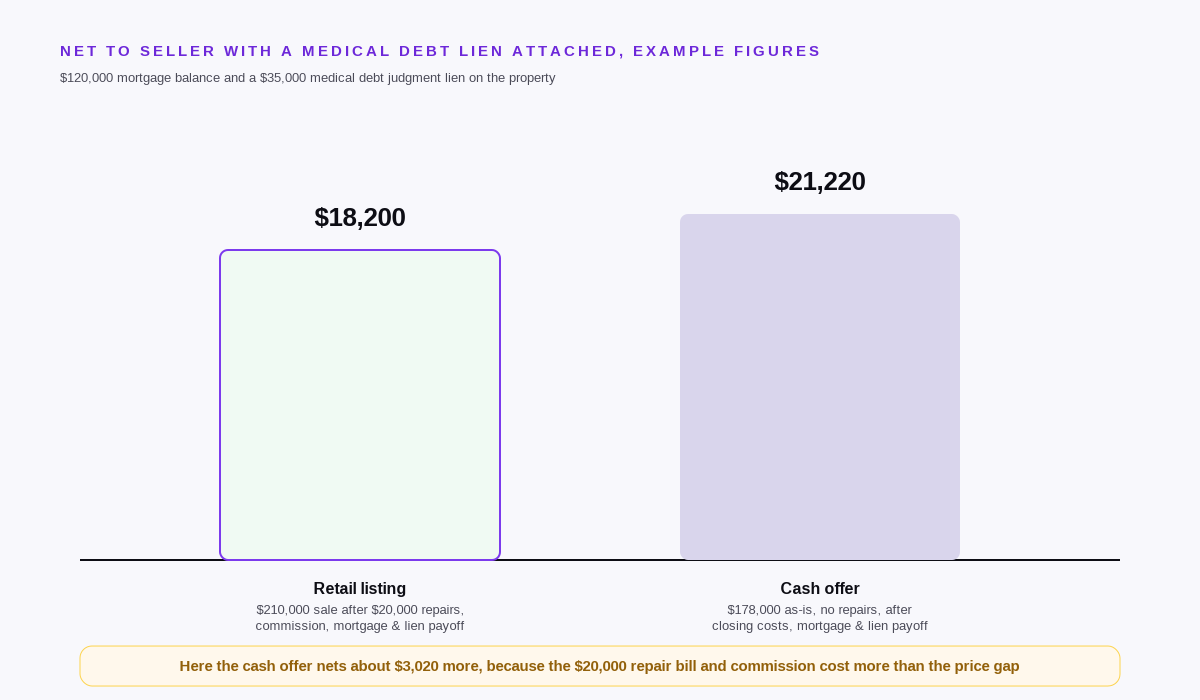
These are example figures for illustration, not a quote for any specific property. Say a homeowner in a capped-exemption state has a $120,000 mortgage balance on a house worth $210,000 once $20,000 in deferred repairs (roof, HVAC) are done, and a $35,000 medical debt judgment has been recorded against the property. The state's homestead exemption shields $21,500 of equity; the remaining equity is well above the judgment amount, so the full $35,000 lien attaches.
| Retail listing (after repairs) | Cash offer (as-is) | |
|---|---|---|
| Sale price | $210,000 | $178,000 |
| Repairs before listing | −$20,000 | $0 (sold as-is) |
| Agent commission (~6%) | −$12,600 | $0 |
| Seller closing costs | −$4,200 | −$1,780 |
| Mortgage payoff | −$120,000 | −$120,000 |
| Judgment lien payoff | −$35,000 | −$35,000 |
| Estimated net to seller | $18,200 | $21,220 |
In this example, the cash offer nets about $3,020 more, not because the price is higher (it is not) but because the $20,000 repair bill and the roughly $12,600 commission together cost more than the $32,000 gap between the two prices. That is the opposite of what happens when there is a bigger equity cushion and a smaller repair bill, where listing retail usually wins once there is enough room to absorb commission and repairs. Whether a cash offer or a repaired retail listing nets you more depends on your specific repair needs, your local price gap, and how much of your equity the lien and mortgage together are already claiming. Run your own numbers before deciding either way.
Restar Acquisitions buys houses directly, as-is, for cash, in 69 markets across Alabama, Arizona, Florida, Georgia, Indiana, Maryland, Michigan, Missouri, Nevada, New York, North Carolina, Ohio, Pennsylvania, and Texas. If your property is in one of those markets, we give a written offer within 24 hours of seeing it, we do not require repairs, we do not charge commissions, and you pick the closing date. We work directly with title and escrow on a recorded judgment lien, including a medical-debt judgment, so it gets resolved as part of closing rather than derailing your timeline.
We are not your only option, and for some sellers we are not even the best one. If your state's homestead law means a medical debt judgment never validly attached to your house at all, you may have no lien to sell around in the first place, and selling to solve a problem that a homestead exemption already solved for you does not make sense. If there is enough equity above the lien and your state's exemption to make a repaired retail listing net you more, as the example above shows can happen, we will tell you that too. What we are confident about is the offer itself: fast, as-is, and based on your real numbers, lien included.
This article is for general information only and is not legal, tax, or financial advice. Judgment lien rules, homestead exemptions, and medical-debt-specific protections vary by state and change over time. Talk to a real estate attorney or consumer-debt attorney about your specific situation before making a decision.
We will give you a written offer within 24 hours and work directly with title and escrow on a recorded medical debt judgment so it does not hold up your closing date, and if your state's homestead law means the lien never validly attached at all, we will tell you that too.
All guides · Selling a house with a judgment lien · Deficiency judgment after a foreclosure or short sale · Sell my house fast
Step 1 of 5
No obligation, no fees, no repairs. We respond the same day.
You’ll talk to Trevor McAmis, Owner & Acquisitions Lead
(313) 710-6129
Takes about two minutes. Your address is never shared.