If your house sold at a foreclosure auction for more than you owed, there may be money left over, and it belongs to you, not the lender, not the county, and not whoever mailed you a letter about it first. Claiming surplus funds after a foreclosure sale is usually a short form filed with the court clerk or trustee who handled the sale. You often don't need to pay anyone to do it.
Step 1 of 5
Tell us where things stand and we'll give you a written cash offer within 24 hours if there's still time to sell.
You’ll talk to Trevor McAmis, Owner & Acquisitions Lead
(313) 710-6129
Takes about two minutes. Your address is never shared.
Educational only. This explains how these situations generally work. It is not legal, tax or financial advice, and the rules differ by state. Talk to an attorney or CPA about your own situation before you act on any of it.
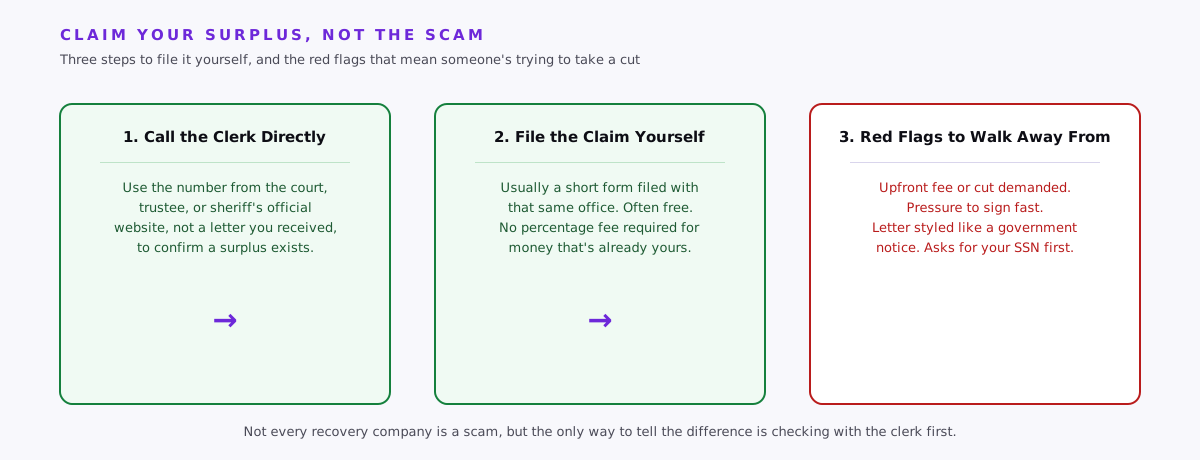
That last part, "often for free," is exactly what a whole category of scammer has built a business around. They watch public foreclosure and sheriff-sale records, spot a sale price that beat the payoff amount, and mail or call the former owner offering to "recover" the surplus for a cut, sometimes 10% to 50% of the money. They're not doing anything you can't do yourself. They just found the file before you did.
This is a different process than the surplus-funds rules you may have seen written up for tax foreclosures (unpaid property taxes). A mortgage foreclosure, whether it's a judicial sale run through the courts or a non-judicial trustee/sheriff sale, follows its own statute and its own clerk's office. Don't assume one process's rules apply to the other.
When a lender forecloses, the property gets sold, usually at a courthouse-steps or trustee auction. The sale proceeds first pay off the mortgage balance, unpaid interest, foreclosure attorney fees, and sale costs. If there's money left after that, it's "surplus" or "excess proceeds," and under every state's law it belongs first to the former owner, after any junior lienholders with a valid claim get paid in line.
How that gets to you varies by state and even by county, so confirm the exact mechanics with the clerk, court, or trustee who handled your sale. Here's what we could verify directly from the law in three of the states we operate in.
Ohio: Under Ohio Revised Code 2329.44, the officer who conducted the sale must deliver any surplus to the clerk of the court within 45 days of the sale being confirmed. The clerk then has to try to notify the former owner (the judgment debtor). If nobody claims it within 90 days of that notice, it gets turned over to the county.
Florida: Under Florida Statute 45.031 and the sections that follow it, the clerk of court handles disbursement after the final judgment, holds any surplus, and the statute lays out who can claim it and when. Clerk guidance in several Florida counties is consistent on one point: there is no fee to file an owner's claim for surplus funds. You fill out a form and file it with the clerk yourself.
Michigan: Under MCL 600.3252, surplus from a foreclosure-by-advertisement sale "shall be paid over by the officer or other person on demand, to the mortgagor, his legal representatives or assigns," unless a junior lienholder has filed a competing claim, in which case the money goes to the circuit court clerk for a hearing.
If your market is in Texas, Arizona, Georgia, Indiana, Alabama, North Carolina, Maryland, New York, Missouri, Nevada, Pennsylvania, or elsewhere on our list, the general shape is the same (file a claim, inside a deadline, with the entity that ran the sale) but the specific form, office, and time limit differ enough that we'd rather point you to your county clerk or the trustee named on your sale notice than guess at a number for you.
Foreclosure sale records are public. A scammer doesn't need to hack anything, they just pull the sale price, subtract the payoff amount, and if the gap is big enough, they have a lead. Then they send a letter or call that looks official, sometimes using language that sounds like a government notice, and offer to file your claim for a percentage.
The CFPB's consumer guidance on foreclosure-related scams is built around a few patterns that apply here directly: real government offices and courts don't charge an upfront fee to release money that's already yours, and anyone pressuring you to sign something fast or hand over your Social Security number before explaining exactly what they're charging for is a red flag. The FTC's guidance on mortgage relief scams makes the same core point about upfront fees for help you can usually get yourself for free or at low cost.
None of this means a recovery company is automatically a scam. Some do legitimate work tracking down owners who've moved and don't know a surplus exists, and charge a reasonable fee for it. The problem is telling the difference, and the only way to do that is to check with the clerk or court directly before you sign anything.
If you still have time before your auction date, selling beats waiting for a possible surplus almost every time, even at a price below full retail. Auctions routinely sell below market value, foreclosure fees and accrued interest eat into whatever's left, and the claims process that follows takes real time and carries real scam risk.
Example: Say the house is worth $220,000 retail and the full payoff (mortgage, fees, accrued interest) is $150,000.
Cash offer today, as-is: $170,000 offer, no commissions, no repairs, no holding costs, closes in two to three weeks. Payoff comes out at closing. Net to you: roughly $20,000, in hand, in under a month.
List it at retail: Sells at $215,000 after 60 to 90 days on market. Subtract a 6% commission (about $12,900) and typical repair/holding costs (say $8,000), then the $150,000 payoff. Net: roughly $44,100, but only if it closes before the auction date, and every week on market is a week the foreclosure clock keeps running.
Let it go to auction: Auctions commonly sell well under market, say $165,000. Subtract the $150,000 payoff plus foreclosure attorney fees, sheriff or trustee costs, and extra accrued interest, easily $10,000 to $15,000 by this stage. That can leave a surplus of anywhere from a few thousand dollars to nothing, depending on how far behind the loan was before the sale. Then comes the claims paperwork, a waiting period that can run months, and a mailbox full of recovery-fee offers.
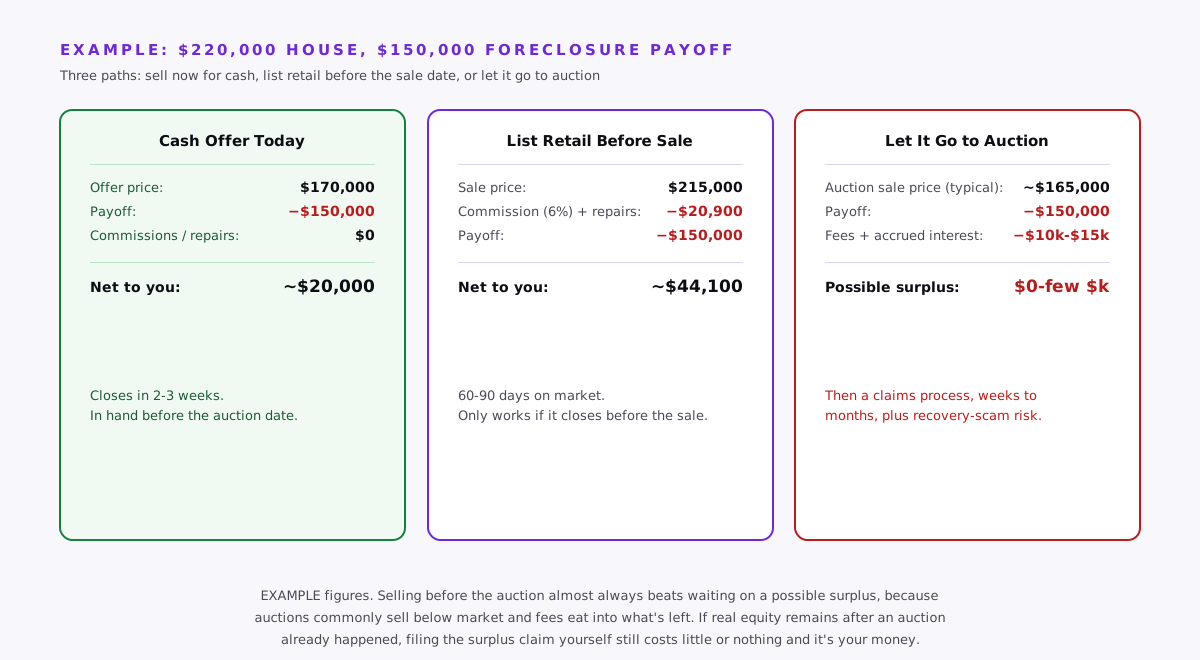
That third path isn't worthless. If there's a lot of equity in the house, a real surplus can still be worth pursuing, filing the claim yourself costs little or nothing, and it's your money either way. The point is that option three is slower, less certain, and loses more to fees along the way than selling before the sale date ever does.
| Sell before the auction date | Let it go to auction, claim surplus after | |
|---|---|---|
| Who sets the price | You (cash buyer or listing) | The auction/bidders, usually below market |
| Timeline to cash | Days to a few weeks (cash) or 60-90 days (listing) | Sale happens, then a claims process of weeks to months |
| What eats into proceeds | Commission/repairs (listing) or a lower cash price | Foreclosure fees, accrued interest, possible scam fees |
| Scam exposure | Low | Real, from "finder's fee" recovery companies |
| Best when | You have any time left before the sale date | The auction has already happened and there's real equity left |
Sell before the auction date, to us or to a listing agent, if there's still time on the calendar. This is the one option that avoids the surplus-claims process altogether.
Loan modification, forbearance, or reinstatement, which can stop the foreclosure before it reaches a sale. A HUD-approved housing counselor or an attorney can walk through eligibility; this is the one place we'd point you to a professional rather than guess.
File the surplus claim yourself, directly with the court clerk, trustee, or sheriff's office that ran the sale, if the house has already sold. It's usually a short form and, in states like Florida, explicitly free to file.
We'll give you a written cash offer within 24 hours, buy the house as-is, cover the payoff at closing, and you pick the closing date. No commissions, no repairs. If listing it would net you more given your timeline, we'll tell you that too. If the sale already happened, file your surplus claim yourself with the clerk or trustee first, and run any "recovery" offer past that same office before you sign anything or pay anyone.
All guides · Selling a house in foreclosure · How to tell if a cash home buyer offer is a scam · Foreclosure situation guide
Step 1 of 5
No obligation, no fees, no repairs. We respond the same day.
You’ll talk to Trevor McAmis, Owner & Acquisitions Lead
(313) 710-6129
Takes about two minutes. Your address is never shared.
