A FEMA Letter of Map Amendment (LOMA) or Letter of Map Revision Based on Fill (LOMR-F) can remove a house from a mandatory flood insurance zone if it truly sits at or above the Base Flood Elevation. FEMA charges nothing to review a LOMA, but the Elevation Certificate a surveyor must prepare commonly costs $400 to $900, and a straightforward case typically takes 10 to 16 weeks start to finish.
Step 1 of 5
Send the address and we will tell you what we would pay, and whether a LOMA is worth pursuing first.
You’ll talk to Trevor McAmis, Owner & Acquisitions Lead
(313) 710-6129
Takes about two minutes. Your address is never shared.
Educational only. This explains how these situations generally work. It is not legal, tax or financial advice, and the rules differ by state. Talk to an attorney or CPA about your own situation before you act on any of it.
Yes, if the property truly sits at or above the Base Flood Elevation. A Letter of Map Amendment (LOMA) or a Letter of Map Revision Based on Fill (LOMR-F) is FEMA's own process for removing a specific structure or lot from a Special Flood Hazard Area when the published flood map does not reflect the ground it sits on. It is not a workaround, and FEMA only issues one when the elevation data supports it.
This is educational information about the LOMA and LOMR-F process, not legal, insurance or engineering advice. Eligibility depends on actual site conditions a licensed surveyor has to verify, and FEMA's fees, forms and processing times can change. Confirm current requirements directly on FEMA's site before you apply.
FEMA treats these as two different corrections, not two names for the same thing. A LOMA applies when a structure or lot was always on natural ground at or above the Base Flood Elevation, and the flood map simply never caught up to that fact. FEMA describes this as an inadvertent inclusion: the land was never really in the flood hazard area, the map boundary was just drawn too broadly.
A LOMR-F applies when fill, meaning earth brought in and compacted, was used to raise a lot up to or above the Base Flood Elevation. The elevation requirement is the same either way. What differs is whether that elevation happened naturally or through construction, and FEMA's own LOMA and LOMR-F program page treats the fill question as the dividing line between the two.
The distinction matters for your wallet. FEMA does not charge a review fee for a LOMA. It does charge one for a LOMR-F, because the fill case also requires confirming the filled land is reasonably safe from flooding, not just elevated.
The test is the same for both letters: the lowest adjacent grade next to the structure, or the lowest point on the lot for a vacant parcel, has to sit at or above the Base Flood Elevation FEMA has published for that location. There is no partial credit and no negotiating the number.
You cannot establish that with a guess or an old survey. FEMA's process requires elevation information certified by a Licensed Land Surveyor or a Registered Professional Engineer, submitted on an Elevation Certificate. That document is the entire case. If the certified elevation comes back below the Base Flood Elevation, the application does not move forward no matter how confident you were about the natural rise or the fill job.
This is also where our guide to selling a house in a flood zone is worth reading first. Confirm your zone and the Base Flood Elevation for your address through FEMA's Flood Map Service Center before paying for a survey. A LOMA is only worth pursuing if you have a real reason, a visible rise, a known fill job, a neighbor's successful application, to think the map is wrong about your specific lot.
A single lot or single structure LOMA request uses FEMA's MT-EZ form, submitted on paper or online through eLOMA or the Online LOMC tool. A LOMR-F, or any request covering more than one lot or structure, uses the longer MT-1 forms package. The paperwork differs, but the underlying evidence, an Elevation Certificate, is the same.
Ordering the Elevation Certificate itself usually takes 1 to 3 weeks once you find a surveyor who does this work regularly. FEMA's own LOMA and LOMR-F page states that once it has a complete application, it normally issues a determination within 60 days. Put those two pieces together and a realistic start to finish timeline for a straightforward single lot LOMA commonly runs 10 to 16 weeks. It runs longer if FEMA marks the first submission incomplete, which restarts the clock, or if a LOMR-F triggers additional review of the fill.
There is no fast track for an urgent closing. If you are under contract and a buyer's lender needs the flood determination resolved in two weeks, a LOMA will not get there in time. That is the biggest reason this is a decision to make before you list, not a condition to chase during an active escrow.
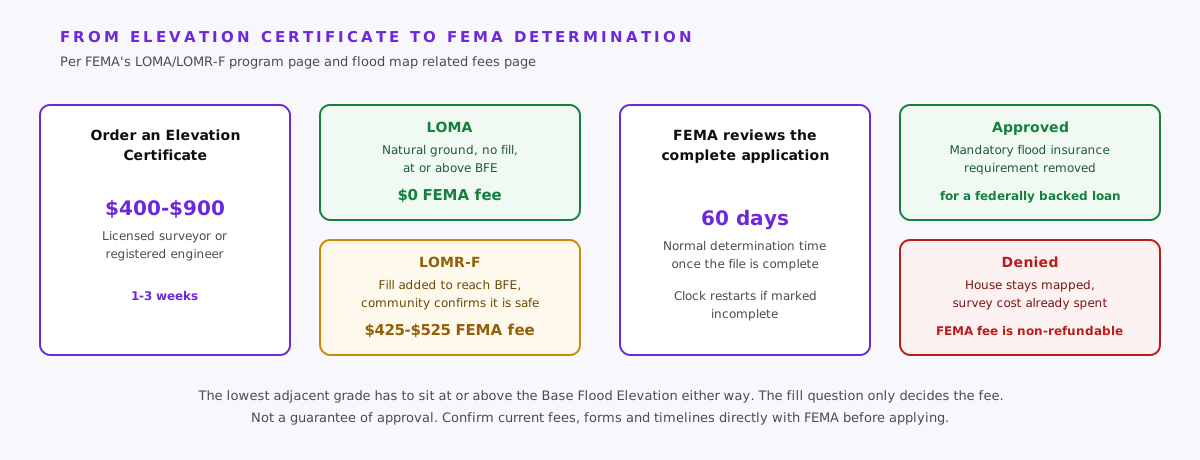
FEMA does not charge anything to review a LOMA. That is stated directly on FEMA's flood map related fees page. A single lot LOMR-F currently costs $425 submitted through Online LOMC or $525 on paper, and FEMA notes the fee is non-refundable once its review begins, approved or not.
The real cost is the Elevation Certificate itself. FEMA does not set surveyor pricing, and quotes vary by region and site access, but current market pricing for a single family lot commonly runs $400 to $900. Budget that before deciding this is worth pursuing, since it is the one cost you pay no matter how the application turns out.
Example: a $265,000 house sits in Zone AE with a $2,400 a year flood insurance quote attached to it, the same premium figure used in our flood zone guide. The owner orders an Elevation Certificate for $650. It comes back showing the lowest adjacent grade 1.4 feet above the Base Flood Elevation, with no fill ever added, so this is a LOMA case, and the FEMA review itself is free. Total out of pocket cost to apply: $650.
Once FEMA issues the LOMA or LOMR-F, the mandatory purchase requirement under the Flood Disaster Protection Act no longer applies to that structure for a federally backed loan. FEMA's own definition of the mandatory purchase requirement is the rule that forces flood insurance onto federally regulated and insured loans in a Special Flood Hazard Area. Remove the structure from that area and the rule stops applying to it.
A lender can still require flood insurance as a condition of a specific loan even after a LOMA. That is a lender's own underwriting choice, not a federal mandate. Buying flood insurance voluntarily after a LOMA is still a reasonable decision for whoever owns the house next, since removing the structure from the mapped hazard area does not remove the underlying flood risk, only the paperwork obligation.
For a seller, the number that moves is borrowing power, not the flood risk itself. Our flood zone guide walks through the mechanism: at roughly 6.5% over 30 years, every $100 of monthly flood premium displaces about $15,800 of what a financed buyer can borrow. A $2,400 a year premium is a roughly $31,600 squeeze on every financed offer you receive. Remove the mandatory premium and that squeeze goes away for the next buyer, financed or not.
Selling as-is now costs nothing extra and starts the clock on a sale immediately. The tradeoff is that every financed buyer who looks at the house is still working against roughly the same $31,600 of displaced borrowing power the premium creates, whether or not the map turns out to be wrong about your lot. Cash buyers are not affected by this at all, since there is no loan and no insurance escrow to qualify around.
Pursuing the LOMA first costs the $650 survey, plus $425 to $525 more if it turns out to be a LOMR-F case, and adds roughly 10 to 16 weeks before you can list with the correction in hand. If the house would otherwise have been under contract and closed in that window, the real cost also includes the carrying costs you would not have paid, taxes, insurance, utilities, which our flood zone guide figures at around $1,180 a month for a comparable house. At 10 to 16 weeks that is another $2,950 to $4,720.
| Line | Sell as-is now | Pursue LOMA first, then sell |
|---|---|---|
| Survey cost | $0 | about $650 |
| FEMA review fee | $0 | $0 for a LOMA, $425 to $525 if it is a LOMR-F |
| Added wait before listing | none | about 10 to 16 weeks |
| Carrying cost during that wait | $0 extra | about $2,950 to $4,720 at $1,180 a month |
| Total extra cost | $0 | about $3,600 to $5,900 |
| Financed buyer pool | squeezed by about $31,600 of displaced borrowing power | if approved, squeeze removed for every future buyer; if denied, cost is sunk and the squeeze stays |
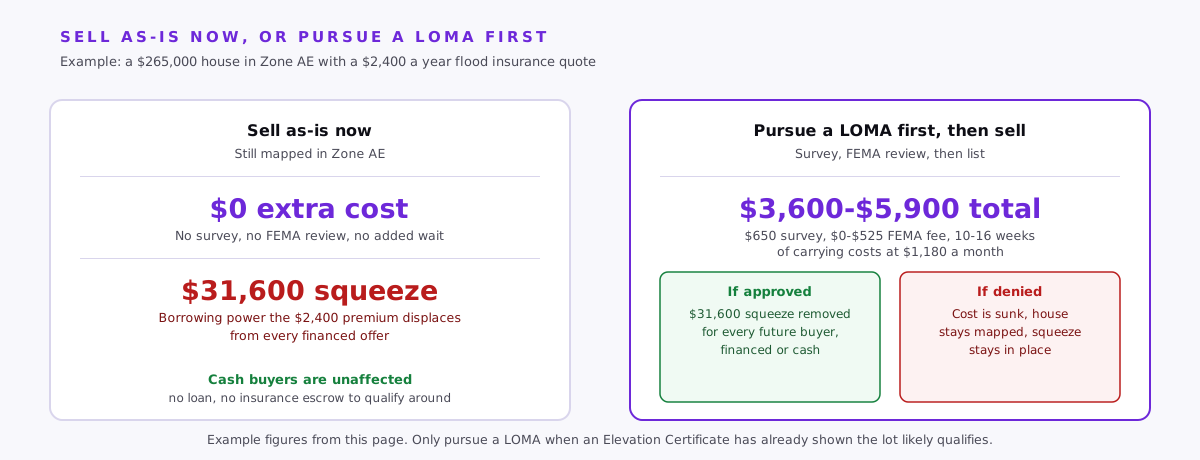
The LOMA path only wins this math if two things are both true: the property truly qualifies, and there is enough time before you need the house sold to absorb 10 to 16 weeks of carrying cost. Spend $650 to test a lot that is clearly still below the Base Flood Elevation, and you have spent $650 to learn what the flood map already told you.
List it as-is, or sell for cash now, when any of these apply: there is no real evidence the property sits above the Base Flood Elevation, there is a closing deadline inside the next few months, the carrying cost of waiting 10 to 16 weeks outweighs what a wider buyer pool would add, or a fast, certain close matters more to you than squeezing out the highest possible price.
A cash sale skips the whole question. A buyer who is not borrowing never triggers the mandatory purchase requirement in the first place, so the zone designation, LOMA or no LOMA, does not change what we can offer. We buy as-is, cover standard closing costs, and if the math on this page says pursuing the LOMA first would net you more, as it often does for a lot that truly qualifies, we will say so instead of steering you toward a faster close that costs you money. Our guide to how cash buyers calculate offers shows exactly where that number comes from.
If you send us the address, we will tell you within 24 hours what we would pay for the house as-is, with no survey, no LOMA application and no flood insurance contingency to clear before closing. We will also tell you if the math on this page favors pursuing the LOMA first, when the property truly qualifies and there is time to wait on it.
All guides · Selling a house in a flood zone · How cash home buyers calculate offers
Step 1 of 5
No obligation, no fees, no repairs. We respond the same day.
You’ll talk to Trevor McAmis, Owner & Acquisitions Lead
(313) 710-6129
Takes about two minutes. Your address is never shared.
