If your mortgage had an escrow account for taxes and insurance, federal law requires your lender's servicer to refund whatever balance is left within 20 business days of your payoff. It doesn't show up at the closing table. It's a separate check that arrives afterward, and most net sheets leave it out entirely.

Step 1 of 5
Send the address and your approximate loan balance. We'll walk through your actual payoff with you, including what's handled at closing and what arrives separately, before you commit to a closing date.
You’ll talk to Trevor McAmis, Owner & Acquisitions Lead
(313) 710-6129
Takes about two minutes. Your address is never shared.
Educational only. This explains how these situations generally work. It is not legal, tax or financial advice, and the rules differ by state. Talk to an attorney or CPA about your own situation before you act on any of it.
The word "escrow" does two unrelated jobs in a home sale, and mixing them up causes most of the confusion. At closing, "escrow" usually means the neutral third party (a title company or attorney) holding the buyer's and seller's funds and documents until everything is signed and recorded. That escrow closes out the day the sale finishes.
The other "escrow" is the mortgage impound account your lender has been collecting into every month, on top of your principal and interest, to pay your property tax and homeowners insurance bills on your behalf. That account has its own balance sitting with your loan servicer, separate from anything happening at the closing table, and it's this one that gets refunded.
Lenders are required to keep a cushion in your escrow account so a tax or insurance bill doesn't bounce if it lands before that month's collection clears. Under federal escrow rules (12 CFR 1024.17), that cushion is capped at one-sixth of your estimated annual disbursements, roughly two months' worth. Add in a tax or insurance bill that was already paid in full for a period extending past your closing date, and most sellers have a real, positive balance sitting in that account on the day they sell.
How much depends entirely on timing. Sell right after your servicer paid an annual tax bill and you're closer to the two-month cushion alone. Sell right before a big insurance renewal is due and the balance can run higher. There's no single "typical" number worth quoting, since it moves with your tax schedule, your insurance premium, and the month you close.
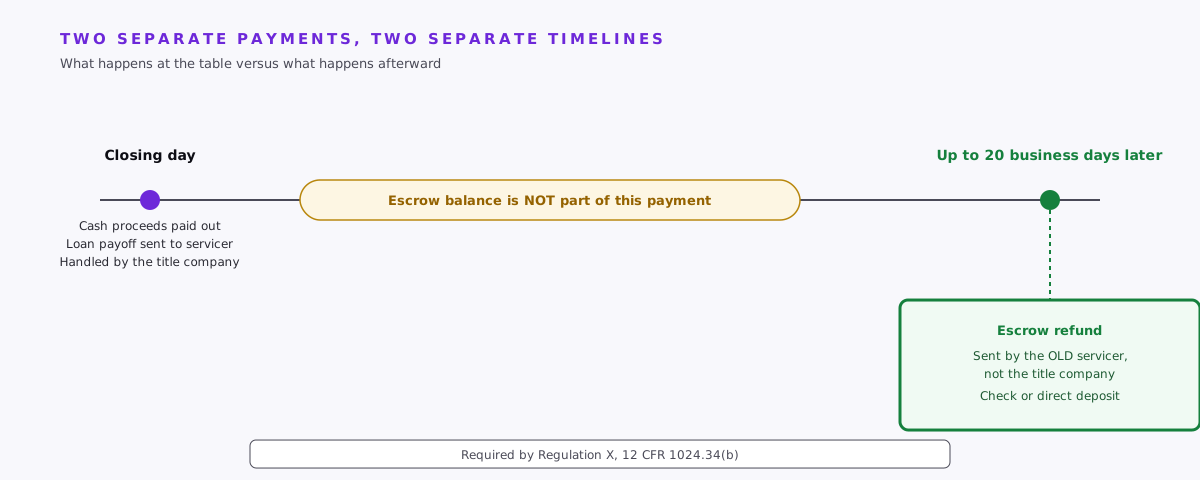
Your mortgage payoff statement tells the closing agent exactly how much to send your old servicer to satisfy the loan. The escrow balance is not part of that number and is not paid out through closing. Once the loan is paid off, your servicer must return any remaining escrow balance to you within 20 business days, by check or direct deposit, unless you've agreed to roll it into a new escrow account on a different loan with the same servicer.
That requirement comes from Regulation X, 12 CFR 1024.34(b). Most sellers never agree to roll the balance over, so most sellers get a check. See our guide to how a payoff statement works for what the payoff number itself covers.
That 20-business-day window (a little under a month, since it excludes weekends and federal holidays) means the money lands well after your closing proceeds do. If a seller's budget assumes every dollar shows up at the table, the escrow refund is the piece that quietly goes missing from the math, not because it's lost, but because it was never supposed to be there in the first place.
A third number sometimes gets lumped in with all this: the property tax proration credit at closing, where buyer and seller settle up for whatever portion of the current tax bill each owes for their time owning the house. That's a line item on the closing statement, handled at the table, and it's unrelated to your escrow cushion. A sale can have both a proration credit and an escrow refund, calculated differently and paid on different schedules.
For the same reason, the escrow refund isn't PMI either. If your loan had private mortgage insurance, it isn't refundable the way an escrow balance is. PMI pays for coverage month to month with nothing held for you. Escrow is your own money, held for bills, which is exactly why it comes back.
None of this changes which selling path nets more, but it does change what to count and when. A seller weighing a cash offer against listing with an agent should price both the same way: proceeds at the table, plus an escrow refund that shows up separately a few weeks later either way.
A faster sale doesn't produce a bigger or smaller escrow refund, since the amount isn't tied to how you sold the house, only to the fact that you paid off the loan. It just means the 20-business-day clock starts sooner.
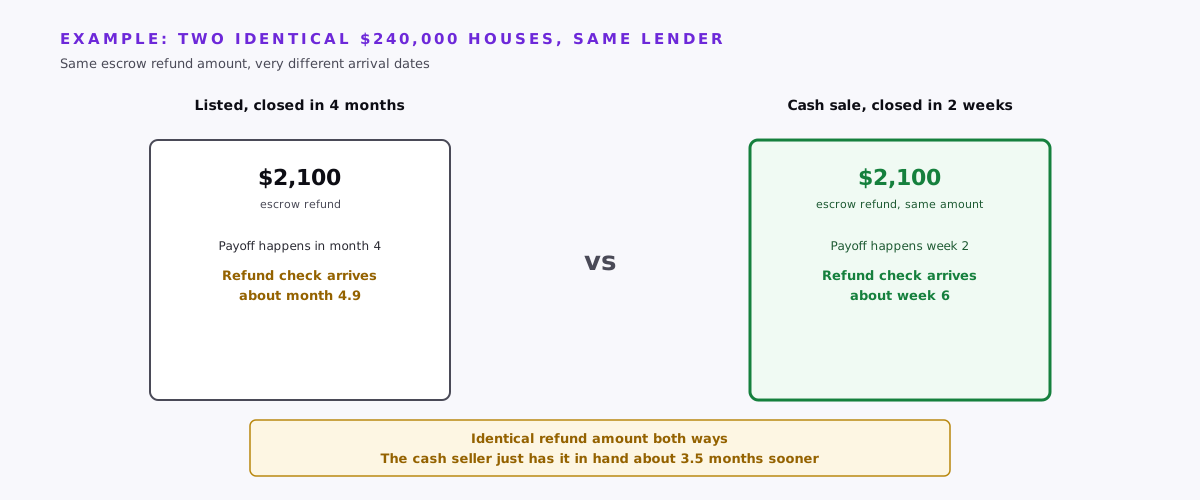
Example: two identical $240,000 houses, same lender, same escrow cushion of about $2,100 each. One seller lists and closes in 4 months; the other sells for cash and closes in 2 weeks. Both get the same $2,100 back from their servicer, 20 business days after their respective payoff, meaning the cash seller has that money in hand roughly 3.5 months earlier than the seller who listed, simply because their payoff happened sooner. The size of the refund is identical. The timing of everything attached to it moves with how fast the sale itself closes.
Your escrow refund won't show up as a credit at our closing table either, since it comes from your current servicer afterward, not from us. What we can do is show you the math straight: a written cash offer within 24 hours, as-is, with what a traditional listing would likely net instead sitting right next to it.
All guides · How a mortgage payoff statement works · Do you get your PMI back when you sell? · Cash offer vs listing net proceeds
Step 1 of 5
No obligation, no fees, no repairs. We respond the same day.
You’ll talk to Trevor McAmis, Owner & Acquisitions Lead
(313) 710-6129
Takes about two minutes. Your address is never shared.
