No — you don't get your private mortgage insurance (PMI) back when you sell your house. PMI is paid month by month for coverage already provided, like liability insurance, not into a refundable account. The only exception is a narrow FHA rule that refunds part of the upfront premium, but only if you refinance into another FHA loan within a few years — never when you sell to a third party.

Step 1 of 5
Tell us your loan balance and we'll help you see what a cash sale nets after payoff, PMI, and closing costs — no surprises at the table.
You’ll talk to Trevor McAmis, Owner & Acquisitions Lead
(313) 710-6129
Takes about two minutes. Or call (313) 710-6129 — we answer.
Educational only. This explains how these situations generally work. It is not legal, tax or financial advice, and the rules differ by state — talk to an attorney or CPA about your own situation before you act on any of it.
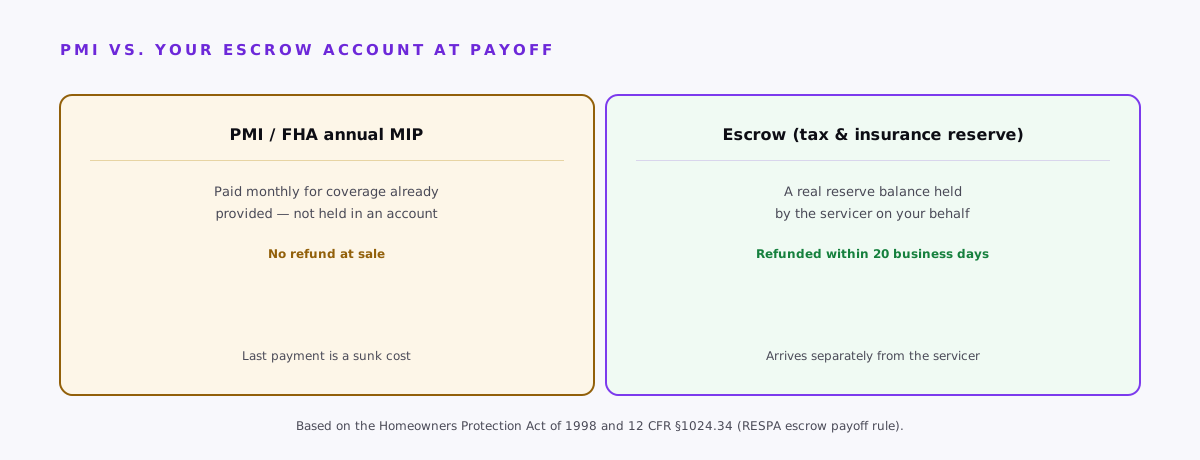
Homeowners often confuse two very different things sitting on the same mortgage statement: PMI (or FHA's mortgage insurance premium, MIP) and the escrow account that holds money for property taxes and homeowners insurance. The escrow account genuinely is a refundable balance — under federal rule 12 CFR §1024.34, a servicer must return any remaining escrow balance within 20 business days of the loan being paid off in full, which is exactly what happens at a home sale's closing. (12 CFR §1024.34) That refund check usually arrives separately, a few weeks after closing, directly from the servicer.
PMI doesn't work that way. It's paid as part of the regular monthly mortgage payment, covering insurance for that month only, and it isn't held in any account a seller could claim a balance from. When the loan gets paid off mid-month at closing, the payoff statement itemizes principal and accrued per-diem interest up to the closing date — it does not itemize or refund PMI, because there's nothing to prorate. The last PMI payment made is simply a sunk cost, the same way a canceled insurance policy doesn't refund the month you were covered.
The Homeowners Protection Act of 1998 is the federal law governing PMI, but it only addresses two scenarios: automatic termination once a borrower's principal balance is scheduled to reach 78% of the home's original value (if payments are current), and borrower-requested cancellation once the balance reaches 80%. (CFPB: removing PMI) It says nothing about what happens to PMI already paid when a loan is paid off through a sale — that scenario simply isn't addressed, because there's no refund mechanism to apply in the first place.
One practical upside worth knowing: because of this 78%/80% automatic-termination rule, a lot of longer-tenured sellers are already PMI-free by the time they list their house, which makes this entire question moot for them.
FHA loans charge two premiums: an upfront Mortgage Insurance Premium (UFMIP), paid at closing, and an annual MIP, paid monthly like conventional PMI. The annual MIP behaves exactly like PMI at a sale — no refund, no proration. The upfront premium is where people get confused, because a real refund mechanism does exist for it, just not for the situation most sellers are in.
For any FHA loan endorsed on or after December 8, 2004 — effectively every FHA loan being sold today — HUD's own guidance is direct: no UFMIP refund is due to the homeowner unless they refinance into a new FHA-insured loan, and no refund applies at all after the third year. (HUD FHA Homeowners Fact Sheet) Selling your home to a third-party buyer never triggers this refund, because the mechanism only works as a credit applied against the upfront premium on a brand-new FHA loan — there's no new FHA loan to credit against in an outright sale, so nothing gets refunded. A small number of much older loans (endorsed before December 2004) fall under a broader, now-largely-obsolete refund schedule under HUD's regulations, which is part of why hundreds of millions of dollars in historical unclaimed refunds trace almost entirely to those older loans — not something a 2026 seller with a typical recent FHA loan needs to worry about. (24 CFR §203.283)
Say a seller has a $280,000 loan balance with monthly PMI running about $140 (roughly 0.6% annually on the loan amount — within the broader 0.46% to 1.50% range industry sources cite for conventional PMI, which varies mainly by credit score), closing mid-month on day 15:
| Line item | Amount | Refunded or prorated? |
|---|---|---|
| Per diem interest (15 days at an illustrative 6.5% rate) | ~$748 | Added to principal payoff — itemized on the statement |
| Final month's PMI payment | ~$140 | Not itemized, not refunded — sunk cost |
| Remaining escrow balance (taxes/insurance reserve) | Varies by account | Refunded separately within 20 business days (12 CFR §1024.34) |
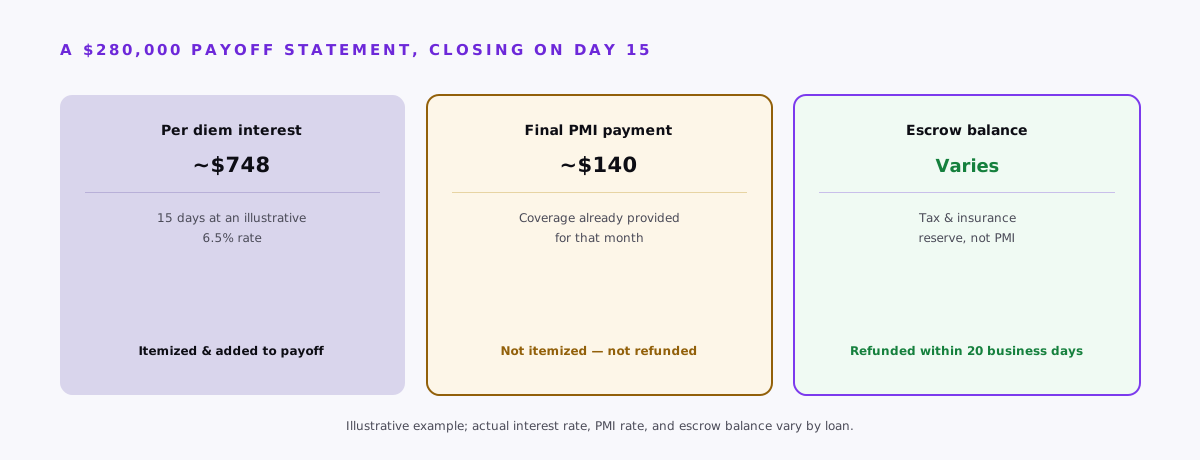
The pattern to take away: interest gets trued up to the exact closing date because that's how a loan payoff is calculated. PMI doesn't, because it was never a prepaid or escrowed amount to true up in the first place — and the escrow refund that does show up a few weeks later is for taxes and insurance, not PMI, even though it's easy to assume otherwise when both line items live on the same monthly statement.
Not at the closing table — PMI isn't a line item on a payoff statement, so there's nothing it adds to or subtracts from your net proceeds directly. Where it matters is as an ongoing carrying cost: every additional month you wait to sell costs another PMI payment on top of principal and interest, the same way property taxes and insurance do. It's a real but modest monthly drag on holding costs, not a one-time number that shows up on your closing statement the way commission or a payoff penalty would.
This is educational information, not financial advice. Your own payoff statement, loan terms, and servicer's specific practices govern what you actually see at closing — a loan officer or your closing agent can confirm the exact figures for your loan.
PMI won't show up as a credit on your payoff statement, but plenty of other numbers will — per diem interest, any prepayment terms, and your escrow refund timeline. We'll walk through your actual payoff with you before you commit to a closing date.
Send us the address and your approximate loan balance, and we'll give you a written cash offer within 24 hours, with the math shown plainly next to what a traditional listing would likely net instead.
All guides · Cash offer vs listing net proceeds · Seller closing costs · How a mortgage payoff statement works
Step 1 of 5
No obligation, no fees, no repairs. We respond the same day.
You’ll talk to Trevor McAmis, Owner & Acquisitions Lead
(313) 710-6129
Takes about two minutes. Or call (313) 710-6129 — we answer.