You get a 1099-S when you sell your house only if your closing or settlement agent is required to file one — and for most primary-residence sales, they're not, because of a seller certification exemption built directly into the IRS's own instructions. The closing agent, not you, is responsible for filing it. If you do receive one, you must report the sale on your tax return even if your entire gain is excludable; if you don't receive one and your gain is fully excludable, you generally don't have to report the sale at all.
Step 1 of 5
Tell us about the property. We'll give you a straight cash number — talk to a CPA for anything tax-specific.
You’ll talk to Trevor McAmis, Owner & Acquisitions Lead
(313) 710-6129
Takes about two minutes. Or call (313) 710-6129 — we answer.
Educational only. This explains how these situations generally work. It is not legal, tax or financial advice, and the rules differ by state — talk to an attorney or CPA about your own situation before you act on any of it.
The IRS's own instructions for Form 1099-S put the filing duty on "the person responsible for closing the transaction" — in almost every residential sale, that's the title company, closing attorney, or settlement agent named on the Closing Disclosure, not the seller (IRS, Instructions for Form 1099-S). The form reports Box 2a: gross proceeds — generally the sale price — not your gain or profit. Basis, selling costs, and any exclusion all get factored in later, on your own return, not by whoever files this form.
Don't confuse this with Form 1099-C, Cancellation of Debt. They report completely different things and can show up in completely different situations: a 1099-S reports what you sold a property for; a 1099-C reports a lender forgiving part of a debt, which can happen separately in a short sale. You could get a 1099-S, a 1099-C, both, or neither on the same transaction — one has nothing to do with whether you get the other.
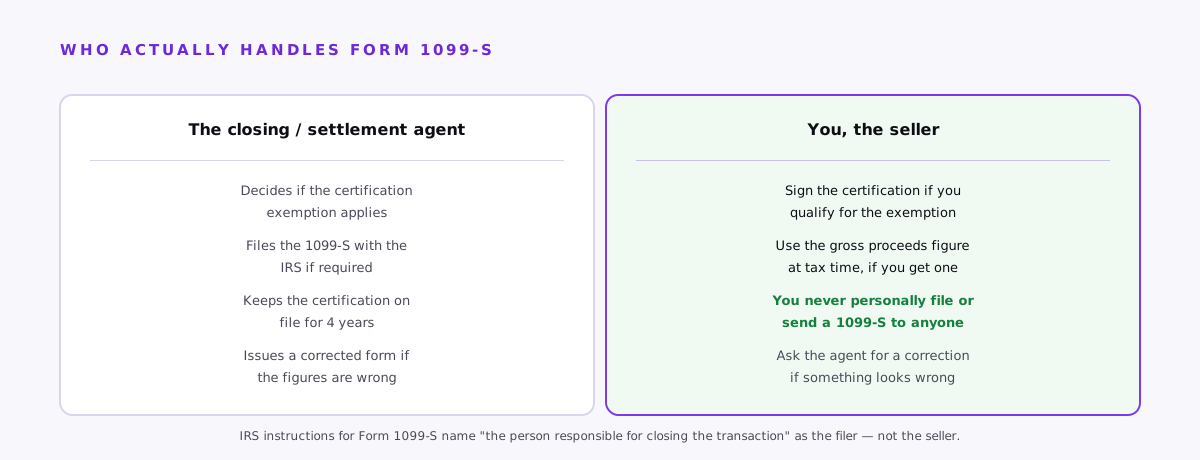
Treasury Regulation 1.6045-4(c)(2)(iv) lets a closing agent skip filing a 1099-S entirely for the sale of a principal residence, if the seller signs a written certification. The IRS's instructions for Form 1099-S, last revised in December 2026, state the threshold directly: a sale for $250,000 or less qualifies if the seller certifies the full gain is excludable under the Section 121 home-sale exclusion; that becomes $500,000 if the certification states the seller is married.
The certification also typically confirms the seller owned and used the home as their main residence for the required period, didn't sell another main home in the prior two years, and hasn't used the property for business or rental in a way that would break the exclusion.
If more than one person owns the property, each owner needs to sign their own certification, or the agent has to file a 1099-S for whichever owner didn't certify. The closing agent is required to keep certifications on file for four years, and relying on a valid certification protects them from a penalty for not filing — unless they actually know, or have reason to know, that something in it is wrong.
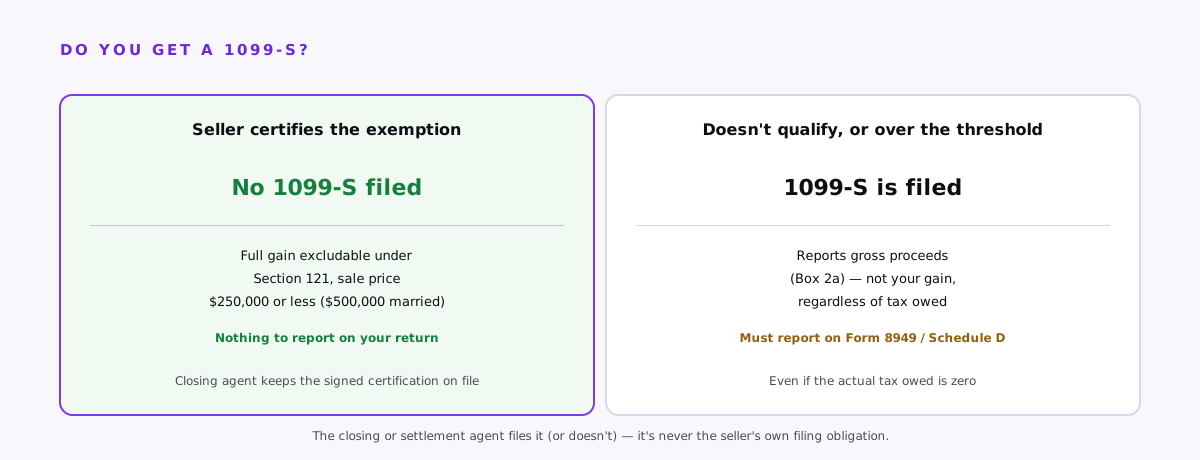
Not necessarily — but you do have to report the sale. The IRS's own guidance is direct on this: "If you receive an informational income-reporting document such as Form 1099-S... you must report the sale of the home even if the gain from the sale is excludable" (IRS Topic No. 701).
That means filling out Form 8949 and Schedule D, even if the number that lands on your actual tax bill from the sale is zero. IRS Publication 523 walks through exactly how to do that, and how to calculate your gain against your actual basis and any exclusion you qualify for.
Flip side: if you didn't get a 1099-S and your entire gain is excludable under Section 121, Topic 701 confirms you generally don't have to report the sale on your return at all. The 1099-S itself is what triggers the reporting requirement regardless of whether tax is actually owed — not the other way around.
The authoritative numbers are always your actual closing documents, not the form — if a 1099-S shows the wrong sale price, or you're confident you properly certified the exemption and shouldn't have received one at all, the fix starts with contacting the closing or settlement agent who filed it and asking them to submit a corrected return.
The IRS's own instructions describe a specific corrected-filing process for the agent to follow, including different procedures depending on whether the dollar amount was wrong versus the wrong taxpayer ID or filing type being used (IRS Publication 1099). We could not find a dedicated IRS consumer page walking a seller through disputing a 1099-S directly with the agency — the practical path is back through whoever issued it, not a special form you file yourself.
On the other side, an agent who fails to file a required 1099-S, or files one with incorrect information, faces real, tiered, inflation-adjusted penalties under the federal information-return rules — another reason most settlement agents are careful about getting the certification paperwork right rather than skipping it casually.
Form 1099-S is a reporting mechanism, not a tax itself — it doesn't change what you owe, and it doesn't change your net proceeds at closing. Whether or not one gets filed, the number that actually lands in your pocket is the sale price minus the mortgage payoff, closing costs, and any capital gains tax actually due after the Section 121 exclusion is applied. A seller who assumes "no 1099-S means no taxes to think about" is making the same mistake as a seller who assumes "I got a 1099-S, so I must owe something" — neither assumption is reliable on its own.
| Scenario | Do you get a 1099-S? | Do you report the sale? | Do you owe tax? |
|---|---|---|---|
| Single seller, $230,000 sale, full gain excludable | No (certification exemption) | No | No |
| Single seller, $230,000 sale, didn't certify or agent requires one anyway | Yes | Yes | Depends on actual gain vs. exclusion |
| Married sellers, $480,000 sale, full gain excludable, certified | No (certification exemption) | No | No |
| Any seller, sale price over the threshold or gain not fully excludable | Yes | Yes | Depends on actual gain |
This is exactly the kind of math worth nailing down with a CPA before you close, not after — see our full breakdown of the capital gains exclusion itself for how the $250,000/$500,000 exclusion amounts actually get calculated against your basis and gain.
Ask your closing agent directly, before closing, whether you qualify to certify the exemption. This is a conversation to have in advance, not a surprise to discover after the fact.
If you already closed and aren't sure whether a 1099-S was filed, ask the title company or closing attorney directly — they're required to keep certification records for four years and can tell you.
If a 1099-S you received looks wrong, go back to the agent who filed it and ask for a corrected form, rather than trying to resolve it with the IRS directly.
Talk to a CPA before you sell if your gain is anywhere close to the exclusion limits, or if the property wasn't your full-time primary residence — the reporting question in this guide is separate from, and simpler than, the actual exclusion-eligibility question.
This article is general educational information, not tax advice. Whether you qualify for the Section 121 exclusion, whether your sale meets the certification requirements, and how to report a specific transaction all depend on your full facts. Talk to a CPA or tax attorney before you file.
A 1099-S question usually means you're already thinking through the real math of a sale. We can give you a straight cash offer to put next to a retail listing's net — for the tax side, a CPA who's seen your actual return is the right call, not us.
All guides · Capital gains tax when you sell your house · Seller closing costs · Cash offer vs. listing net proceeds
Step 1 of 5
No obligation, no fees, no repairs. We respond the same day.
You’ll talk to Trevor McAmis, Owner & Acquisitions Lead
(313) 710-6129
Takes about two minutes. Or call (313) 710-6129 — we answer.
