Comparing FSBO vs. agent vs. cash buyer usually starts and ends with one number: the commission a listing agent would have charged. That's the wrong comparison. Skipping the listing agent looks like an automatic 2.5-3% saved, and lately it hasn't even been reliably true: the most recent national data shows homes sold by owner going for noticeably less than agent-listed homes, often erasing the commission saved and then some. This page runs the actual arithmetic across all three routes on the same house, so you can see where each number comes from instead of taking anyone's word for which is cheapest.
Step 1 of 5
Tell us about the house. We'll give you a written cash figure so you can put it next to what FSBO or an agent would actually net you.
You’ll talk to Trevor McAmis, Owner & Acquisitions Lead
(313) 710-6129
Takes about two minutes. Or call (313) 710-6129 — we answer.
Educational only. This explains how these situations generally work. It is not legal, tax or financial advice, and the rules differ by state — talk to an attorney or CPA about your own situation before you act on any of it.
FSBO sellers skip the listing agent's roughly 2.5-3% commission but often still owe a buyer's agent fee if the buyer is represented, and nationally FSBO homes sold for a median of $360,000 against $425,000 for agent-assisted homes in the year ending mid-2025 — an 18% gap that can easily outweigh the commission saved. A full-service agent typically nets the most on a market-ready house after costs; a cash sale skips commission and repairs entirely but prices both into the offer.
This is general information to help you compare routes, not a prediction about your specific house or market. Commission rates, typical price gaps and local custom all vary — run your own numbers with an agent or attorney before deciding.
For-sale-by-owner has gotten rarer, not more common, and the trend is worth noting before anything else: the National Association of Realtors' 2025 Profile of Home Buyers and Sellers found that only 5% of home sales over the prior year were FSBO — an all-time low — while a record 91% of sellers used an agent.
The commission structure changed in a way that matters directly to FSBO sellers. Since the court-approved NAR settlement took effect on August 17, 2024, a seller's agent can no longer advertise buyer-agent compensation inside the MLS, and a buyer's agent must have a signed written agreement with their buyer before touring homes. That means a FSBO seller does not automatically owe a buyer's agent commission the way sellers once assumed — but it is also not automatically zero. If the buyer brings a represented agent, compensation for that agent is now negotiated directly between the seller and that agent (or paid by the buyer, or some mix), separately from any MLS listing. Many FSBO sellers still end up paying something in that 2.5–3% range to avoid narrowing their buyer pool to only unrepresented buyers.
What FSBO reliably saves is the listing side of the commission — typically 2.5–3% of the sale price, the part that pays for pricing strategy, professional photography, MLS syndication, showings coordination, negotiation and paperwork. What it does not reliably save is everything else a listing agent is paid for, which is the part the price gap below is actually measuring.
This is the number FSBO advocates rarely lead with. NAR's 2025 data put the median FSBO sale at $360,000 against a median of $425,000 for agent-assisted sales — a difference of $65,000, or about 18%, in the twelve months ending mid-2025.
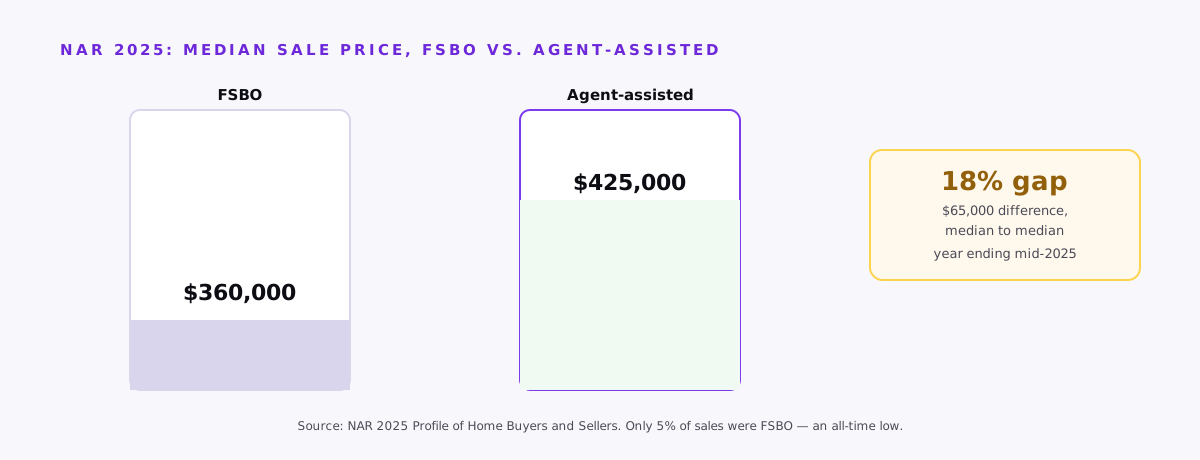
That gap isn't purely commission-adjusted — FSBO sales skew toward simpler transactions (often a sale between people who already know each other, which pulls the median down for reasons that have nothing to do with marketing), so treat it as directional rather than a dollar-for-dollar prediction for any specific house. But the direction itself is the point: a seller weighing FSBO purely against the commission saved is comparing the wrong two numbers. The real comparison is the commission saved against the pricing, marketing and negotiating leverage given up, and recent national data says that trade has not been going FSBO sellers' way.
Take a house worth $400,000 prepared and priced correctly, needing no repairs, in a seller's hands either way.
| Line item | FSBO | Full-service agent | Cash buyer |
|---|---|---|---|
| Starting sale price assumption | $360,000* (FSBO median discount) | $400,000 (market value) | $400,000 ARV, offer reflects no repairs needed |
| Listing agent commission | $0 | −$10,000–$12,000 (2.5–3%) | $0 |
| Buyer agent compensation (negotiated) | −$9,000–$10,800 (2.5–3%, if buyer is represented) | −$10,000–$12,000 (2.5–3%) | $0 |
| Your own time: showings, contracts, disclosures | Significant, unpaid | Minimal | Minimal |
| Typical closing timeline | Variable, often slower | 30–60 days | 7–21 days |
| Approximate net | $339,200–$351,000 | $376,000–$380,000 | $300,000–$328,000 (75–82% of ARV) |
*Illustrative, using the national FSBO-vs-agent median gap as a directional discount, not a guarantee for any specific house. Your actual FSBO price could land anywhere from roughly at market to well below it depending on your pricing, marketing and negotiating.
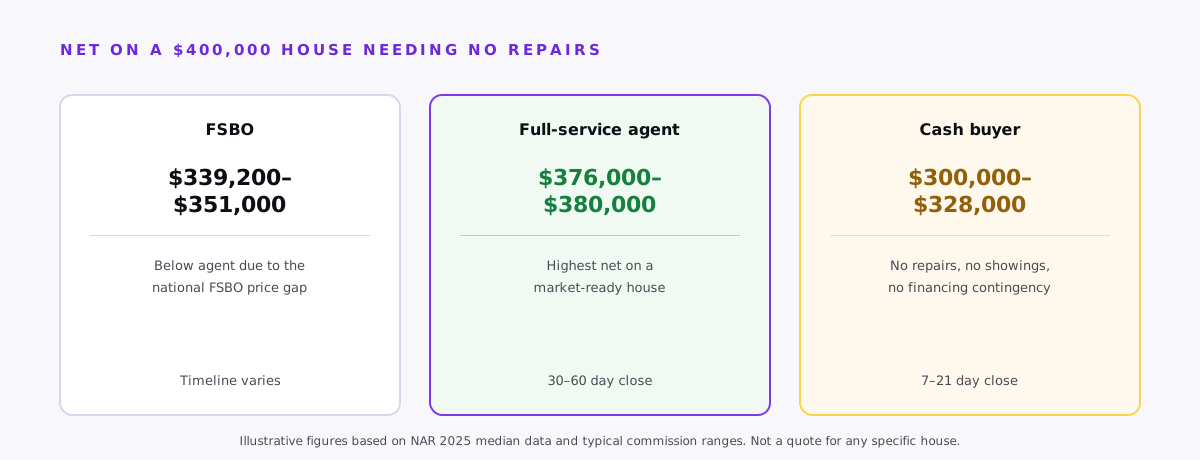
The honest read. On a house that's genuinely market-ready and needs no repairs, a full-service agent typically nets the most once the FSBO price gap is accounted for — the commission saved by going FSBO is real, but the national data suggests it's frequently smaller than the price gap it trades against. A cash sale nets the least of the three in dollar terms on a ready-to-list house, because it prices in speed, certainty, and the buyer taking on all resale risk and cost — it is not the higher-net option and this page will not pretend otherwise. Where cash wins is everything the table's dollar row doesn't show: no showings, no financing contingency to fall through, no repairs to fund up front, and a close measured in days rather than months.
The arithmetic above is a median, not a verdict on every seller. FSBO tends to work out better than the national gap suggests when:
It tends to work out worse when the house needs real marketing reach, when you're unfamiliar with required disclosures (getting those wrong carries its own legal exposure, separate from the price you get), or when you don't have the time to handle showings and negotiation yourself while still working your regular job.
FSBO's appeal is the commission it avoids; the risk is a price gap the national data says is frequently larger than that commission. A full-service agent usually nets the most on a market-ready house once both are weighed honestly. A cash sale nets less in dollar terms but buys speed and certainty that neither of the other two routes can promise. If you want a real number for the third option on your specific house, send us the address and we'll put one in writing.
Every route on this page has a real cost somewhere — FSBO in price and your time, an agent in commission, a cash sale in price. We'll put a written, no-obligation cash figure in front of you within 24 hours so you can compare it honestly against what FSBO or a listing agent would actually net you on your specific house.
All guides · Seller closing costs · Cash offer vs listing net proceeds · Who pays realtor fees when selling a house
Step 1 of 5
No obligation, no fees, no repairs. We respond the same day.
You’ll talk to Trevor McAmis, Owner & Acquisitions Lead
(313) 710-6129
Takes about two minutes. Or call (313) 710-6129 — we answer.
