The cost of selling a house at auction vs a cash offer comes down to a seller commission — commonly around 2% on the first $200,000 and 1% above that — plus your own marketing costs, with no guarantee the reserve price is met. If it isn't, you still owe a no-sale fee and lose the advertising spend. A cash offer skips all of that and closes in days, not months.

Step 1 of 5
Tell us about the house and the timeline you're working with. We'll give you a straight cash number — no reserve risk, no marketing spend.
You’ll talk to Trevor McAmis, Owner & Acquisitions Lead
(313) 710-6129
Takes about two minutes. Or call (313) 710-6129 — we answer.
Educational only. This explains how these situations generally work. It is not legal, tax or financial advice, and the rules differ by state — talk to an attorney or CPA about your own situation before you act on any of it.
A real estate auction runs on one of two structures. A reserve auction sets a confidential minimum price the seller won't go below; an absolute (no-reserve) auction commits to selling to the highest bidder no matter what. The National Auction Association's own case study makes the tradeoff concrete: one home listed with a reserve drew weak turnout and didn't sell. Relisted without a reserve, it attracted roughly twice as many bidders and closed for about $100,000 more. (National Auction Association) That's one case, not a guarantee — but it illustrates why a reserve, while it protects you from a lowball result, can also actively suppress the bidding that would otherwise push the price up.
Two of the states Restar buys in have a licensing wrinkle worth knowing if you're considering this route: Georgia and North Carolina both require a separate real estate license, on top of the auctioneer's license, to auction real property — not just a general auctioneer's credential. (National Auctioneers Licensing Law Officials Association) Make sure whoever you're hiring actually holds both.
Real published auction-company terms give a clearer picture than the vague "it's like agent commission" framing you'll see in most searches. One established auction house's actual seller rate card: 2% commission on the first $200,000 of the sale price, and 1% on everything above that — negotiable for higher-value properties — with all advertising and marketing costs billed to the seller separately, on top of commission. (Horst Auctioneers) Standard closing costs — title, settlement, recording fees — apply the same way they would in any other sale.
The buyer, not the seller, pays the buyer's premium — commonly 5% of the winning bid, or a flat minimum (one major platform sets it at $2,500, whichever is greater). (Auction.com) That fee doesn't come out of your proceeds directly, but it affects you anyway: a bidder who has to pay an extra 5% on top of their winning number simply bids less to begin with, which is part of why a reserve set too high can suppress turnout the way the NAA example above shows.
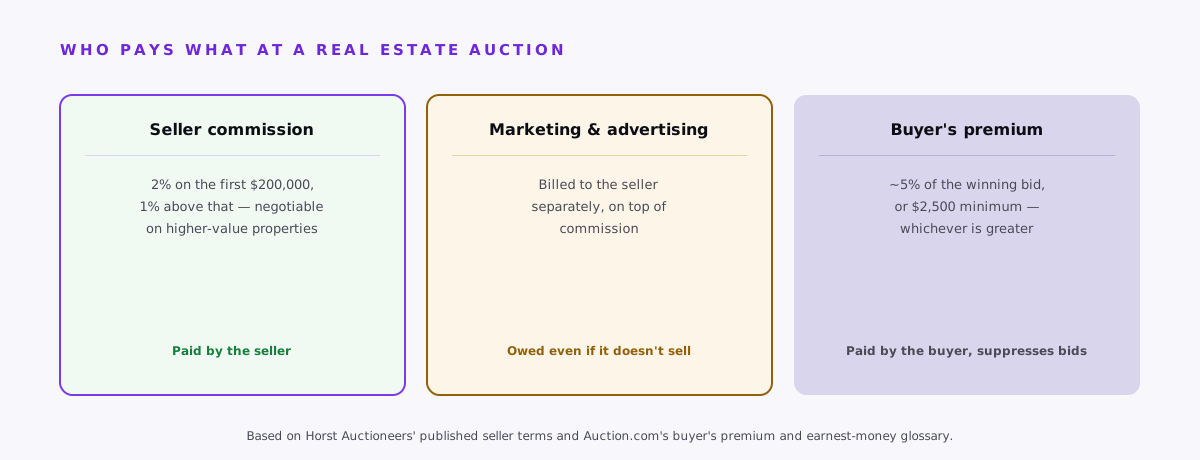
This is the part most auction pitches gloss over. If you set a reserve and bidding doesn't reach it, the house doesn't sell — and you still owe money. The same auction house's published terms are blunt about it: when the reserve isn't met, "the commission is waived and a $200 no sale fee is charged in addition to the advertising fees incurred." (Horst Auctioneers) You've paid for the marketing and gotten nothing for it, and you're back to starting over — either with a lower reserve, an absolute auction, or a different sale method entirely.
One major platform's own data shows how much the outcome diverges by reserve status: listings where the reserve was met averaged 14.2 bids, against just 2.9 bids on listings where it wasn't — and when it was met, the final price averaged about 21% over the reserve. (Auction.com) That's the platform's own marketing data about its own listings, not an independent study of the broader market, so treat the specific numbers as illustrative rather than something you can bank on for your house.
Be skeptical of anyone who tells you auctions always net more — the National Association of Realtors' own page on auctions claims sale prices "can exceed" a negotiated sale and that the property "will be sold at true market value," but offers no data, percentage, or methodology behind either claim. That's promotional language, not evidence, and we're not going to repeat it as fact.
The one real study we could find is an academic one, and it points the other way, with real caveats. A paper first circulated as a 1993 Federal Reserve Bank of Boston working paper, later published in Real Estate Economics in 1998, examined actual residential auction results and found auctioned properties sold at a discount relative to negotiated sales — the size of that discount depended heavily on market conditions, ranging from 0 to 9% in a strong 1980s Los Angeles market to 9 to 21% in a weak, late-1980s Dallas market. That data is decades old and focused on condominium auctions specifically, so don't treat it as a fixed modern percentage — but it's the only rigorous evidence either direction, and it doesn't support the "auctions always net more" claim.
A real auction-company's own published terms call for a 6 to 8 week marketing lead time before auction day, to allow proper advertising and at least two open houses. (Horst Auctioneers) After the auction, closing typically takes another 30 to 45 days from contract execution. (Auction.com) Add those together and a successful auction realistically runs 10 to 15 weeks, start to finish — and that's before accounting for a failed reserve forcing a second attempt.
For comparison, a traditional listing isn't dramatically faster: the median home spent 49 days on the market before accepting an offer, plus another 30 to 60 days to close — roughly 11 to 16 weeks all-in. (Redfin) A cash offer is commonly cited at 7 to 14 days from offer to close — the real difference isn't auction versus listing, it's either of those versus skipping the marketing period entirely.
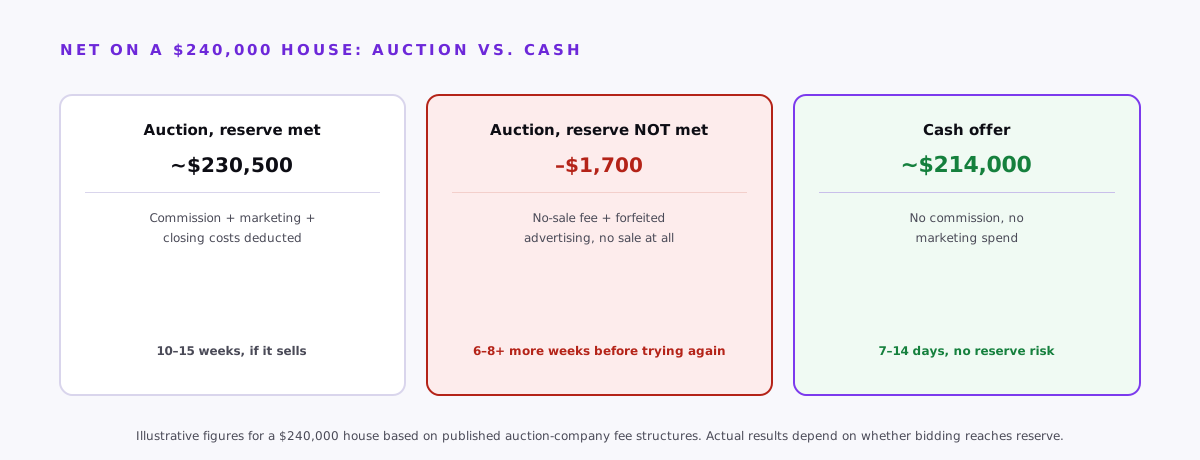
On a $240,000 house, comparing a successful auction, a failed-reserve auction, and a cash offer:
| Route | Sale price | Commission | Marketing/fees | Net to seller | Timeline |
|---|---|---|---|---|---|
| Auction, reserve met | $240,000 | 2% on first $200k + 1% above (−$4,400) | Advertising ≈−$1,500, closing costs ≈−$3,600 | ~$230,500 | 10-15 weeks |
| Auction, reserve not met | $0 (unsold) | Waived | $200 no-sale fee + forfeited ≈$1,500 advertising spend (−$1,700) | −$1,700, no sale | 6-8+ more weeks before a second attempt |
| Cash offer | $214,000 | $0 | $0 | ~$214,000 | 7-14 days |
A successful auction can net more than a cash offer — the math above shows it does, in this example, if the reserve is met on the first attempt. What that comparison leaves out is the real chance it isn't met, which costs you real money and real weeks with nothing to show for it, something no one selling an auction service tends to lead with. A cash offer gives up the upside of a bidding war, but it also gives up that specific downside entirely.
If your house is the kind that could draw real bidding competition, a no-reserve auction can net more than a cash offer — we'd tell you that directly.
Where a cash offer earns its place is certainty: no commission, no marketing spend, and no risk of a failed reserve costing you money with nothing to show for it. Send the address and we'll send a written offer within 24 hours. No cost, no obligation.
All guides · Cost of selling FSBO vs agent vs cash buyer · Cash offer vs listing net proceeds · iBuyer vs cash home buyer net proceeds
Step 1 of 5
No obligation, no fees, no repairs. We respond the same day.
You’ll talk to Trevor McAmis, Owner & Acquisitions Lead
(313) 710-6129
Takes about two minutes. Or call (313) 710-6129 — we answer.