<b>A full furnace-and-AC replacement for an average home typically runs $5,000 to $11,000, climbing toward $15,000 for a large, high-efficiency system.</b> The cost of replacing an HVAC system before selling a house depends on tonnage, efficiency rating, and whether you need one component or the whole system — and whether you need to replace it at all depends on a rule of thumb most contractors actually use, not a guess. Here's the real math: what each type of system costs, when repair genuinely beats replacement, how an old or failing system can affect a buyer's financing, and the honest comparison between fixing it yourself and selling as-is.
Step 1 of 5
Tell us the system's age and what's wrong, and we'll factor it into a real number.
You’ll talk to Trevor McAmis, Owner & Acquisitions Lead
(313) 710-6129
Takes about two minutes. Or call (313) 710-6129 — we answer.
Educational only. This explains how these situations generally work. It is not legal, tax or financial advice, and the rules differ by state — talk to an attorney or CPA about your own situation before you act on any of it.
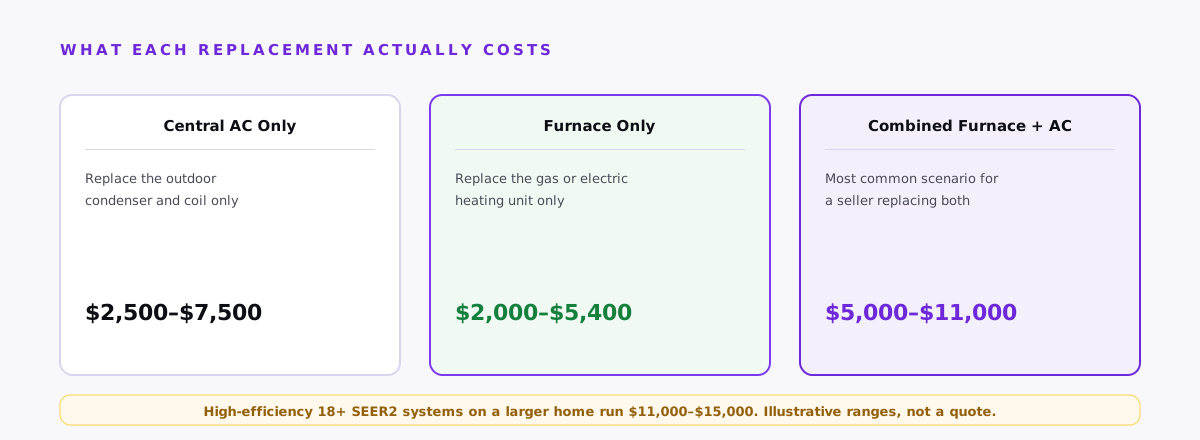
Cost scales mainly with tonnage (cooling capacity) and SEER2 efficiency rating, and whether you're replacing one component or the full system. Per Angi's cost data, a central air unit alone runs roughly $1,300 to $4,000 for a 1.5-ton system up to $2,800 to $6,800 for a 5-ton system, before installation labor of $3,500 to $7,000. Looking at full combined systems instead of components alone, HomeGuide's breakdown puts a central-air-only replacement at $2,500 to $7,500, a furnace alone at $2,000 to $5,400, a heat pump system at $3,800 to $8,200, and a combined furnace-and-AC replacement at $5,000 to $11,000 — the figure most sellers should plan around for a typical mid-size home. By SEER2 tier, the same source shows 13–14 SEER systems running $1,000 to $4,200 installed, climbing to $3,700 to $8,500 for 22–26 SEER high-efficiency systems.
For a roughly 2,000 square-foot home needing a 3 to 4-ton system, blending those figures puts a realistic mid-efficiency replacement at $7,000 to $12,000 installed, and a high-efficiency 18-plus SEER2 system at $11,000 to $15,000. Heat pump systems span the widest range of all — HomeGuide's figures alone run $3,800 to $8,200, and that's before factoring in geothermal or ductless mini-split variants, which install so differently from a standard split system that they're worth pricing separately with a contractor rather than assuming either number applies.
Contractors commonly use a version of what's called the "$5,000 rule": multiply the system's age in years by the repair estimate in dollars, and if that number tops $5,000, replacement usually makes more financial sense than another repair. One HVAC contractor's explanation of the rule argues it's become outdated on the replacement side, since a full system now realistically runs $10,000 and up rather than the lower figures the rule assumed when it became popular — worth keeping in mind so you don't under-budget based on an old rule of thumb.
The federal government's own guidance is simpler and age-based rather than cost-based: per the joint DOE/ENERGY STAR "Repair or Replace?" guidance, an air conditioner or heat pump under 10 years old is usually worth repairing, while one over 10 years — especially with repeat problems or an expensive repair — is usually worth replacing; for a furnace or boiler, that threshold moves to 15 years. A furnace's average service life is federally estimated at 21.5 years, per the Department of Energy's own technical analysis in its 2023 energy conservation standards rule for consumer furnaces — useful context for deciding whether an aging system is near the end of its realistic life or still has years left.
A 2025–2026 regulatory wrinkle worth knowing about: under the EPA's HFC phasedown, new residential AC and heat pump systems using R-410A refrigerant (the standard in most existing systems) couldn't be newly manufactured after January 1, 2025, per the EPA's technology-transitions final rule. The EPA later lifted a related installation deadline for pre-2025 R-410A equipment still in distribution, per an HVAC contractor trade association's coverage of the May 2026 reconsideration, but the broader transition to the newer refrigerant is still actively tightening supply and pushing new-equipment costs upward. We couldn't find a verified, EPA-sourced dollar or percentage figure for exactly how much that's adding to a typical replacement right now, so we won't invent one — just know that the regulatory backdrop is real and the direction of price pressure is up, not down.
FHA financing. HUD's own appraisal standard requires the heating system to be "adequate for healthful and comfortable living conditions," automatically heating the home's living areas to a minimum of 50 degrees, and a faulty or defective mechanical system can be made a condition of the loan closing, per HUD Handbook 4000.1. In plain terms, a non-functioning HVAC system on an FHA deal is a common path to a lender-required repair before closing — it's not automatically disqualifying, but it is something an appraiser is specifically looking for.
Florida's 4-point inspection. If your home is more than 20 years old and you're in Florida, Citizens Property Insurance Corporation's own inspection standard requires a 4-point inspection covering electrical, plumbing, roof, and HVAC before binding a policy, and states that "serious hazards or deficiencies... should be repaired before an application for coverage is submitted." A failing HVAC system in an older Florida home can therefore hold up the buyer's insurance binder, which in turn can hold up their mortgage closing — lenders generally won't fund without proof of insurance in hand.
Worked example: a $255,000 house, 2,000 square feet, with a 16-year-old central AC and furnace combo that's still running but has had two service calls this year. A contractor quotes $8,500 to replace both with a mid-efficiency system.
| Retail listing | Cash sale | |
|---|---|---|
| List / offer price | $255,000 | $230,000 |
| HVAC replacement | −$8,500 | $0 (sold as-is) |
| Agent commission (~5.5%) | −$14,025 | $0 |
| Seller closing costs | −$2,800 | −$1,050 |
| Carrying costs during replacement and marketing (6–9 weeks) | −$2,000 | $0 |
| Net to seller | ~$227,675, in 6–9+ weeks, if the replacement satisfies the buyer's lender | ~$228,950, in 1–2 weeks, with certainty |
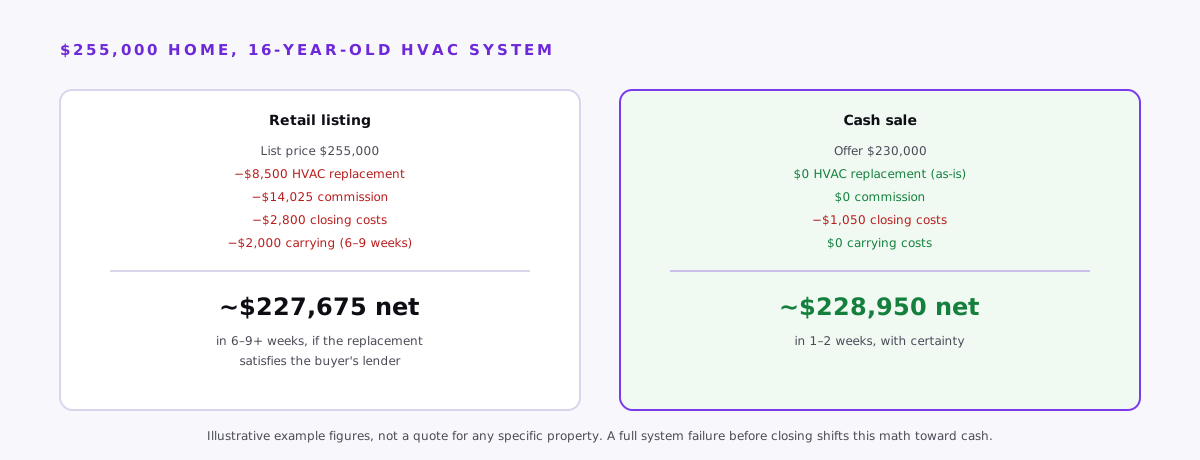
Cash edges ahead by a small margin in this example, once you count commission and the weeks of carrying costs a replacement adds — and that's the honest result when the repair is a known, bounded cost rather than a true emergency. The math tips further toward cash if the system fails completely before you can schedule the replacement, if you're in Florida and the insurance-binder timeline becomes the bottleneck, or if you don't have $8,500 available before closing. It tips toward listing if your system still has real working life left and you can absorb the upfront cost comfortably. See our guide to lender-required repairs for how this kind of repair request typically gets negotiated once an appraiser flags it.
Restar Acquisitions buys houses as-is for cash in 12 states, and we price in HVAC age and condition the same way we price in any other repair item — before we give you a number, not after an appraisal stalls a financed deal. We give a written offer within 24 hours, no repairs or commissions, and you pick the closing date. We're a direct buyer, not your real estate agent, and we don't represent you in the transaction.
Alternatives worth checking before you decide:
This article is for general education only and isn't a quote or a substitute for a licensed HVAC contractor's inspection. Costs vary by region, system size, and efficiency choice. Confirm your own numbers with a licensed contractor before you budget around any figure here.
We factor HVAC age and condition into our offer the same way we factor in any repair item — before we give you a number, not after a buyer's lender flags it.
You'll get a written offer within 24 hours, no repairs or commissions, and you pick the closing date.
All guides · Cost of lender-required repairs before closing · Should I repair before selling · Cash offer vs. listing net proceeds
Step 1 of 5
No obligation, no fees, no repairs. We respond the same day.
You’ll talk to Trevor McAmis, Owner & Acquisitions Lead
(313) 710-6129
Takes about two minutes. Or call (313) 710-6129 — we answer.