<b>A standard 40–50 gallon tank water heater replacement runs roughly $800 to $2,500 installed; a tankless conversion runs roughly $1,400 to $5,600; and a heat-pump model runs roughly $2,000 to $4,600.</b> An inspector flagging an aging water heater is one of the most common, and most overthought, items on a pre-sale punch list. It's a small repair compared to a roof or a foundation, but it still raises the same question every repair does: fix it yourself, negotiate a credit, or sell as-is and let the number reflect it. For a repair this size, the honest math usually lands all three selling paths within a few hundred dollars of each other — here's the real numbers.

Step 1 of 5
Tell us about your property and we'll send a written cash offer within 24 hours, priced for the condition it's in today. No repairs or commissions.
You’ll talk to Trevor McAmis, Owner & Acquisitions Lead
(313) 710-6129
Takes about two minutes. Or call (313) 710-6129 — we answer.
Educational only. This explains how these situations generally work. It is not legal, tax or financial advice, and the rules differ by state — talk to an attorney or CPA about your own situation before you act on any of it.
Figures below come from HomeGuide and Angi's current contractor-cost data, which don't fully agree with each other — reported here as ranges rather than a single number, since that disagreement is itself useful information about how much installation specifics (venting, gas line work, access) can move the price.
Standard 40–50 gallon tank (gas or electric): HomeGuide puts this at $600 to $3,100 installed ($400–$2,100 for the unit alone); Angi's 2026 data (30,979 verified Angi Pro projects) puts it at $800 to $2,300 installed, averaging $1,348. Reconciling the two, expect roughly $800 to $2,500 for a typical like-for-like swap, with premium brands or venting upgrades pushing toward $3,100.
Tankless conversion: HomeGuide: $1,400 to $5,600 installed ($600–$2,600 for the unit). Angi: $1,406 to $3,902, averaging $2,641. The gap between the two mostly reflects gas-line and venting retrofit work — converting from a tank system to tankless, rather than installing tankless in new construction, tends to land toward the higher end.
Heat-pump (hybrid) electric: HomeGuide: $2,000 to $4,600 installed ($1,500–$3,000 for the unit alone). Converting fuel type (electric to gas or vice versa) adds $400 to $2,000+ on top of any of the above, per HomeGuide, for the added line work.
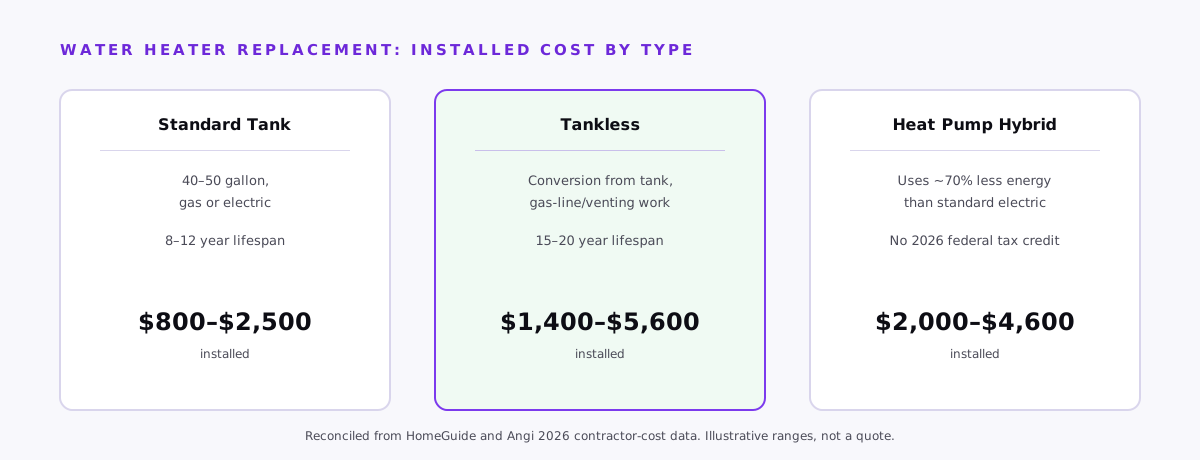
Tank water heaters last 8 to 12 years on average, per HomeGuide, extendable to about 15 years with regular maintenance (flushing sediment, checking the anode rod). Tankless units last meaningfully longer — 15 to 20 years with maintenance.
HomeGuide's own replacement guidance is a reasonable rule of thumb: consider replacing a water heater once it's over 10 years old, or any time repair costs would run more than 50% of a full replacement. A home inspector flagging a water heater that's already into its early teens, rusting at the fittings, making popping or rumbling sounds (usually sediment buildup), or producing inconsistent hot water is flagging a unit that's realistically closer to the end of its service life than the beginning, even if it's technically still working.
FHA. Multiple professional-appraiser sources describing HUD Handbook 4000.1's living-unit requirements agree that a water heater has to carry a properly piped temperature-and-pressure (T&P) relief valve and otherwise comply with local code — a functional, safety-focused standard rather than an age limit. There's no FHA rule that disqualifies a water heater purely for being old; the issue that actually stops an appraisal is a missing or improperly installed safety component, not the unit's age by itself.
VA. A VA Minimum Property Requirements appraisal judges mechanical systems, water heaters included, on the same basic safety-and-soundness footing as FHA, without a publicly documented rule distinct enough to cite separately here. Don't read that as laxer — it's the same functional standard, just without a separately quotable clause.
In practice, a working water heater with a properly installed relief valve doesn't block either loan type regardless of age. An old unit with a missing or jury-rigged relief valve, or one that's actively leaking or failing, is what actually trips a lender-required repair.
If you're weighing a heat-pump water heater partly because of a tax credit you remember hearing about, that credit is gone for anything installed this year. The IRS confirms, following the One Big Beautiful Bill Act (Public Law 119-21, signed July 4, 2025): “The credit will not be allowed for any property placed in service after December 31, 2025.” That accelerated the original 2032 sunset for the Section 25C Energy Efficient Home Improvement Credit by seven years. Before the repeal, the credit was worth 30% of qualifying cost, capped at $2,000 per year for heat pumps and heat-pump water heaters combined — don't use that figure for a 2026 purchase, since it no longer applies.
What's still real is the operating-cost savings, separate from any tax credit: ENERGY STAR's own figures state that a certified heat-pump water heater uses about 70% less energy than a standard electric tank, which it estimates could save a household of four roughly $550 a year and more than $5,600 over the unit's lifetime. That's a genuine ongoing-savings argument for a heat pump model — just don't conflate it with a tax credit that no longer exists.
Worked example: a $225,000 house where a pre-listing inspection flags a 14-year-old tank water heater — rust visible at the fittings, past the point most inspectors would call it near end of life. A plumber quotes $1,500 for a standard like-for-like replacement.
| Replace, then list retail | List as-is, credit at closing | Sell as-is for cash | |
|---|---|---|---|
| Sale / offer price | $225,000 | $225,000 | $208,000 |
| Replace water heater | −$1,500 | $0 | $0 |
| Buyer credit at closing | $0 | −$1,800 | $0 |
| Agent commission (5.5%) | −$12,375 | −$12,375 | $0 |
| Seller closing costs | −$3,375 | −$3,375 | −$1,000 |
| Net to seller | ~$207,750, ~8 weeks | ~$207,450, ~8 weeks, with negotiation risk | ~$207,000, 1–2 weeks, certain |
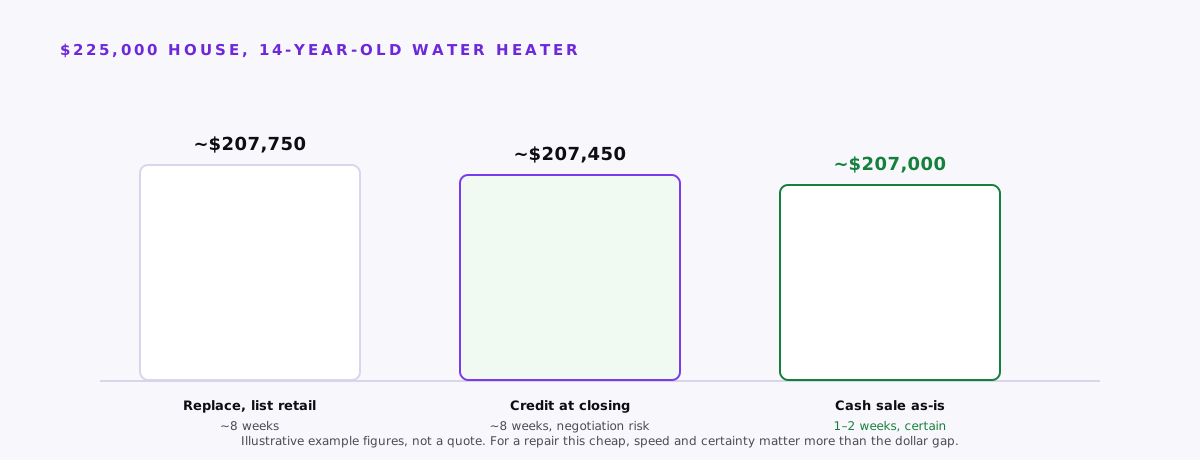
All three land within a few hundred dollars of each other — the honest result for a repair this cheap and this well understood. For an item this size, the thing that actually separates the three paths isn't the dollar amount; it's time, certainty, and whether you want to deal with scheduling a plumber and a re-inspection at all. That's a genuinely different story than a defect like a failed sewer lateral or a foundation issue, where the repair cost itself is large enough to swing the comparison by tens of thousands — see our guides on those if that's closer to your situation.
Restar Acquisitions buys houses as-is for cash in 12 states, and we price in a known item like an aging water heater the same way we'd price in any other repair — before we give you a number, not after a buyer's inspection flags it. We give a written offer within 24 hours, no repairs or commissions required, and you pick the closing date. We're a direct buyer, not your real estate agent, and we don't represent you in the transaction.
Alternatives worth checking before you decide:
This article is for general education only and isn't a quote or a substitute for a licensed plumber's assessment. Costs vary by region, fuel type, and installation specifics.
We factor a known item like an aging water heater into our offer the same way we factor in any other repair — before we give you a number, not after a buyer's inspection flags it.
You'll get a written offer within 24 hours, no repairs or commissions required, and you pick the closing date.
All guides · Cost of lender-required repairs before closing · Cost of replacing an HVAC system before selling · Cash offer vs. listing net proceeds
Step 1 of 5
No obligation, no fees, no repairs. We respond the same day.
You’ll talk to Trevor McAmis, Owner & Acquisitions Lead
(313) 710-6129
Takes about two minutes. Or call (313) 710-6129 — we answer.