<b>Removing a mid-size above-ground pool with an attached deck runs roughly $1,000 to $4,200 all-in once draining, teardown, and site restoration are added to the pool shell itself.</b> But appraisers generally give above-ground pools zero contributory value either way, so the real question isn't just the removal bill — it's whether removing, repairing, or simply disclosing a non-functional pool as-is actually nets you more at closing.

Step 1 of 5
Tell us about the property and we'll send a written cash offer within 24 hours, pool and all — no removal, no repairs, no commissions required on your end.
You’ll talk to Trevor McAmis, Owner & Acquisitions Lead
(313) 710-6129
Takes about two minutes. Or call (313) 710-6129 — we answer.
Educational only. This explains how these situations generally work. It is not legal, tax or financial advice, and the rules differ by state — talk to an attorney or CPA about your own situation before you act on any of it.
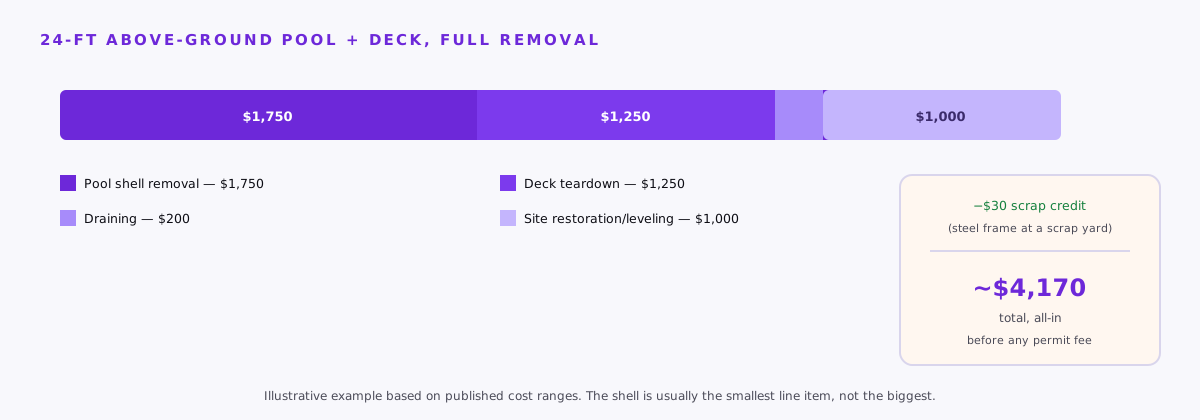
Professional removal of a steel-frame above-ground pool typically runs $475 to $3,000 depending on size, according to Dropcurb's 2026 cost breakdown, with DIY teardown and disposal running $100 to $700 in tools and hauling fees instead of labor. The pool shell itself is usually the smallest line item — a 12-foot round pool runs $475–$1,000 professionally, scaling up to $1,200–$3,000 for a 15x30 oval.
Semi-inground pools (partially recessed into the yard) are a genuine gap in the published cost data — every semi-inground figure available describes an in-ground pool filled in partway, not a true semi-inground above-ground unit, so treat any number you see for that specific scenario as an inference, not a confirmed quote, and get a site-specific estimate instead of assuming.
The deck is usually the single biggest add-on, running $500 to $2,000 to remove on its own per Dropcurb's breakdown, with an attached concrete pad adding another $300 to $800. Draining costs $175 to $225 professionally or $30 to $50 for a DIY pump rental.
Chlorinated pool water can't just go down any storm drain, though. Local rules on where you're allowed to discharge it vary by city, and some municipalities require a permit for any sewer connection while others don't — check with your water utility or public works department before you drain, rather than assuming one city's rule applies everywhere.
Site restoration and leveling the ground afterward adds $500 to $1,600, and a permit (where your city requires one at all) runs $100 to $400. There is a modest offset: a steel pool frame is worth $15 to $45 at a scrap yard, and some removal companies will even haul the shell away for as little as $59 in curbside pickup fees once it's dismantled — a real credit, but not a meaningful dent in the total.
A basic steel-frame pool is genuinely feasible to tear down yourself with hand tools and a helper or two over a weekend — about 1 to 2 days, per Dropcurb's 2026 breakdown — and the dollar savings on paper look real: DIY disposal runs $100 to $700 against $475 to $3,000 professionally.
The honest caveat is that rusted bolts and sharp cut steel edges are real injury risks, and the "hidden" costs of tool rental, fill dirt, and extra hauling trips eat into the savings faster than most people expect once they actually add them up.
If your time has any real value to you, or you don't already own the tools, the professional number and the true DIY cost end up closer together than the headline range suggests.
Mostly not, in terms of the appraised number. Licensed appraisers discussing this directly describe above-ground pools as personal property with essentially no contributory value — one put it bluntly in a professional forum thread: “above ground pools in my area are virtually worthless” from an appraisal standpoint, confirmed across a thread of practicing appraisers discussing exactly this. That's a real contrast with in-ground pools, which HomeLight's own research says do get case-by-case contributory value depending on the market.
There's a tax-basis wrinkle worth knowing too. IRS Publication 523 explicitly lists a swimming pool as an improvement that adds to your home's basis while it's part of the property — but it also excludes improvements that are “no longer part of your home” once removed. In practice this rarely moves the needle much for an above-ground pool's modest original cost, but it's the kind of detail worth mentioning to your CPA if your capital-gains math is close to the exclusion limit. This isn't tax advice — talk to a CPA about your specific numbers.
Take a $235,000 house with a non-functional 24-foot above-ground pool and attached deck. Removing it first costs roughly $4,170 all-in (shell, deck, draining, restoration, minus the scrap credit), then listing nets $235,000 minus $13,160 commission (5.6%) minus $4,700 closing costs minus the $4,170 removal spend — about $212,970, over roughly 3–4 months once removal and marketing time are added together.
Repairing it instead (liner and labor, roughly $1,500) costs less than removal but — per the appraisal data above — adds the same $0 to the appraised value. Listing at the same $235,000 after a $1,500 repair nets roughly $215,640, actually the highest of the three listing paths on paper, simply because the repair bill is smaller than the removal bill for an identical appraisal outcome.
Selling as-is and disclosing the non-functional pool, letting the buyer negotiate a credit (a realistic ask might be around $2,500) instead of doing the work yourself, nets roughly $214,830 — close to the repair path, with no cash spent upfront. The arithmetic says disclosure often beats spending money either way, but a visibly neglected or unsafe pool can also scare off buyers or blow up at inspection in ways a spreadsheet doesn't capture — which is exactly why most sellers still remove a pool that's a genuine safety hazard rather than gamble on disclosure alone.
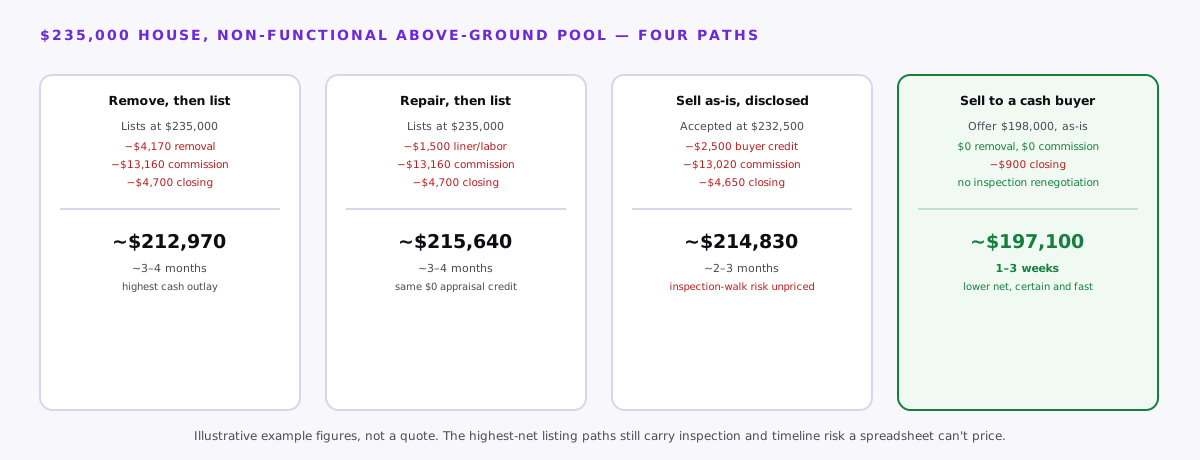
A cash sale skips all three calculations: an as-is offer around $198,000 on this house, with no commission, no repair or removal spend, and minimal closing costs, nets roughly $197,100 in 1–3 weeks — about $18,000 less than the best listing path, in exchange for not spending anything on the pool, not negotiating over it at inspection, and closing in weeks instead of months.
If you're not selling soon, repairing and keeping a pool you'll actually use avoids this calculation entirely — it only becomes a cost-benefit question once a sale is on the table. If budget is tight, removing just the unsafe elements (the ladder, the fencing, draining it so it can't collect standing water) while leaving the shell in place can address the safety concern for a fraction of full removal cost.
A pre-listing inspection can also tell you whether a typical buyer's inspector would actually flag the pool as a real issue or just note it — worth knowing before you spend on removal you might not need. And some local buyers or removal companies will take an intact pool off your hands for free or even pay a little for the frame and pump, which is worth a quick call before you default to paying for a full teardown.
A cash offer accounts for the pool as-is, so you're not choosing between a removal bill and a repair bill before you can even list.
You'll get a written offer within 24 hours, no repairs or commissions required, and you pick the closing date. We're a direct buyer, not an appraiser or your CPA, and this isn't tax advice.
All guides · Cost of repairing or removing an in-ground pool · Should I repair before selling? · Cash offer vs. listing net proceeds
Step 1 of 5
No obligation, no fees, no repairs. We respond the same day.
You’ll talk to Trevor McAmis, Owner & Acquisitions Lead
(313) 710-6129
Takes about two minutes. Or call (313) 710-6129 — we answer.