Repairing a cracked or non-functional in-ground pool typically costs $1,000-$20,000+ depending on the damage and whether it needs resurfacing. Filling it in partially runs $2,500-$10,000 but can create a standing disclosure obligation. Fully removing it runs $5,000-$16,000 but leaves a clean lot. Selling as-is to a cash buyer skips all three and lets the buyer decide.
Step 1 of 5
Tell us about the pool's condition and whether you've gotten any repair bids. We'll give you a straight answer, including when fixing it up first actually pays for itself.
You’ll talk to Trevor McAmis, Owner & Acquisitions Lead
(313) 710-6129
Takes about two minutes. Or call (313) 710-6129 — we answer.
Educational only. This explains how these situations generally work. It is not legal, tax or financial advice, and the rules differ by state — talk to an attorney or CPA about your own situation before you act on any of it.
A pool is the rare home feature homeowners love and appraisers barely reward. The National Association of Realtors' 2023 Remodeling Impact Report on outdoor features found that installing a new in-ground gunite pool costing around $90,000 recovers only about 56% of that cost at resale.
Just 1% of surveyed real estate agents recommend completing a pool addition before selling, the lowest "recommend before selling" share of any outdoor project in the report. That data is about adding a new pool, not fixing a broken one, but it points at the same underlying reluctance: pools are expensive, polarizing, and agents generally don't think spending money on one right before a sale pays for itself. If your pool is actually non-functional — cracked, leaking, or long neglected — you're choosing between three real paths: repair it, remove it, or sell the house with the problem intact.
All figures below come from contractor cost-estimate aggregators (HomeAdvisor, Fixr, Angi, Dropcurb), not government data — treat them as directional ranges, not quotes, and get a local contractor's bid before committing to any number.
| Pool type | Minor crack/leak | Major structural crack |
|---|---|---|
| Vinyl liner | $130-$300 (liner slippage/leak) | $1,125-$3,688 full liner replacement, avg. ~$2,393 |
| Gunite/concrete | $100-$200 | $1,000-$5,000+ |
| Fiberglass | $300-$700 (gel coat) | $1,500-$5,000+ |
Concrete/gunite pools are the most likely to need a full resurfacing on top of a structural repair — a complete gunite resurfacing runs $10,000-$20,000, while fiberglass resurfacing runs closer to $6,500. (HomeAdvisor, pool repair cost)
If repair doesn't make financial sense, removing the pool entirely is the other real option, and it comes in two meaningfully different forms with meaningfully different price points: a cheaper partial fill-in that leaves the shell buried in place, or a full removal that excavates and hauls the whole structure away. Several independent contractor-cost sources converge on the same order of magnitude for both.
| Method | What happens | Typical cost | Timeline |
|---|---|---|---|
| Partial fill-in | The shell is broken up and buried in place with gravel/soil fill | $2,500-$10,000 | 2-3 days |
| Full removal | The shell is fully excavated and hauled away, replaced with compacted clean fill | $5,000-$16,000 | 5-10 days |
Permits for either method typically run $150-$800, and are required in virtually every jurisdiction — at minimum a demolition permit, often a grading or fill permit too. (Dropcurb, pool removal cost; Fixr, fill-in-pool cost)
By material, full removal is cheapest for vinyl or steel-wall pools and most expensive for gunite/concrete, which has to be jackhammered apart. A fiberglass shell can sometimes be removed more cheaply if a crane can lift it out whole, at a crane-rental cost of roughly $3,000-$5,000.
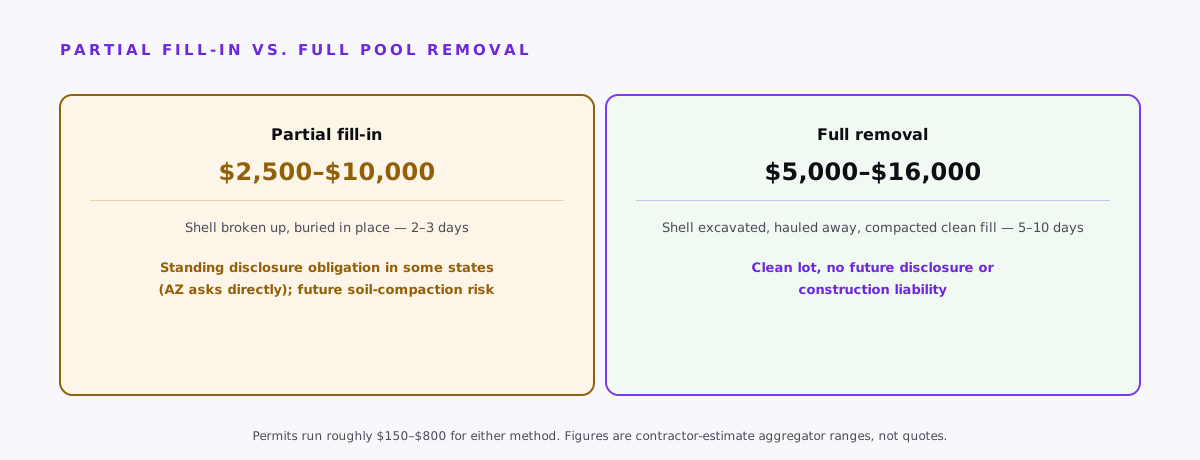
Choosing the cheaper partial fill-in over full removal can look like the obvious money-saving choice, but a buried pool shell doesn't actually disappear from the property's history once it's under a few feet of soil. A partial fill-in specifically creates two ongoing issues that a full removal doesn't:
If you're removing the pool specifically to make the lot more marketable rather than just cheaper to deal with, full removal is the option that doesn't leave a landmine for the next buyer's contractor.
A pool "collapsing" or suffering damage from a documented lack of maintenance — a clogged filter, a neglected pump — is explicitly not covered under standard homeowners policies, since that kind of failure is treated as a maintenance issue rather than a covered loss. (Progressive, does insurance cover swimming pools) A pool is also typically treated as an "attractive nuisance," which raises your liability exposure the longer it sits unmaintained rather than lowering it.
A stagnant, mosquito-breeding, or visibly neglected pool is commonly treated as a public nuisance under municipal code, with an enforcement pattern of notice, a cure period, then city remediation and a lien on the property if it isn't addressed. Our site has a separate guide on the fencing side of this — see selling a house with a non-compliant pool barrier — this guide is about the pool's mechanical condition and what it costs to fix or remove, not fence compliance. The two problems can show up on the same property but are solved differently.
This is educational information, not legal or engineering advice. Confirm your specific state's disclosure requirements and your municipality's permit and nuisance rules before deciding how to handle a non-functional pool.
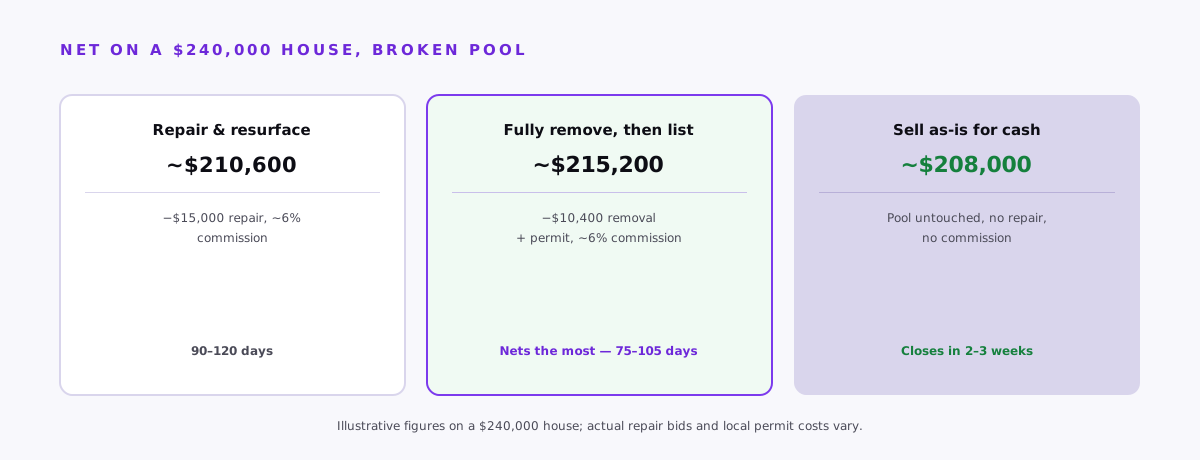
Worked on a $240,000 house with a cracked, non-functional 18x36 gunite pool:
| Route | Gross price | Repair/removal cost | Commission | Net to seller | Timeline |
|---|---|---|---|---|---|
| Repair the crack and fully resurface, then list | $240,000 | −$15,000 (structural crack repair plus full gunite resurfacing) | ~6% (−$14,400) | ~$210,600 | 90-120 days: repair, resurfacing, then a normal listing |
| Fully remove the pool and compact clean fill, then list | $240,000 | −$10,400 (removal plus permit) | ~6% (−$14,400) | ~$215,200 | 75-105 days: demolition, inspection, then listing |
| Sell as-is to a cash buyer, pool untouched | $208,000 | $0 | $0 | ~$208,000 | 2-3 weeks |
Full removal nets more here than repairing and resurfacing — spending $15,000 to fix a pool that, per NAR's own data, buyers and agents are lukewarm about even when it's new rarely pencils out as well as simply taking it out and compacting the lot. A cash sale nets the least of the three but skips the repair decision, the permit process, and the months of work entirely. These numbers are illustrative — your own repair bids, local permit costs, and market's appetite for pools will move all three rows.
If full removal and a normal listing is realistic for your timeline, it usually nets more than a cash sale — we'd tell you that directly.
Where a cash offer earns its place is skipping the repair-or-remove decision entirely and letting the buyer take on that cost instead. Send the address and we'll send a written offer within 24 hours. No cost, no obligation.
All guides · Selling a house with a non-compliant pool barrier · Cost of getting a house market-ready before you list · Cash offer vs listing net proceeds
Step 1 of 5
No obligation, no fees, no repairs. We respond the same day.
You’ll talk to Trevor McAmis, Owner & Acquisitions Lead
(313) 710-6129
Takes about two minutes. Or call (313) 710-6129 — we answer.