If a private lender paid off your delinquent county taxes and took over the lien, you have a property tax loan, not a regular tax bill anymore. The cost of paying off a property tax loan before you sell depends almost entirely on how long the loan has been accruing interest, because Texas caps the rate at 18% a year but doesn't cap how many years it can run. Here's the exact math, and the tradeoff between paying it off now and carrying it through a longer listing.

Step 1 of 5
Send the address and the current payoff amount and we'll send a written cash offer within 24 hours. No repairs or commissions required.
You’ll talk to Trevor McAmis, Owner & Acquisitions Lead
(313) 710-6129
Takes about two minutes. Your address is never shared.
Educational only. This explains how these situations generally work. It is not legal, tax or financial advice, and the rules differ by state. Talk to an attorney or CPA about your own situation before you act on any of it.
This product is mostly a Texas thing. Under Texas Tax Code Section 32.06, a homeowner can authorize a licensed lender, called a "transferee," to pay the county's delinquent tax bill directly. The county's tax collector certifies the taxes paid and the lien transfers to that lender. Companies doing this business today include Propel Tax, Ovation Lending, Home Tax Solutions and others, all licensed as property tax lenders by the Texas Office of Consumer Credit Commissioner (OCCC) under Finance Code Chapter 351.
Three things make this different from a normal loan. First, the lien that transfers is a property tax lien, which Texas law treats as superior to almost everything else recorded against the house, including a first mortgage that was recorded years earlier. Second, the lender can charge up to 18% a year on the funds it advanced (the back taxes, penalties, interest and collection costs it paid the county, plus allowed closing costs), under Section 32.06(e). Third, a homeowner who is 65 or older and already eligible for the senior property tax exemption is legally barred from authorizing one of these loans in the first place, under Section 32.06(a-3), which is why county deferral programs exist as the intended path for that group instead.
Texas law also gives owner-occupants a narrow safety valve: a three-business-day right to cancel the contract, similar to the federal Truth in Lending Act rescission right for loans secured by a home, under Section 32.06(d-1). Once that window closes, the contract and its interest rate are locked in, and Section 32.065 governs how the lender can move to foreclose if payments stop.
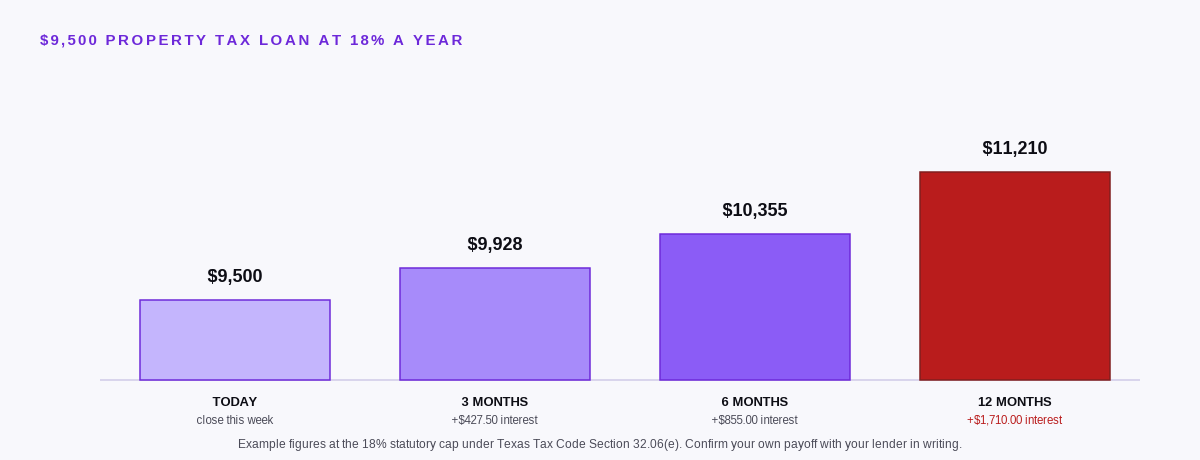
Example: a Texas homeowner falls behind on county taxes. A licensed property tax lender pays $9,000 in back taxes, penalties and county collection costs, plus $500 in its own allowed closing and recording costs. The loan originates today at $9,500, with an 18% annual contract rate, which is the statutory maximum and close to the 12% to 18% range these lenders commonly disclose.
At 18% a year, interest works out to $142.50 a month ($9,500 x 18% / 12), assuming no principal gets paid down, which is realistic in the early part of a long amortization schedule.
| When you pay it off | Interest accrued | Payoff balance |
|---|---|---|
| Today (close this week) | $0 | $9,500 |
| 3 months from now | $427.50 | $9,928 |
| 6 months from now | $855.00 | $10,355 |
| 12 months from now | $1,710.00 | $11,210 |
That's the whole mechanic: every month you carry the loan adds roughly $142.50 to what you'll owe at closing, on this balance. A bigger original loan or a higher contract rate moves faster.
Before you wire a payoff to the lender, get the exact current figure in writing, not an estimate from a statement you printed weeks ago. Fees, per-diem interest and whether a payment already posted can shift the number by a few hundred dollars either way. If anything on that payoff statement looks wrong, that's a conversation for an attorney or a CPA, not a guess.
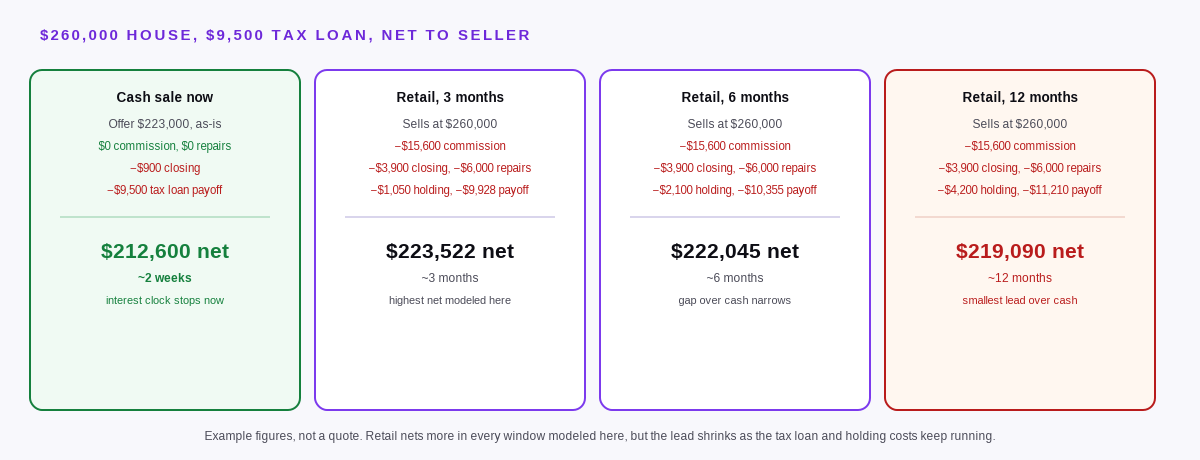
This is where the real decision sits. A retail listing usually nets more than a cash sale on paper, but every month it takes to find a buyer and close adds both holding costs and tax loan interest. A cash sale nets less on paper, but it stops the interest clock in about two weeks instead of months.
Example, continuing the same $9,500 loan on a house worth $260,000 retail, free and clear of any mortgage:
| Path | Timeline | Price/offer | Commission | Closing costs | Repairs/concessions | Holding costs | Tax loan payoff | Net to seller |
|---|---|---|---|---|---|---|---|---|
| Cash sale now | ~2 weeks | $223,000 | $0 | $900 | $0 (as-is) | $0 | $9,500 | $212,600 |
| Retail, closes in 3 months | ~3 months | $260,000 | $15,600 | $3,900 | $6,000 | $1,050 | $9,928 | $223,522 |
| Retail, closes in 6 months | ~6 months | $260,000 | $15,600 | $3,900 | $6,000 | $2,100 | $10,355 | $222,045 |
| Retail, closes in 12 months | ~12 months | $260,000 | $15,600 | $3,900 | $6,000 | $4,200 | $11,210 | $219,090 |
Here is what that means: at every timeline modeled here, the retail listing still nets more than the cash offer, even after the extra interest and holding costs pile on. If your situation looks like this one, a retail listing is probably the better math. What the extra interest does is quietly shrink the gap. Retail beats cash by about $10,900 at 3 months but only about $6,500 at 12 months, because the tax loan and the holding costs both kept running while the house sat on the market. A slower sale, a bigger loan balance, or a higher contract rate can erase that gap entirely or flip it, which is exactly why the math is worth running on your own numbers instead of assuming either path wins.
County installment or deferral plans. Many Texas counties let any homeowner set up an installment agreement on a delinquent balance before a set deadline, and a four-payment plan with no penalty or interest is available specifically to homeowners 65 or older, disabled, or a disabled veteran's surviving spouse, under Tax Code Section 31.031. Harris County's own property tax FAQ page walks through its installment terms directly. Ask your own county tax office before you ever call a private lender.
Deferral for seniors and the disabled. Under Tax Code Section 33.06, a homeowner 65 or older, or disabled, can postpone paying property taxes on their homestead entirely while they live there, with deferred amounts accruing at 5% a year instead of normal penalties. It's a postponement, not forgiveness, and the balance comes due within 180 days of moving out or losing eligibility. Required pre-closing disclosures for property tax loans, covered under 7 Tex. Admin. Code Section 89.504, specifically require the lender to tell borrowers this option exists.
Direct negotiation with the lender. If you already have one of these loans, ask for a current, itemized payoff statement in writing and compare it line by line against what you believe you owe. Fee disputes get resolved faster when you ask before closing, not after.
A standard mortgage refinance. If you have enough equity and can qualify, a cash-out refinance at a conventional mortgage rate can retire an 18% tax lien loan with much cheaper debt. This depends on credit and income qualifying the normal way a refinance does. If a refinance isn't available and you're weighing a bridge loan instead, our cost of a balloon payment default before selling a house guide runs that same kind of payoff math.
Selling. Covered above, both the cash and retail paths.
Mostly, yes. Texas built an entire licensed industry around transferring tax liens to private lenders, and it's the dominant market for this product by a wide margin. Nevada has a statute, NRS 361.7311, authorizing agreements to assign tax liens to a private party, which is structurally similar on paper. We did not find public evidence of an active consumer property-tax-loan industry operating in Nevada the way it does in Texas, so treat that as a legal possibility there, not a confirmed live market.
Other states generally handle delinquent property taxes a different way: the county sells a tax lien certificate or the property itself at a public auction to third-party investors, who then earn interest or can eventually foreclose if the homeowner doesn't redeem. That's a different transaction. The homeowner isn't taking out a loan from a private company; the county is selling its claim to an investor at auction. If you're dealing with that kind of sale instead of a private loan, our guide to selling a house facing tax foreclosure covers that process state by state.
Restar Acquisitions buys houses as-is for cash across 69 markets in 14 states: Alabama, Arizona, Florida, Georgia, Indiana, Maryland, Michigan, Missouri, Nevada, New York, North Carolina, Ohio, Pennsylvania and Texas. We give a written offer within 24 hours, no repairs or commissions required, and you pick the closing date. We're a direct buyer, not your lender, your real estate agent, or a financial advisor.
Restar Acquisitions buys houses as-is for cash across 69 markets in 14 states, including Texas. Send us the address and the current payoff amount on your tax loan and we'll send a written offer within 24 hours. No repairs, no commissions, no showings, and you pick the closing date.
If the math points to a retail listing netting you more, we'll tell you that directly. We're a direct buyer, not your lender, your real estate agent, or a financial advisor.
All guides · Selling a house facing tax foreclosure · Cost of a balloon payment default before selling a house · Sell my house fast
Step 1 of 5
No obligation, no fees, no repairs. We respond the same day.
You’ll talk to Trevor McAmis, Owner & Acquisitions Lead
(313) 710-6129
Takes about two minutes. Your address is never shared.