Losing a grandfathered flood insurance rate when you sell is a math problem, not a feeling. Many sellers assume an old, subsidized National Flood Insurance Program premium just carries over to whoever buys the house. It does not happen on its own. FEMA requires the seller to actively assign the existing policy to the new owner before closing. Skip that step, or have it fall through, and the buyer gets priced fresh under FEMA's current Risk Rating 2.0 method, which can run several thousand dollars a year higher. That gap shows up in your net proceeds before it ever shows up in the buyer's mailbox.

Step 1 of 5
Send the address and we will tell you what we would pay, and whether the insurance math changes it.
You’ll talk to Trevor McAmis, Owner & Acquisitions Lead
(313) 710-6129
Takes about two minutes. Your address is never shared.
Educational only. This explains how these situations generally work. It is not legal, tax or financial advice, and the rules differ by state. Talk to an attorney or CPA about your own situation before you act on any of it.
No. FEMA's own page on its pricing approach states it plainly: "Policyholders are able to transfer their discount to a new owner by assigning their flood insurance policy when their property changes ownership" (FEMA: NFIP's Pricing Approach). Assigning is a specific paperwork step, not a side effect of the deed transfer. If nobody does it, in writing, before closing, the discount does not follow the house.
This is educational information about how NFIP pricing and policy assignment generally work, not insurance, legal or tax advice. Carrier practices, lender requirements and state disclosure rules vary and change, so confirm your own numbers with your insurance agent and the current NFIP before you price a sale around them.
Since October 1, 2021, FEMA has priced NFIP policies under Risk Rating 2.0, a method that rates each property on its own flood frequency, distance to a water source, elevation and the cost to rebuild it, rather than a flat zone-wide rate. FEMA is explicit that it still allows two kinds of discounted premium to exist at once: assigned subsidized policies, and brand-new ones. "FEMA is continuing to offer premium discounts for pre-FIRM subsidized and newly mapped properties" when a policy is kept in force and assigned (FEMA: NFIP's Pricing Approach).
A new policy, written fresh because the old one lapsed or because the buyer's lender or carrier required a new one, does not inherit that discount. It is rated at that property's current full-risk price on day one. FEMA's own breakdown of single-family NFIP premiums shows how wide the resulting gap can be: 37% of policies nationwide fall in the $0 to $1,000 a year bracket, 32% fall in the $1,000 to $2,000 bracket (a bracket most pre-FIRM subsidized houses sit in), and FEMA's own chart carries brackets up to $4,000 to $5,000, $5,000 to $10,000 and $10,000 and up for higher-risk, lower-elevation structures (FEMA: Cost of Flood Insurance for Single-Family Homes).
FEMA calls the two numbers the "Current Cost," what a policyholder pays today, and the "Risk-Based Cost," what the same property would cost at its full actuarial rate. The agency states that 38% of single-family policyholders are already paying the risk-based rate, while the rest are still paying less by law, through the subsidy or a capped glide path. Congress caps most individual rate increases at 18% a year, so even policies moving toward full risk climb gradually rather than all at once (Congressional Research Service, R44593). The same report puts the share of NFIP policies still carrying a pre-FIRM subsidy at roughly 15% as of October 2023, a shrinking but still real slice of the program.
The two brackets above, the common $1,000 to $2,000 pre-FIRM bracket and FEMA's own $4,000-plus high-risk brackets, are not abstractions. They describe what a real seller and a real buyer can run into on the same house, a few months apart.
Example: a 1974 house in Zone AE, $280,000 market value, carries an assigned pre-FIRM subsidized NFIP premium of $1,200 a year, $100 a month, escrowed into the current owner's payment. The seller lists, assuming the rate "comes with the house." The buyer's lender does require flood insurance under the Flood Disaster Protection Act's mandatory purchase requirement, since the loan is federally backed and the house sits in a Special Flood Hazard Area (FEMA: Mandatory Purchase of Flood Insurance). But the assignment paperwork was never filed before closing, so the buyer's insurer writes a new policy instead of assuming the old one. Priced fresh for this non-elevated, older structure, that new policy lands at $4,800 a year, $400 a month, squarely in FEMA's own $4,000 to $5,000 bracket.
That $300-a-month jump is not just the buyer's problem. At roughly 6.5% over 30 years, every $100 of monthly flood premium displaces about $15,800 of loan a buyer can qualify to carry. The old $100-a-month premium displaced about $15,800. The new $400-a-month premium displaces about $63,300. The difference, about $47,500, is borrowing power the buyer's lender no longer sees on the file, at the exact same monthly budget the buyer started with.
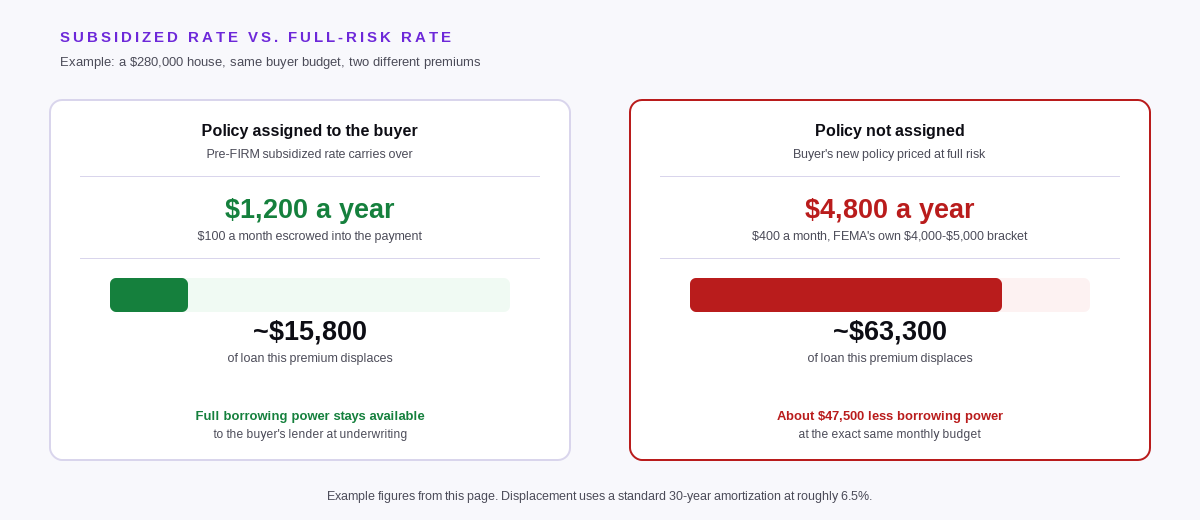
| Scenario | Annual premium | Per month | Borrowing power displaced |
|---|---|---|---|
| Assigned, subsidized rate | $1,200 | $100 | about $15,800 |
| New policy, full-risk rate | $4,800 | $400 | about $63,300 |
| Difference | $3,600 | $300 | about $47,500 |
A seller rarely sees this number until it is too late to plan around. It arrives as one of three things: a shrunken buyer pool, a late renegotiation, or a flat-out walked deal.
The buyer pool shrinks first, quietly. A buyer's lender runs debt-to-income against the monthly payment they expect, usually the number in the listing or the one a buyer's agent quoted off the seller's current bill. Buyers who can qualify at $1,200 a year and buyers who can qualify at $4,800 a year are not the same pool, and a house priced for the larger pool draws offers it cannot actually close.
The renegotiation happens later, usually mid-underwriting, when the lender orders a current flood determination and insurance quote and the number comes back nothing like what everyone assumed. At that point the buyer has already spent weeks and an inspection fee on the house. Most buyers do not walk immediately; they come back asking for roughly the borrowing-power gap, in this example about $47,500, off the price, or ask the seller to buy down the rate, or ask for seller-paid points to offset the new payment. Either way the seller is negotiating from a weaker position than before an offer existed, with a clock running on the contract.
Disclosure sits underneath all of this. Whether or not your state has a specific flood insurance disclosure statute, telling buyers up front what the current premium is, whether it is assigned, and what a fresh quote would likely run, turns a late-underwriting surprise into an early, priced-in fact. A buyer who knows the number before they write an offer negotiates once. A buyer who finds it out from their lender negotiates twice, and resents the seller for the second round.
The fastest way to see what the insurance question is actually worth is to run both paths on the same house with real numbers.
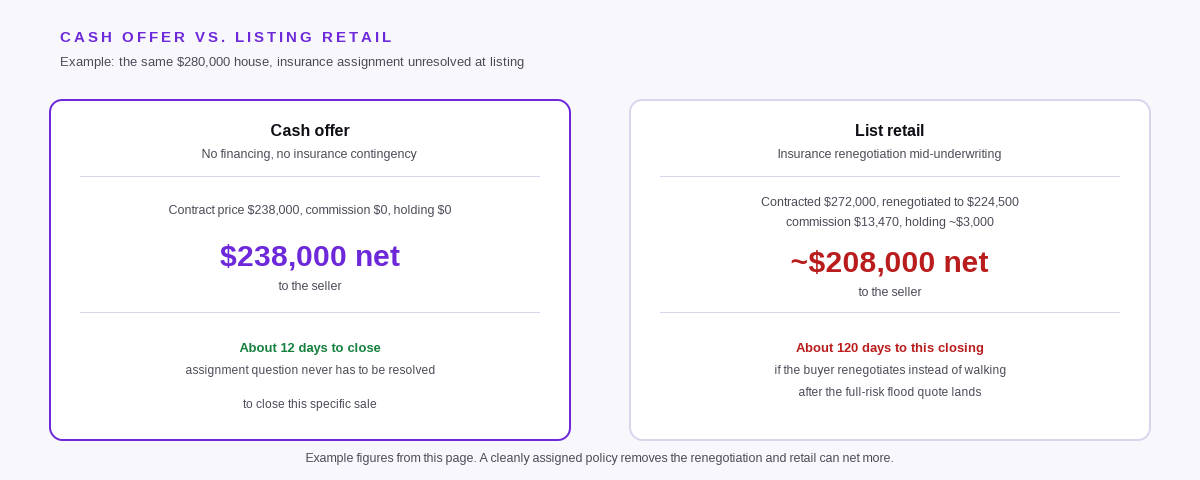
Example: the same $280,000 house. A cash buyer who is not financing offers $238,000, as-is, no inspection renegotiation, no appraisal contingency, no commission, closing in 12 days. Net to seller: $238,000.
Listed with an agent, the house goes on the market at $279,000 and a financed buyer contracts at $272,000 after 38 days. During underwriting the lender orders the flood determination, finds the old policy was never assigned, and prices the buyer's new policy at the $4,800 full-risk rate from the example above. The buyer's debt-to-income no longer supports $272,000 at that payment. Rather than walk, buyer and seller renegotiate the price down by the $47,500 borrowing-power gap, to $224,500, to keep the loan qualifying. At closing: $224,500, minus a 6% commission of $13,470, minus roughly 83 extra days of carrying costs at $1,100 a month (about $3,000) compared with the cash timeline, nets $208,000. Total time from listing to this closing: around 120 days.
| Line | Cash offer | List retail (with insurance renegotiation) |
|---|---|---|
| Contract price | $238,000 | $272,000, renegotiated to $224,500 |
| Commission | $0 | $13,470 |
| Extra holding costs vs. cash timeline | $0 | about $3,000 |
| Net to seller | $238,000 | about $208,000 |
| Time to close | about 12 days | about 120 days |
This is not a claim that cash always wins. If the policy assignment is filed correctly, in writing, before closing, and the buyer's lender accepts it, none of the renegotiation happens and the retail listing likely nets more than either number above. The entire point of the arithmetic is that the insurance question is a real swing factor in net proceeds, worth pricing before you list, not discovering during underwriting.
A few steps change this math, and none of them require guessing.
Get the assignment question answered first, in writing, from your current carrier: is the policy assignable, what does it cost the buyer to keep it in force, and what would a fresh quote run if it is not assigned. That single piece of paper turns every number above from a worst case into a known quantity you can disclose.
An Elevation Certificate can lower the full-risk number itself, even without a map change, since Risk Rating 2.0 factors in a structure's elevation relative to flood risk. If your house sits higher than the map assumes, our guide to how a LOMA can remove a house from a flood zone before you sell covers the LOMA and LOMR-F process, the real cost and the 10 to 16 week timeline in detail, and our guide to selling a house in a flood zone covers the mandatory purchase rule and the broader borrowing-power math this article builds on.
Listing with an agent anyway can still be the right call. If the current policy assigns cleanly, if the buyer pool at the real premium is wide enough, or if you have the time to let a LOMA clear first, retail can net more than a fast cash sale. The only mistake is pricing the listing on the assumption that the old rate travels with the house without checking.
If you send us the address, we will give you a written offer within 24 hours for the house as-is, no inspection renegotiation and no commission. You pick the closing date.
If the math on this page says listing with an agent would net you more once the flood insurance question is actually settled, we will tell you that instead of steering you toward a faster close that costs you money. Send us the property here.
All guides · Selling a house in a flood zone · How a LOMA can remove a house from a flood zone
Step 1 of 5
No obligation, no fees, no repairs. We respond the same day.
You’ll talk to Trevor McAmis, Owner & Acquisitions Lead
(313) 710-6129
Takes about two minutes. Your address is never shared.