Sellers usually only learn what their listing agreement actually says when they want out of it — the house isn't moving, they're unhappy with the agent, or a cash offer showed up and they want to take it. Here's what that contract actually obligates you to, how sellers really get out of it, and what it can cost if you don't handle it carefully.
Step 1 of 5
Tell us about the house. We'll give you a written cash offer within 24 hours — no listing agreement required on our end, whatever you decide about your current one.
You’ll talk to Trevor McAmis, Owner & Acquisitions Lead
(313) 710-6129
Takes about two minutes. Or call (313) 710-6129 — we answer.
Educational only. This explains how these situations generally work. It is not legal, tax or financial advice, and the rules differ by state — talk to an attorney or CPA about your own situation before you act on any of it.
Most listing agreements aren't cancellable at will — getting out early usually means asking your agent for a mutual written release, which most brokerages will give, though some agreements let the brokerage bill for marketing costs already spent, and a “protection clause” can still entitle the original agent to a full commission if a buyer they introduced closes later. A cash sale has no listing agreement at all, so none of this applies — but it also doesn't maximize your sale price the way a full-commission, patiently-marketed retail listing can.
Most sellers sign what's called an exclusive right-to-sell listing agreement. The National Association of Realtors describes it plainly: you work with one agent, and “you are responsible for your agent's compensation no matter who sells the property” during the term — even if you find the buyer yourself. See NAR's consumer guide to listing agreements. Terms commonly run 90 to 180 days, and commission rates are fully negotiable — nothing sets them by law.
Buried in most of these agreements is a protection clause (also called a safety clause, extension clause, or tail provision): language that keeps you obligated to pay the original broker's commission if the house sells — even after the agreement ends — to a buyer that agent introduced during the listing period. The specific window varies by contract, commonly somewhere in a 30-to-180-day range after the listing ends, and the broker typically has to give written notice naming the protected buyer near expiration. Some sellers successfully negotiate a written exclusion list naming buyers they already know (a specific cash buyer, for instance) to carve out of this clause before signing — worth asking about if you're about to sign a new agreement.
This is a private contract, not a government form. A listing agreement is typically a state real estate association's standard template, and most state regulators are explicit that they don't referee disputes over it — Texas's own real estate commission, for example, states it “cannot advise on private contractual matters” because the listing agreement “is not promulgated by TREC.”
The realistic path is a mutual written release — you ask, the brokerage agrees in writing, and the agreement ends for both of you. Most brokerages will do this for an unhappy seller rather than force the issue, especially before the house is under contract. California uses a standard “Cancellation of Listing” form for this; Texas Realtors have an equivalent “Termination of Listing” form where any marketing-cost reimbursement to the brokerage gets negotiated directly as a line item on the form, not added afterward.
If the brokerage refuses, you're generally bound for the remaining term. Your recourse at that point is limited: wait it out, argue the agent breached their own obligations to you, or file a complaint with your state's real estate licensing board or association ethics process — which can discipline the agent but generally can't force a release from a private contract.
One more risk even after a release or expiration: procuring cause. If an agent introduced a buyer during the listing and you later close with that same buyer — even after the agreement formally ended — the agent can still have a valid claim to commission under procuring-cause doctrine in many states, independent of any protection clause. Courts in some states have held that simply waiting out the listing term doesn't defeat that claim if the agent was genuinely the one who brought the buyer to the table. This varies by state, so don't assume letting a listing lapse is a clean way around a specific buyer relationship an agent already built.
One correction worth making directly: the August 2024 National Association of Realtors settlement is sometimes assumed to have changed listing agreements generally. It didn't. NAR's own settlement materials confirm the reforms are entirely on the buyer-representation side — written buyer agreements before home tours, and compensation offers moved off the MLS. Seller listing agreements, their terms, and protection clauses were not part of that settlement.
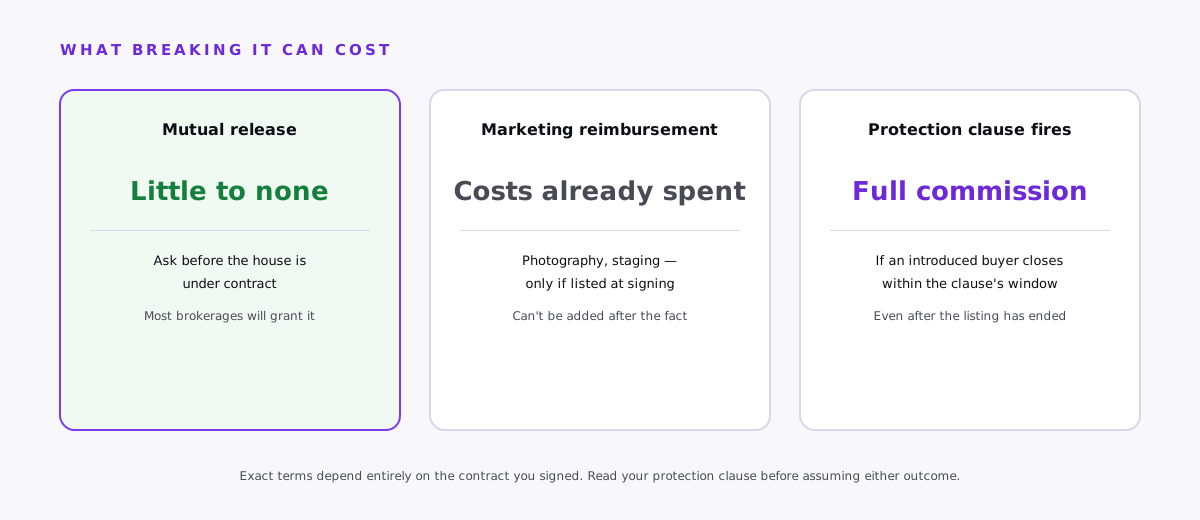
| Situation | What it typically costs you | What it doesn't solve |
|---|---|---|
| Ask for a mutual release before going under contract | Usually little to nothing beyond any marketing costs already agreed to in the contract | Doesn't erase a valid procuring-cause claim if a specific buyer was already introduced |
| Wait out the listing term | No direct cost, but the house stays off other channels during that time | Protection-clause exposure can still apply after the term ends |
| Protection clause triggers after release or expiration | The full commission rate in your original agreement | Nothing — this is the cost, not a workaround |
| Sell to a cash buyer with no listing agreement at all | No termination exposure of any kind | Does not maximize price the way a patient, fully marketed retail listing typically can |
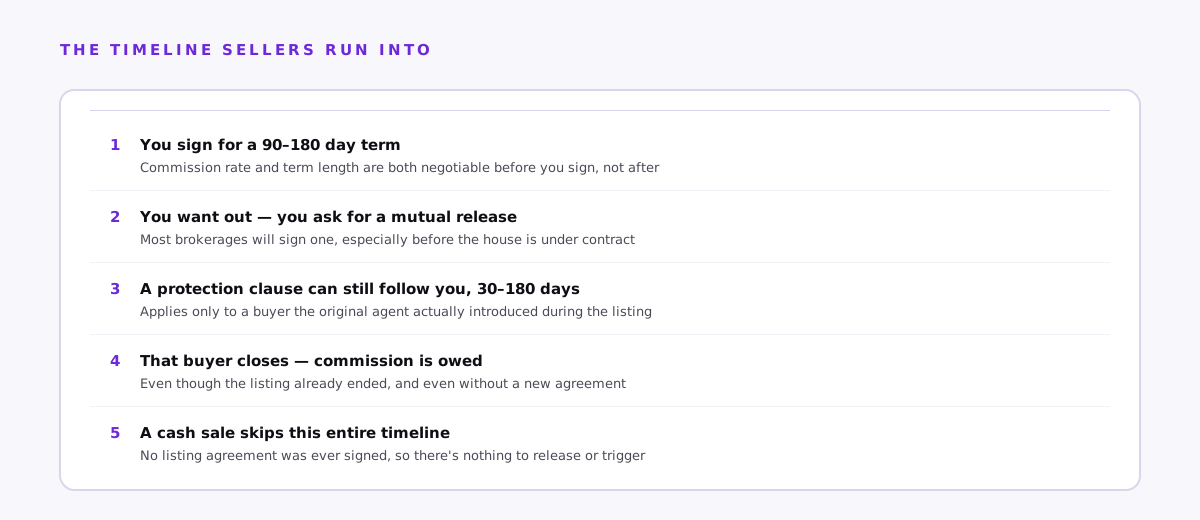
That last row is the honest tradeoff worth sitting with: a cash sale sidesteps every cost and clause described above because there's no listing agreement in the picture at all. That's a genuine advantage if you're stuck in, or trying to avoid, a bad agreement. It is not the same as saying a cash sale nets you more money — a fully marketed, agent-assisted retail sale will generally bring a higher gross price, even after commission. The right call depends on whether your priority is maximizing price or avoiding the time, friction, and contractual risk the listing-agreement path can carry.
If you're weighing a cash offer against a full agent-assisted listing generally, not just the cost of exiting an existing agreement, cost of selling FSBO vs. agent vs. cash buyer walks through the full three-way comparison. And if a written cash offer within 24 hours is the clean exit you're after, no listing agreement required, we're glad to make one.
This article is for general educational purposes only and is not legal advice. Listing agreement terms, protection-clause enforceability, and procuring-cause rules vary by state and by the specific contract you signed. Talk to a real estate attorney about your specific agreement before taking action.
There's no protection clause, no marketing-cost reimbursement, and no term length to negotiate out of, because there's no listing agreement in the picture.
Send us the address and we'll give you a straight number to weigh against your options.
All guides · Cost of selling FSBO vs. agent vs. cash buyer · Cash offer vs. listing net proceeds · Who pays realtor fees when selling a house
Step 1 of 5
No obligation, no fees, no repairs. We respond the same day.
You’ll talk to Trevor McAmis, Owner & Acquisitions Lead
(313) 710-6129
Takes about two minutes. Or call (313) 710-6129 — we answer.
