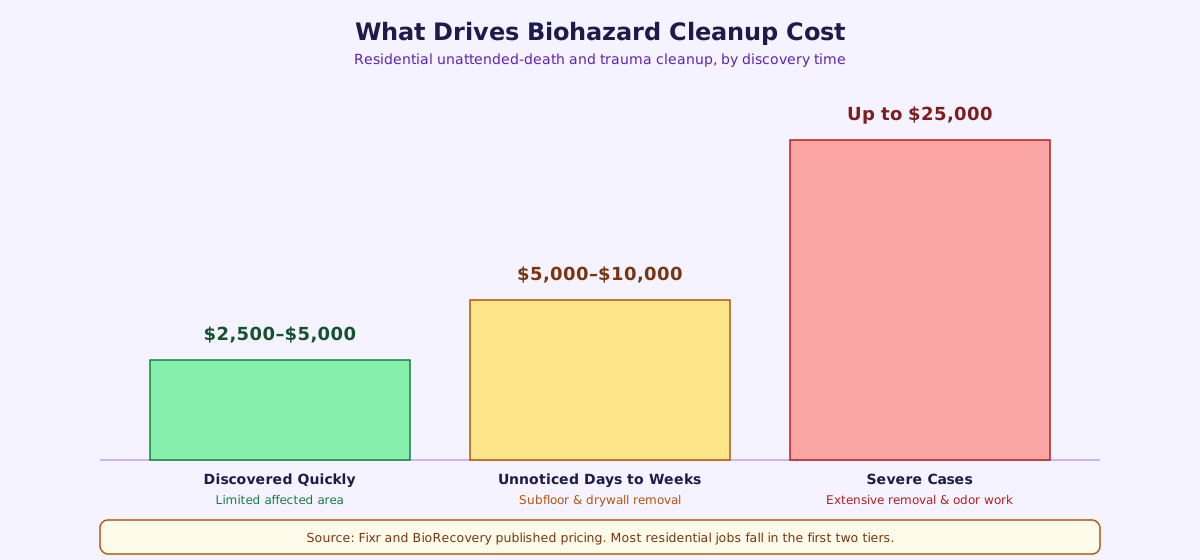
A death at home before you can sell the house usually means professional cleanup first, and it runs $2,500 to $8,000 for most residential jobs, with severe cases reaching $25,000. Standard homeowners insurance sometimes covers it and sometimes doesn't. Here's what the cost depends on, who's legally allowed to do the work, and what it means for selling the house afterward.
Step 1 of 5
Send the address. We'll tell you straight whether we can buy it as-is, cleanup and all, or whether remediation first would net you more.
You’ll talk to Trevor McAmis, Owner & Acquisitions Lead
(313) 710-6129
Takes about two minutes. Your address is never shared.
Educational only. This explains how these situations generally work. It is not legal, tax or financial advice, and the rules differ by state. Talk to an attorney or CPA about your own situation before you act on any of it.
Two industry sources that publish real pricing agree on a similar range. Fixr puts the national average at roughly $4,000 for a 2,000-square-foot home, with an overall range of $1,500 to $25,000 and a typical job landing between $3,000 and $5,000. BioRecovery, a remediation company that publishes its own pricing data, puts an unattended death specifically at $3,000 to $10,000, and most residential jobs overall at $2,500 to $8,000.
Hourly pricing explains the spread. Fixr cites $200 to $300 an hour for an unattended death and $400 to $600 an hour for more involved crime-scene-level cleaning. A job discovered quickly, with limited area affected, lands at the low end. A death that went unnoticed for days or weeks, with fluid that soaked into subflooring, drywall, or insulation, costs more because the crew has to remove and replace those materials, not just clean the surface.
What drives the final number in practice: how long before the death was discovered; flooring type, since carpet and padding almost always get torn out while hardwood sometimes can be saved; whether the subfloor or drywall absorbed fluid and needs removal; square footage of the affected area, not the whole house; and odor remediation, which can mean sealing and repainting beyond the immediate area.
This isn't a job for a general cleaning service or a well-meaning relative in gloves. The reason comes down to a specific federal workplace rule, and it's worth understanding why that rule shapes who you should hire for a job like this.
The federal rule here is OSHA's Bloodborne Pathogens Standard, 29 CFR 1910.1030. It's important to be precise about what this regulates: it's a workplace-safety rule governing employers and their employees who have reasonably anticipated exposure to blood or other potentially infectious materials. It doesn't directly tell a homeowner what they're allowed to do in their own house. What it means in practice is that a legitimate remediation company's employees are trained in bloodborne pathogen exposure control, use specific PPE, and follow disposal protocols, because their employer is legally required to provide that. A general cleaning crew without that training and equipment is taking on real health risk, and likely isn't insured for the job.
California goes a step further and licenses this specific work. Under the state's Trauma Scene Waste Management Act, California Health and Safety Code Sections 118321 through 118321.6, anyone who removes human blood, body fluids, and related waste from the scene of a serious injury, illness, or death as a commercial activity has to register with the California Department of Public Health and carry a hauling permit. The "commercial activity" language is the key phrase: this licenses businesses doing the work for pay, not family members doing light cleanup themselves. Most states don't have a parallel licensing scheme as specific as California's, but the underlying OSHA exposure rules still shape who's equipped to do this safely everywhere.
Sometimes, and it depends on the policy. A standard HO-3 open-peril homeowners policy usually covers non-fire-related trauma, blood, or crime-scene cleanup as a sudden, accidental loss to the structure. A more limited named-peril policy, often called HO-1, typically doesn't list this as a covered event at all. Coverage is also usually limited to the structure itself, not contents like mattresses, furniture, or carpet, which get treated separately or excluded.
One pattern that catches people off guard: a death connected to prior neglect, like an undetected illness paired with hoarding conditions that let it go unnoticed, is more likely to get treated as a maintenance issue and denied, rather than a sudden loss. If you're the heir and not the policyholder, start by finding the decedent's policy and calling the carrier directly to ask about trauma or biohazard cleanup coverage before you pay out of pocket. Several remediation companies also bill insurance directly, which is worth asking about when you get quotes.
Usually not, if the death was from natural causes, and this varies significantly by state. Florida's disclosure statute, Section 689.25, states that the fact a property was the site of a death isn't a material fact an owner is required to disclose, and it shields owners and agents from liability for not disclosing it.
South Dakota's required seller disclosure form asks specifically about a death by homicide or suicide during the seller's ownership, not a natural or unattended death. The pattern across most states that address this at all is the same: natural deaths generally don't trigger a disclosure duty, while a small number of states require disclosure of a homicide or suicide within some window of time.
One caveat that matters regardless of state: not having a duty to volunteer the information is different from being allowed to lie about it. If a buyer asks you directly whether anyone died in the house, most states don't protect a seller who answers dishonestly.
If you're an heir dealing with this, the cleanup cost doesn't have to come out of your own pocket before the estate pays you anything. Costs necessary to prepare an estate's real property for sale are generally treated as estate administration expenses, reimbursed from the estate before whatever's left gets distributed to heirs.
The practical problem is timing: if the estate doesn't have liquid cash yet because the house hasn't sold, an heir sometimes has to front the cost and get reimbursed once the sale closes or once other estate assets are available.
Three paths from here, roughly in order of how much they cost you upfront:
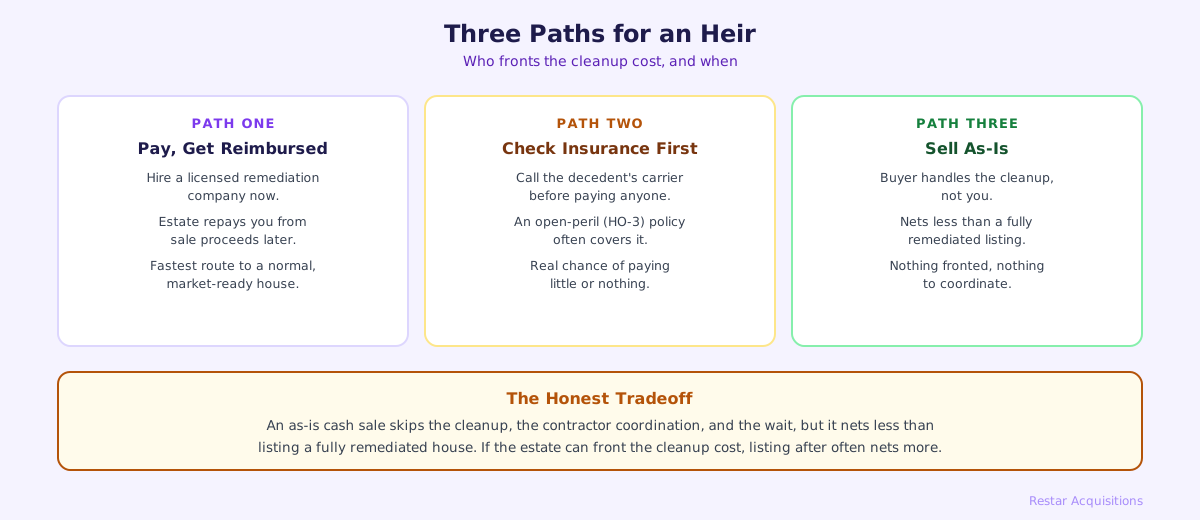
That last point is the real tradeoff. A cash sale, as-is, skips the cleanup, the contractor coordination, and the wait, but it nets less than listing a fully remediated house would. If you have the time and the estate has the cash to front the remediation, listing after cleanup often nets more. If you don't, or you simply don't want to manage a remediation project on top of everything else probate already has you handling, an as-is sale is a legitimate choice, not a corner you're cutting.
This article is educational, not legal, tax, or insurance advice. Disclosure requirements, insurance coverage, and licensing rules vary by state and by policy. Talk to the decedent's insurance carrier and, if needed, a probate attorney before making cleanup decisions.
If cleanup is standing between you and a listing, we can often buy the house as-is and handle it ourselves. We'll also tell you straight if remediating first and listing would net the estate more.
All guides · Selling an inherited house · Cost of an estate cleanout · Cost of probate when selling an inherited house
Step 1 of 5
No obligation, no fees, no repairs. We respond the same day.
You’ll talk to Trevor McAmis, Owner & Acquisitions Lead
(313) 710-6129
Takes about two minutes. Your address is never shared.
